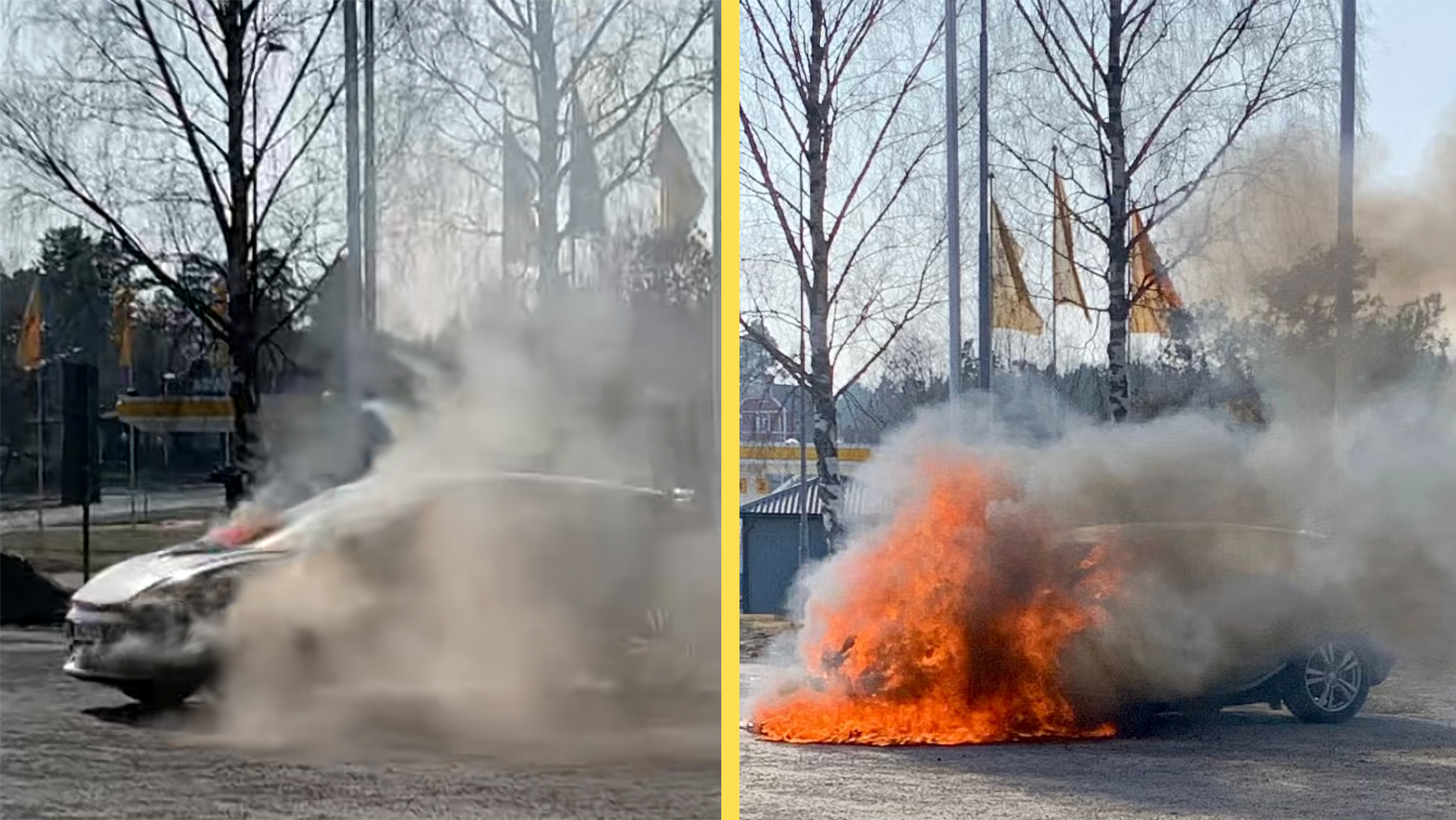
An almost new electric car that had been submitted for troubleshooting in Eksjö suddenly started to emit smoke and then exploded in flames outside the workshop. The incident was captured on film by a student intern and is yet another example of the risks associated with fires in electric vehicles – fires that can develop extreme heat, toxic gases, and are very difficult to control.
The drama unfolded last week at a car dealership in Eksjö. The vehicle, a 2024 model electric car, had been brought in because the heating system was not working properly. But instead of a regular troubleshooting, the car first started to smoke and then was quickly engulfed in flames.
Intern Olle Sommarnatt, 14, was on site when the fire broke out and managed to capture the sequence on film.
– I was a bit shaken. It happened really fast. First a lot of smoke came from the hood, then the hood burned through and the fire really took off, he told SVT.
Caught Fire Outside the Workshop
According to information from the dealership, the car had been submitted for inspection because the cabin heating didn’t work. The plan was to send the vehicle on for further troubleshooting.
The fire alarm was received at 1:25 pm on Tuesday. When emergency services arrived a few minutes later, the fire had already taken firm hold. High flames were coming from under the hood and large parts of the car were by then fully ablaze.
– The fire started out of nowhere. Fortunately, no one was in or near the car. An electrician who was working here saw the fire outside and called for us. There was smoke at first, but then flames erupted quickly, says Blerim Krasniqi, owner of Eksjö Bilaffär, in a comment to SVT.
After the alarm was raised, staff made sure to move nearby vehicles away to reduce the risk of the fire spreading. Blerim Krasniqi says that no one dared to start firefighting efforts until the emergency services arrived.
When the fire was finally extinguished, only a burnt-out shell of the car remained, which later had to be towed from the site.
Burning Puddles and Acrid Smell
Witnesses on site describe how burning material collected on the ground around the front of the car. It was reportedly not ordinary gasoline or diesel, but melted components from the car. In the area around the wreck, a distinct and acrid smell of burnt plastic lingered after the fire.
READ ALSO: Municipality’s Electric Cars Burned – Toxic Gas Spread
The fact that the fire started in an almost new car makes the incident particularly noteworthy. No official cause of the fire has yet been announced.
Different from Regular Vehicle Fires
The incident in Eksjö is far from unique. In recent years, a number of widely reported fires in electric cars and other battery-powered vehicles have demonstrated how differently such fires can behave compared to a traditional car fire.
When lithium-ion batteries catch fire, it can lead to what is called thermal runaway – a chain reaction where cell after cell overheats and ignites. It is often not enough to just extinguish the visible flames. The battery can continue to generate heat deep inside the construction and then re-ignite, sometimes several hours later.
Firefighters and safety experts have long warned about this. The fires can take a very long time to fight, require enormous amounts of water and at the same time emit toxic substances. Hydrogen fluoride is one of the gases that can form during battery fires and makes such efforts especially risky.

In a widely reported case in Pennsylvania, USA, it took around 45,000 liters of water and two hours of intense effort to bring a burning Tesla under control. Despite huge amounts of extinguishing water, the car repeatedly reignited. When the firefighters finally managed to contain the fire, virtually nothing remained but a melted mass.
READ ALSO: Two hours and 45,000 liters of water to extinguish burning electric car
In another fire in Sundsvall last year, the battery in an electric car being charged exploded. The shockwave damaged several nearby cars and emergency services described the explosion as powerful. Toxic smoke from the vehicle also spread, and the operation was both prolonged and complicated.
Extreme Heat Can Destroy More Than Just the Car
One of the major problems with battery fires is the temperatures that can develop. In maritime safety, it has been pointed out that when batteries burn, temperatures can easily reach around one thousand degrees Celsius. This presents levels where surrounding materials are at risk of being seriously affected.
The intense heat also explains why electric cars sometimes don’t just burn, but almost melt. Combined with the risk of reignition, this means that emergency services often have to handle these incidents differently than regular car fires.
It is not uncommon for burnt-out electric cars to be placed in isolation for a long time afterwards, precisely to reduce the risk that embers or heat in the battery will ignite a new fire.
Growing Concerns at Sea
The problems with battery fires are not limited to roads and parking lots. In the shipping industry, the issue has become increasingly debated as more electric cars are transported on ferries and car carriers.
The risks are especially severe on car transport ships. Vehicles are tightly packed in enclosed steel structures, often on several decks, with limited access for emergency measures. If a fire takes hold, it can spread quickly and be very difficult to control.
Several major ship fires in recent years have been linked or suspected to be linked to electric vehicles. A notable example is the ship Morning Midas, which was abandoned in the Pacific Ocean after a major onboard fire. The ship carried about 3,000 vehicles, including around 800 electric cars. The crew started extinguishing efforts but failed to control the fire and was forced to evacuate.
READ ALSO: Electric vehicle caught fire – several injured in apartment building
Previously, the fires on Felicity Ace and Fremantle Highway also received international attention. In the latter case, there was said to be “a good chance the fire started with electric cars.”
The industry is therefore increasingly speaking of electric car fires as a maritime nightmare. The European Maritime Safety Agency has previously stated that in the EU, one to two cars a week catch fire on ships, and that more than half of these fires are electric-related.
Restrictions on Battery Charge Levels on Ferries
As a result of the risks, some ferry operators and countries have started to introduce restrictions. One example is Greece, where electric vehicles cannot board certain ferries if the battery is charged to more than 40 percent. The purpose is to reduce the risk of explosive battery fires during crossings.
Other shipping actors have also begun to consider or introduce special safety procedures, such as greater distances between vehicles, stricter rules around charging, and new methods for firefighting on board.
Manufacturers Have Issued Warnings
The fact that almost new electric cars can catch fire has also been highlighted in several recalls and safety warnings from manufacturers. For example, Audi recalled the e-tron 55 after a discovered risk of fire in the battery, and owners were advised not to charge the battery above 80 percent for the time being.
General Motors, in turn, has warned owners of the Chevrolet Bolt and recommended that the car not be parked near other vehicles or buildings. Owners were also advised to avoid overnight charging indoors and preferably park outdoors, away from anything that could catch fire.
Such recommendations show that the risk is not limited to older or heavily used vehicles. Even relatively new cars can suffer serious technical faults that, in the worst case, lead to fire.
Reminder of a Growing Safety Problem
The fire in Eksjö fortunately did not result in any injuries. No one was in the car when the fire broke out and staff managed to move other vehicles away before the fire spread. But the incident is yet another reminder of how quickly an apparently stationary vehicle can turn into a dangerous fire incident.
What began as troubleshooting a heating system ended with a burnt-out wreck. At the same time, the incident highlights a bigger issue: how society is to handle a growing number of battery-powered vehicles, whose fires are more difficult to control, last longer, and in some cases are significantly more dangerous than traditional car fires.