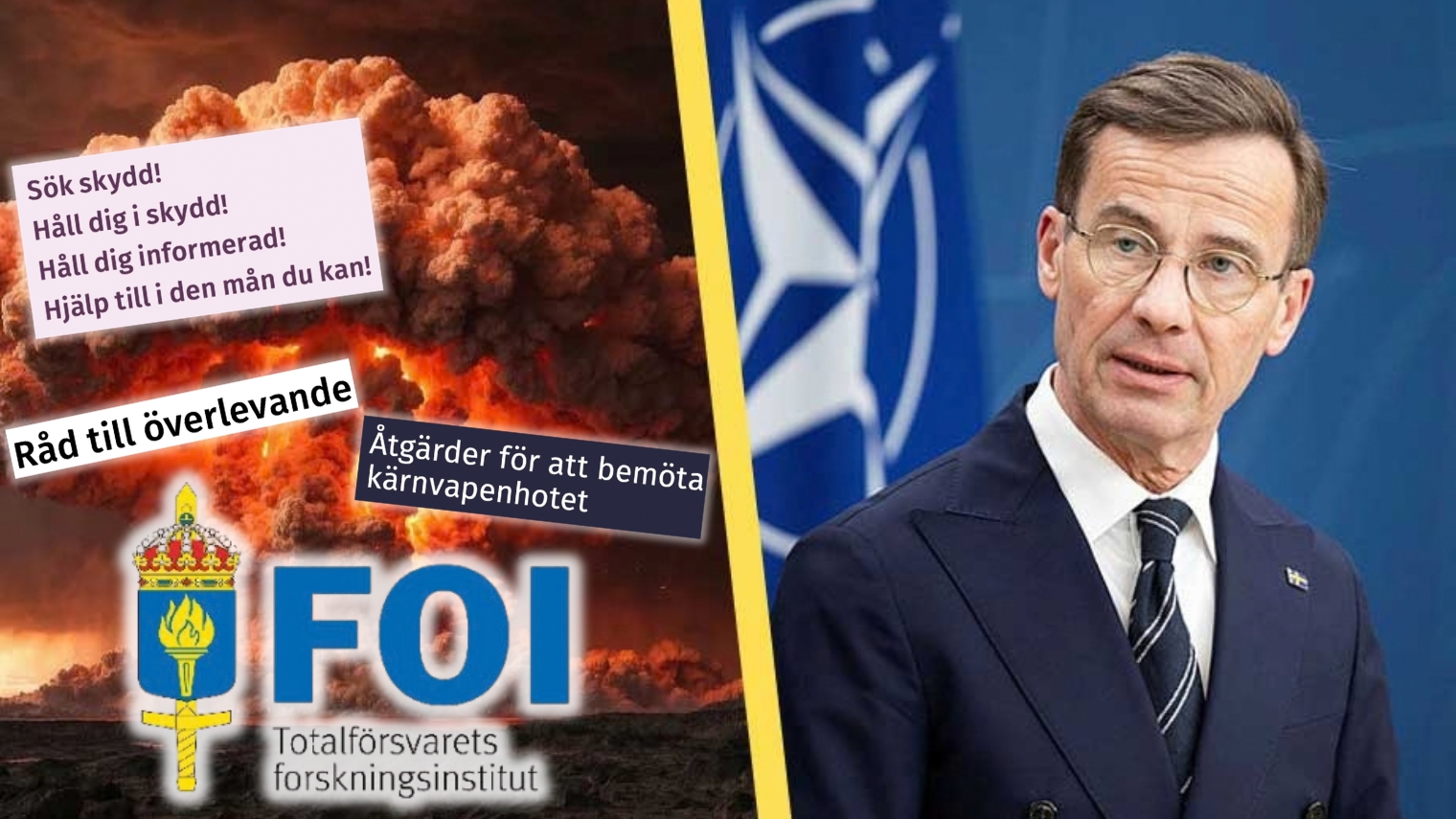
Nuclear weapons have once again taken a prominent place on the European security policy agenda. Prime Minister Ulf Kristersson (M) has opened up for French nuclear weapons on Swedish soil, while warnings of potential Russian attacks on the EU are on the rise. Against this backdrop, the Swedish Defence Research Agency (FOI) is releasing a comprehensive review of nuclear weapons and how Sweden should protect itself in the event of a nuclear strike. At the same time, both U.S. President Donald Trump and Russian President Vladimir Putin dismiss any Russian interest in attacking EU countries.
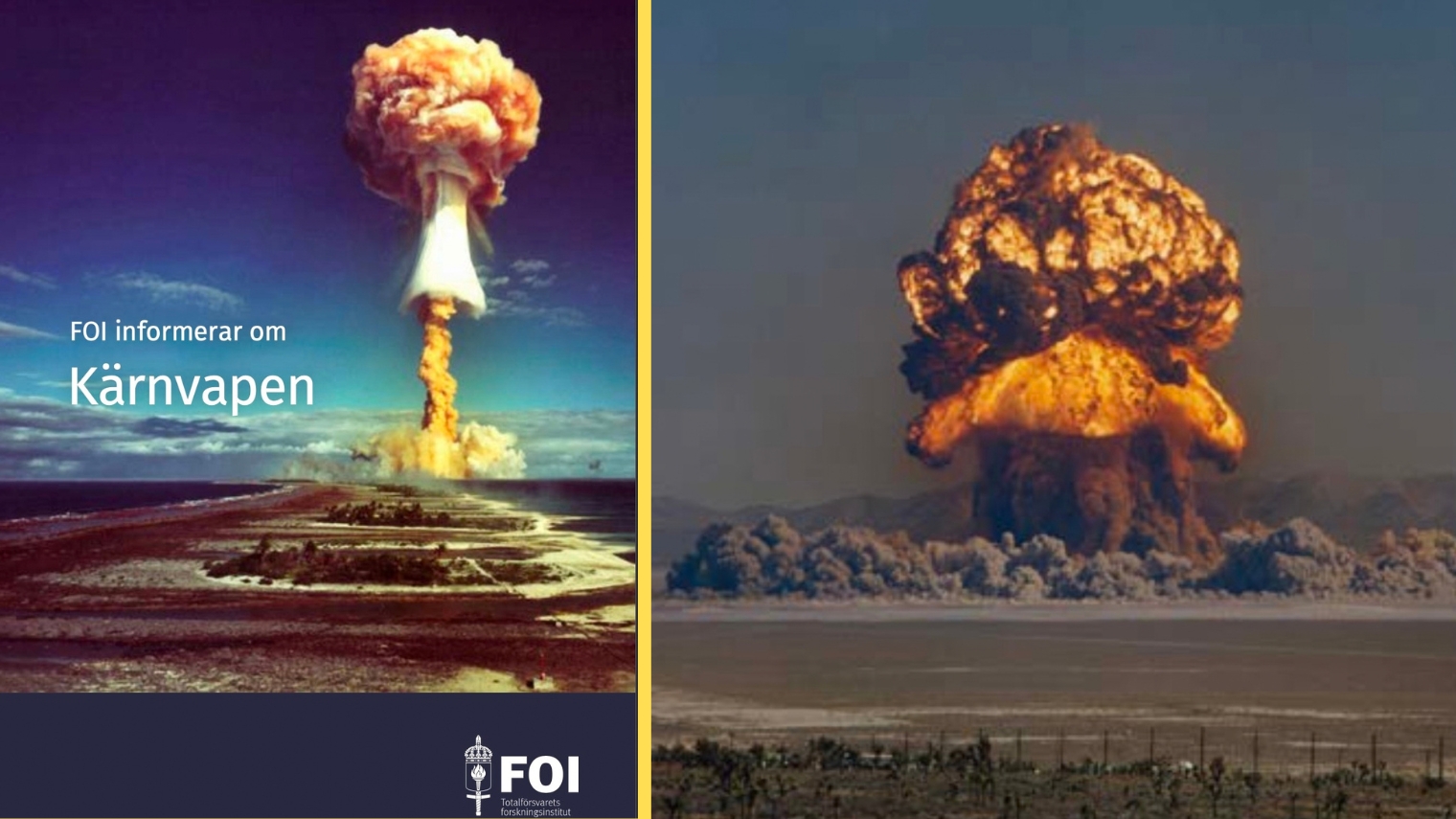
On September 23, the report “FOI Information – Nuclear Weapons” was published, spanning 124 pages. Written by FOI researcher Jessica Strömbro, it targets not only policymakers and those involved in total defense, but also the Swedish public.
The purpose is to provide a fundamental understanding of nuclear weapons, with a special focus on their technical aspects. Beyond history and technology, the report also includes a section on how society can respond to nuclear threats—from protective measures to civil defense, rescue services, and healthcare.
Jessica Strömbro, head of FOI’s Nuclear Threat unit and responsible for the new publication, says the work is ultimately about increasing Sweden’s preparedness.
READ ALSO: Supreme Commander: Swedes Must Be Mentally Prepared for a Russian Attack on Sweden
– Our aim during the preparation for this publication has been to contribute to making Sweden better equipped in case of a nuclear attack. We want to share our knowledge regarding everything from the technical function of nuclear weapons to strategies surrounding these arms, says Jessica Strömbro.
Technology and History
Nuclear weapons have been a part of international security policy since the 1940s. Now, the issue has again become a tangible part of Swedish preparedness discussions. The report also starts with the history of nuclear arms.
FOI reviews the Manhattan Project during World War II and the atom bombs first used on Hiroshima and Nagasaki, before addressing the development throughout the Cold War and the subsequent international regulations.
READ ALSO: Government: Sweden Will Be Attacked First in a NATO-Russia War
A significant part is devoted to technology itself. The reader is introduced to how nuclear weapons are constructed and how they function, as well as the materials required to produce them. The report covers weapons-grade uranium and plutonium, plus the processes of enrichment and reprocessing.
From there, the report continues to nuclear weapons development and test explosions and includes examples of different types of nuclear weapon systems. A chapter is devoted to nuclear strategies and deterrence. There’s also a historical thought experiment about Sweden around 1960, considering how the country might have developed if it had continued to contemplate a future as a nuclear state.
The report further addresses today’s nuclear-armed states, the non-proliferation treaty, arms control, and the relationships between nuclear powers.
Chain of Damage
FOI also reviews the damage process in a nuclear explosion. This includes the course of the explosion and the various effects that follow—such as heat radiation, shockwave, ionizing radiation, and radioactive fallout.
READ ALSO: Government: Sweden Will Be Attacked First in a NATO-Russia War
Another section discusses how a nuclear explosion can be detected. Various technical methods are used to register explosions, including underground detonations, and to verify compliance with international treaty bans on nuclear testing.
How to Protect Yourself
But the report does not stop at weapon construction and strategic significance. FOI has also included practical questions on protection and preparedness.
READ ALSO: Dagerlind: When Did Sweden Stop Talking About Peace?
– The publication also contains advice on various protective measures in the event of a nuclear strike. Even the simplest protection is important if you’re not too close to the explosion. We also give advice for rescue services and healthcare, says Jessica Strömbro at FOI.

In FOI’s information, the reader is met with messages such as: “Seek shelter! Stay in shelter! Stay informed! Help as much as you can!”
The information is also directed at the Swedish public more broadly and contains advice on how to act.
Advice for Survivors
If the explosion causes radioactive fallout, it will likely consist of relatively large particles, resembling dust or fine sand carried by the wind. The radioactivity is initially high but diminishes rapidly. Therefore, protection during the first hours is crucial. Close to the explosion, the fallout may arrive within 15 minutes.
Attempting to leave the area on your own initiative is often inappropriate since you risk being completely unprotected when the fallout is at its most dangerous. Therefore, it is better to quickly get to some form of shelter wherever you are, such as a basement or the innermost part of a large building, rather than traveling far to reach a shelter.
Note that, for example, cars provide poor protection against fallout. If you get dust on your body, brushing it off and changing clothes is usually sufficient. It’s more important to do this quickly than thoroughly. Because it will initially be difficult to determine the presence and distribution of fallout, the recommendation is for everyone within a certain distance from a nuclear explosion to seek shelter.
For example, the U.S. Federal Emergency Management Agency (FEMA) has used a distance of 80 kilometers in a circle from the explosion in its planning. If the population can shelter, the acute radiation injuries are significantly reduced in the event of a ground explosion.
To be able to remain sheltered, having supplies for a few days is desirable, and it is also important to have a radio, mobile phone, or other communication to stay informed about the situation. However, the mobile network can be expected to have severe disruptions or be down in the period immediately following the explosion.
– FOI’s advice to the Swedish people
Anyone who wants to read the entire FOI report can find it HERE.
The Security Situation in Europe
The reason FOI is now issuing a whole report to provide the public with a basic understanding of nuclear weapons coincides with a dramatic shift in Europe’s security policy after Russia’s invasion of Ukraine.
In recent years, governments and security agencies within the EU have repeatedly warned about various forms of Russian influence and so-called hybrid warfare. At the same time, much of the information and warnings have received significant media attention after press conferences and public statements, while concrete evidence behind the claims has often received far less attention.
READ ALSO: Germany’s Warning: Major War in Europe Before 2029 as Russia Builds Up Near NATO’s Border
These events then fade in the reporting, before the next warning or alleged Russian operation comes into focus. In parallel, there are repeated warnings about Russian military exercises and activities near EU countries—such as around the Baltic Sea, Kaliningrad, and Belarus.
Such activities have in turn been linked to the risk of future conflict with the EU and warnings that a Russian military attack on European countries may be imminent. At the same time, the message from the same political leaders, security services, and media is often that Russia has stalled in Ukraine, is not achieving its goals, and is facing military disaster. That support for Ukraine must increase, and that more weapons and attacks inside Russia are needed.
READ ALSO: Expressen: Russian Army Obliterated—Now Forced to Rely on Camels and Donkeys
This development and these recurring messages deserve a closer look. What do the leaders themselves actually say?
What does U.S. President Donald Trump, who unlike most other EU leaders maintains direct contact with Vladimir Putin—through his special envoys Steve Witkoff and Jared Kushner, through Foreign Secretary Marco Rubio’s contact with Russian Foreign Minister Sergei Lavrov, and via direct phone calls between Trump and Putin—actually say?
Trump: Putin Will Not Attack
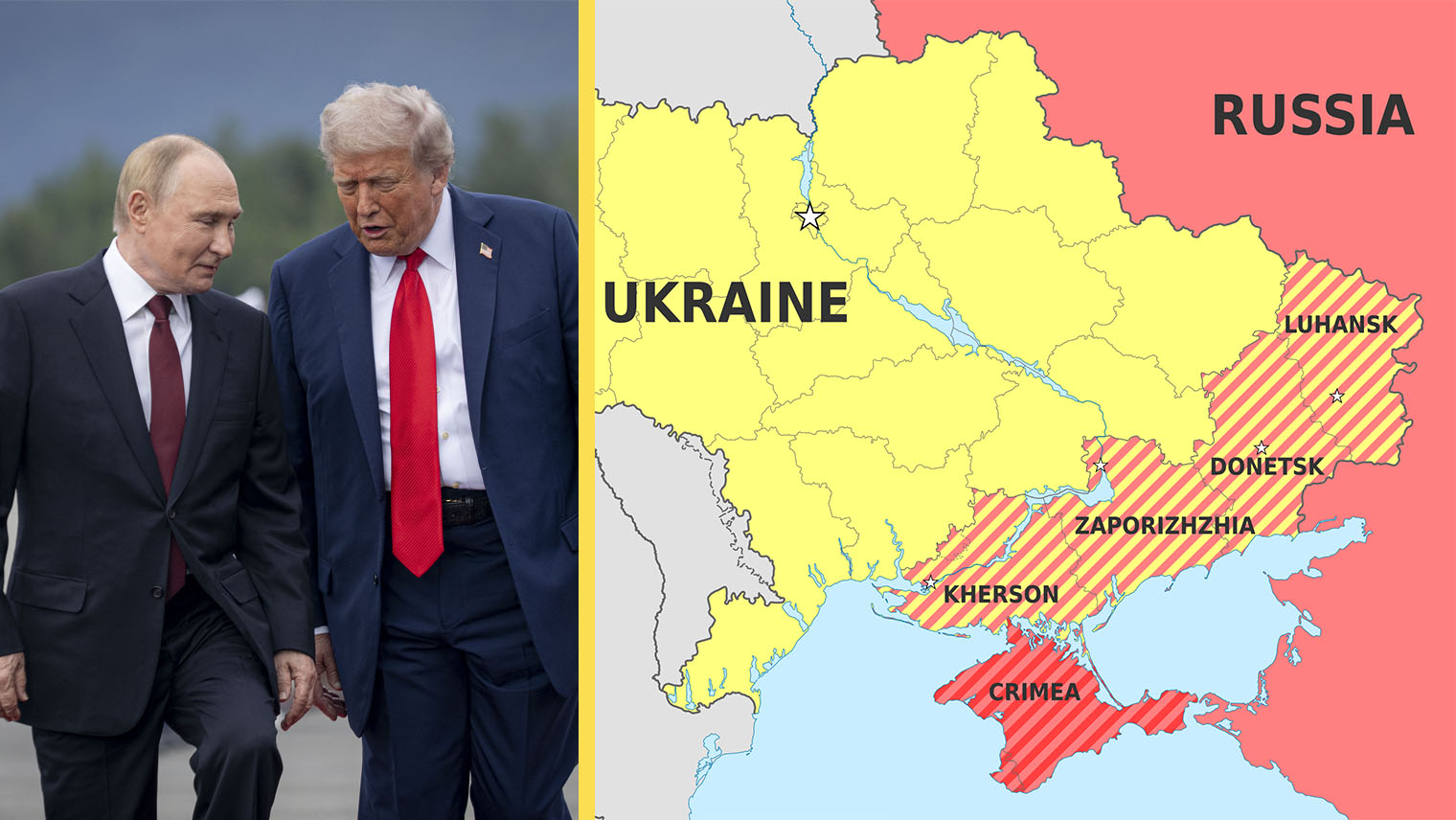
Meanwhile, a different picture is coming from the US and President Donald Trump. He has downplayed the risk of a Russian attack on the EU and NATO.
– He is not going to attack any NATO country, the president stated in the Oval Office.
Putin: “Nonsense”
On September 8, Vladimir Putin spoke with U.S. President Donald Trump. According to Putin’s foreign policy advisor Yuri Ushakov, Putin then raised the European speculations about a Russian threat, emphasizing that Russia has no aggressive plans towards Europe.
A few days later, Putin further developed this view publicly, as covered by the French news agency AFP. On September 14, Putin stated that Russia does not threaten EU countries and has no intention to. He calls such claims pure “nonsense.”
– There is no such threat and there never has been. We do not threaten European countries and have no intention to do so. Why would we? No one even takes into account the fact that we have no reason for conflict with Europe.
AFP also reports that Putin believes EU leaders are frightening their populations by presenting a Russian threat that, according to him, lacks substance.
He claims such a threat does not exist today and never has. At the same time, he stresses that Russia has no interest in escalating conflicts with EU countries.
– I want to stress once again: We are not preparing for any hostilities with Europe.
READ ALSO: Magdalena Andersson’s Message to Putin: “We Can Bomb Russia to Pieces”
During the press conference, he also elaborated on his view of the conflict and the security situation in Europe. He claims that EU leaders are involved in the conflict and use Ukraine as a tool to limit Russia’s ability to develop and to hamper the country. He also suggests that European leaders will eventually have to explain to their own populations whether funding this line is worthwhile.
In the same AFP news coverage from Putin’s press conference in St. Petersburg, the French agency reports that Russia views a deployment of NATO forces to Ukraine as a red line. Putin said EU leaders had discussed such a military presence and warned that it could mean a direct conflict with Russia.
AFP further states that Russia justifies its invasion of Ukraine by citing what it describes as a security threat from NATO’s expansion closer to Russian borders.
Two Sides
There is a clear dividing line in the current European security debate, coming as FOI now seeks to inform the Swedish public about possible nuclear attacks on the country. Governments and security services within the EU, as well as the media, warn of a growing Russian military threat and the risk that the conflict may soon spread to more parts of Europe.
At the same time, both U.S. President Donald Trump and Russian President Vladimir Putin have stated that Russia does not intend to attack EU countries, and that the war is limited to Ukraine. Who will be proven right remains to be seen. What is clear, however, is that the war has now lasted for almost six years without Russia attacking any other EU country.
READ ALSO: Former Ambassador to Russia: Why Putin Won’t Attack Sweden
Finland’s President Alexander Stubb has meanwhile, in an interview with Politico, recently urged his EU colleagues to tone down the rhetoric and not overreact to the debate about Russia and the country’s activities. According to Stubb, Russia is not seeking a full-scale war with NATO but instead aims to scare Europe into reducing support for Ukraine.
– We must also understand that it is neither in Russia’s interest nor within Russia’s capacity to enter into a full military escalation. Therefore, they will continue trying to frighten us, and as I usually say, we simply must remain calm, cool, and collected in this situation, he said.