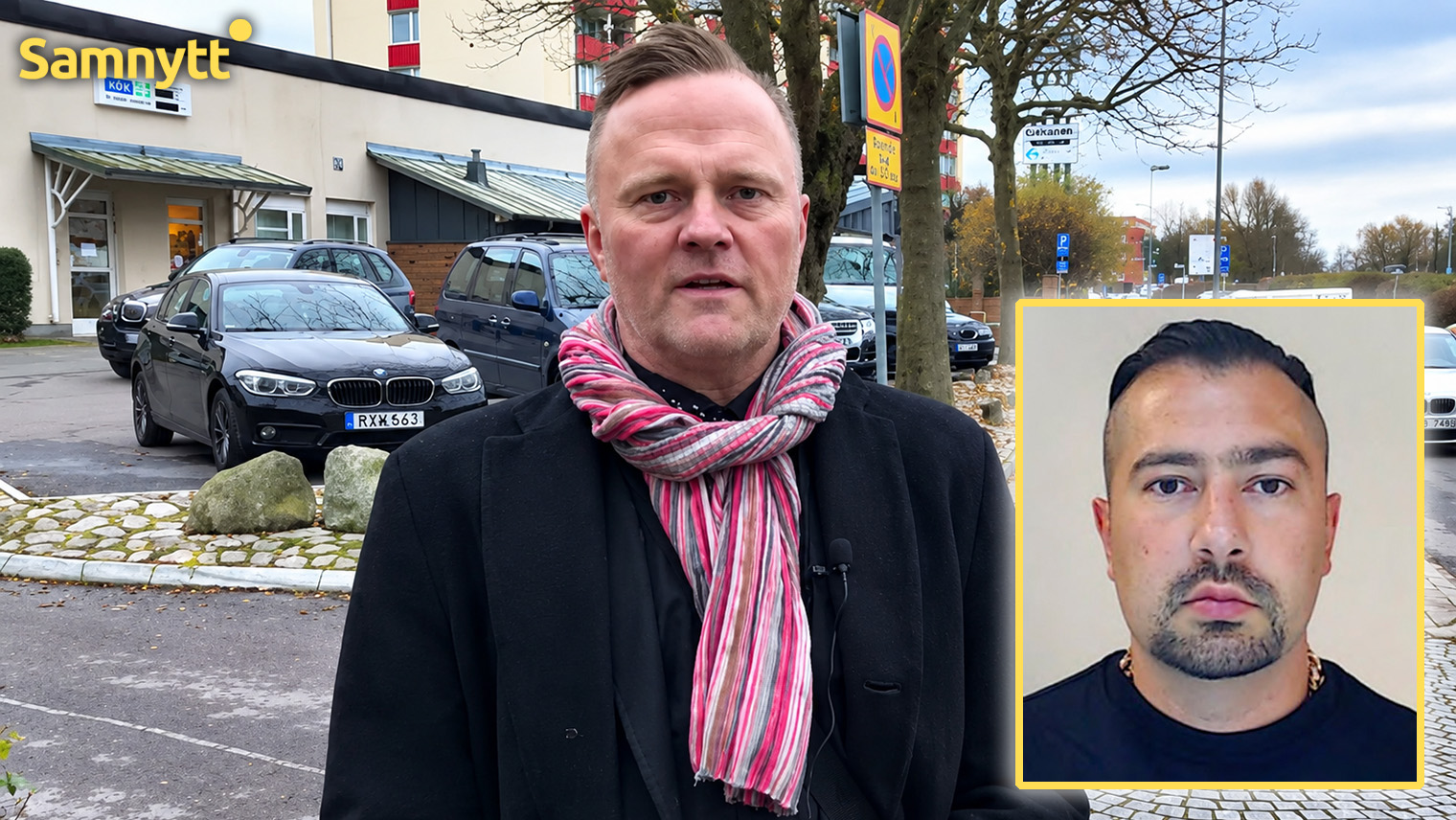
The prominent crime journalist Joakim Palmkvist from Sydsvenskan has become implicated in a Lebanese murder investigation along with Foxtrot leader Rawa “the Kurdish Fox” Majid and two other men. The case concerns the murder of the ‘Swedish’ gang member Yaser Abdelaziz, known as “Bentley”. Palmkvist firmly denies any wrongdoing and states that his contacts with criminals have been exclusively in the context of journalistic work.
The news about the high-profile murder investigation was published on Wednesday by several Lebanese media outlets. There, Sydsvenskan’s veteran crime reporter Joakim Palmkvist is named alongside the internationally wanted Foxtrot leader Rawa “the Kurdish Fox” Majid and two other men.
Palmkvist works in the joint investigative team of Sydsvenskan and Helsingborgs Dagblad and has for a long time covered serious organized crime and high-profile murder cases, including abroad, in this case in Lebanon.
Shot by three masked men
The murder victim was 26-year-old Yaser Abdelaziz, also known as “Bentley”, from Malmö. On October 18, 2025, Abdelaziz was shot by three masked perpetrators in Aramoun, south of Beirut. During the incident, he was also reportedly robbed of around 5,000 dollars.
He survived the shooting and was taken to the hospital, where according to the Lebanese investigation, he acted under a false identity. He allegedly presented a forged Iraqi ID card in the name of Hassan Adib Mohammed Ali and claimed to have been the victim of a robbery attempt.
In December, his condition sharply worsened. According to Lebanese reports, he suffered from, among other things, meningitis and pneumonia, while still suffering from injuries to the spine as a result of the gunshot. He died in hospital on December 25.
Wanted for double murder of the Britons
At the time of his death, Abdelaziz was internationally wanted in Sweden as a suspect in the double murder of British nationals Juan Cifuentes, 33, and Farooq Abdulrazak, 37. The two men were found dead in a burned-out car in the Fosie industrial area in Malmö in July 2024.
READ ALSO: 2 Brits Travelled to Malmö – Shot Dead and Burned in Their Rental Car
Abdelaziz was later remanded in absentia on suspicion of the murders and became internationally wanted. He was already known in Malmö’s criminal circles and had been involved in several serious criminal investigations. He had been convicted of serious weapons offenses and had previously been suspected of involvement in murder plots.

Lebanese media report that after Abdelaziz’s death, authorities received information from Sweden that his family was planning a revenge act against a Swedish-Lebanese man suspected of involvement in the shooting.
READ ALSO: Here Are the ‘Brits’ Murdered in Their Rental Car in Malmö
Arrested on his way to Iran
That man, Hassan Qansouh, was arrested at Beirut International Airport on July 16 this year when, according to investigators, he was attempting to travel to Iran via Iraq. At the time of arrest, he reportedly had both Swedish and Lebanese passports, two mobile phones, and cash in his possession. Investigators also seized an automatic weapon and two pistols.
READ ALSO: DN Contributor Sent 150,000 to the Kurdish Fox’s Drug Courier

READ ALSO: Five Years’ Prison for DN’s Drug Courier
READ ALSO: DN Journalist Quits After Money Transfer to Gang Criminal
Through analysis of his phones, the investigation expanded. Phone data, according to Lebanese media, shows Qansouh was in the Aramoun area at the time of the shooting. Investigators also say there was Snapchat contact between him and Abdelaziz shortly before the event.
Qansouh denies having shot or taken part in the murder.
Money from “the Kurdish Fox”
Investigators also discovered information about cryptocurrency transfers from a wallet linked to Rawa Majid. According to the investigation, the equivalent of $3,000 was transferred from Majid to Qansouh after the shooting.
Qansouh has explained that the money had nothing to do with the murder and that Majid sent them to help him ahead of a trip to Iran. Rawa Majid, who for years has been identified as the leader of the Foxtrot network, is believed himself to be in Iran.
Palmkvist appears in the chats
It is in the review of Qansouh’s communications that Joakim Palmkvist enters the murder investigation. According to Lebanese reporting, Qansouh asked Palmkvist for help in locating Abdelaziz and getting confirmation that he was really dead. The victim’s Snapchat account and a photo of his grave reportedly figured in the communication.
There was also discussion about how to ensure that Abdelaziz was indeed deceased and had not staged his own death to evade international search notices. Among other things, the possibility of confirming the death via DNA was mentioned.
In questioning, Qansouh stated that he has known Palmkvist since 2008 and described him as a Swedish journalist. According to Qansouh, the purpose of the contact was precisely to confirm that an internationally wanted person had indeed died.
Nevertheless, the Lebanese prosecutors have included Palmkvist in the case alongside Qansouh, Majid, and another Swedish national. Lebanese reporting refers to suspicions of murder and participation in a conspiracy to commit serious crimes.
At the same time, Lebanese media themselves note that the available investigative material does not specify any concrete act Palmkvist is alleged to have committed beyond the contacts and efforts to determine what happened to Abdelaziz.
Palmkvist: ‘Completely Stunned’
Joakim Palmkvist told Expressen that the news came as a shock.
– I was completely stunned when I heard this. What I have done is journalistic work, nothing else. Of course, it is frightening when such accusations begin to spread.
He emphasizes that his contacts should be seen in the context of his work as a crime journalist.
– I have tried to find out what happened and verify information. As far as we know, no charges have been filed, and I find it hard to see how these suspicions could remain once someone actually reviews what I have done.
To TV4 News, Palmkvist gave the same account.
– At first, I didn’t understand anything. I did my job as a journalist and tried to verify information about a death. That’s all there is to it. As far as we can tell, I’m not charged, and the case is now being further evaluated. I am confident this will become clearer when someone looks at what I’ve actually done.
The newspaper: Routine journalistic work
Sydsvenskan also rejects the suspicions and points out that the newspaper has not been contacted by Lebanese authorities.
– If, against all expectations, there are suspicions of crime against our employee, these are completely unfounded. The reports in Lebanese media come as a complete surprise. Neither the employee nor the newspaper has been contacted by Lebanese authorities, according to editor-in-chief Lena Philipson as cited by Expressen and TV4.
The newspaper’s assessment is that the contacts in the investigation were part of Palmkvist’s journalistic work.
– What has been done by our employee is routine journalistic work. We are convinced it will be clear when the matter is reviewed and that any suspicions against the employee will then be dismissed.
Reports of ‘charges’ corrected
Several Swedish media initially reported, citing Lebanese sources, that Rawa Majid, Joakim Palmkvist, and the two other men had been “charged”. However, this description appears to be based on how Lebanese legal process terminology was translated into Swedish. According to later information from Expressen, the case is at an earlier stage than what would be considered a charge under Swedish law.
– As we understand it, the case has been handed to an investigating judge for further evaluation. No charges have been filed. The reports about charges are incorrect and may be due to translation errors, the newspaper states.
According to Swedish media, Palmkvist has not yet been questioned by Lebanese authorities. Swedish police say they are aware of the investigation but do not comment on other countries’ criminal investigations. The Swedish Ministry of Foreign Affairs has confirmed that a Swedish citizen—the man arrested in July—is detained in Lebanon and is receiving consular support.
The Lebanese suspicions against Joakim Palmkvist have not been legally tested. He denies any crime and maintains that all the communication at the heart of the suspicions has entirely taken place within the scope of his journalistic work.