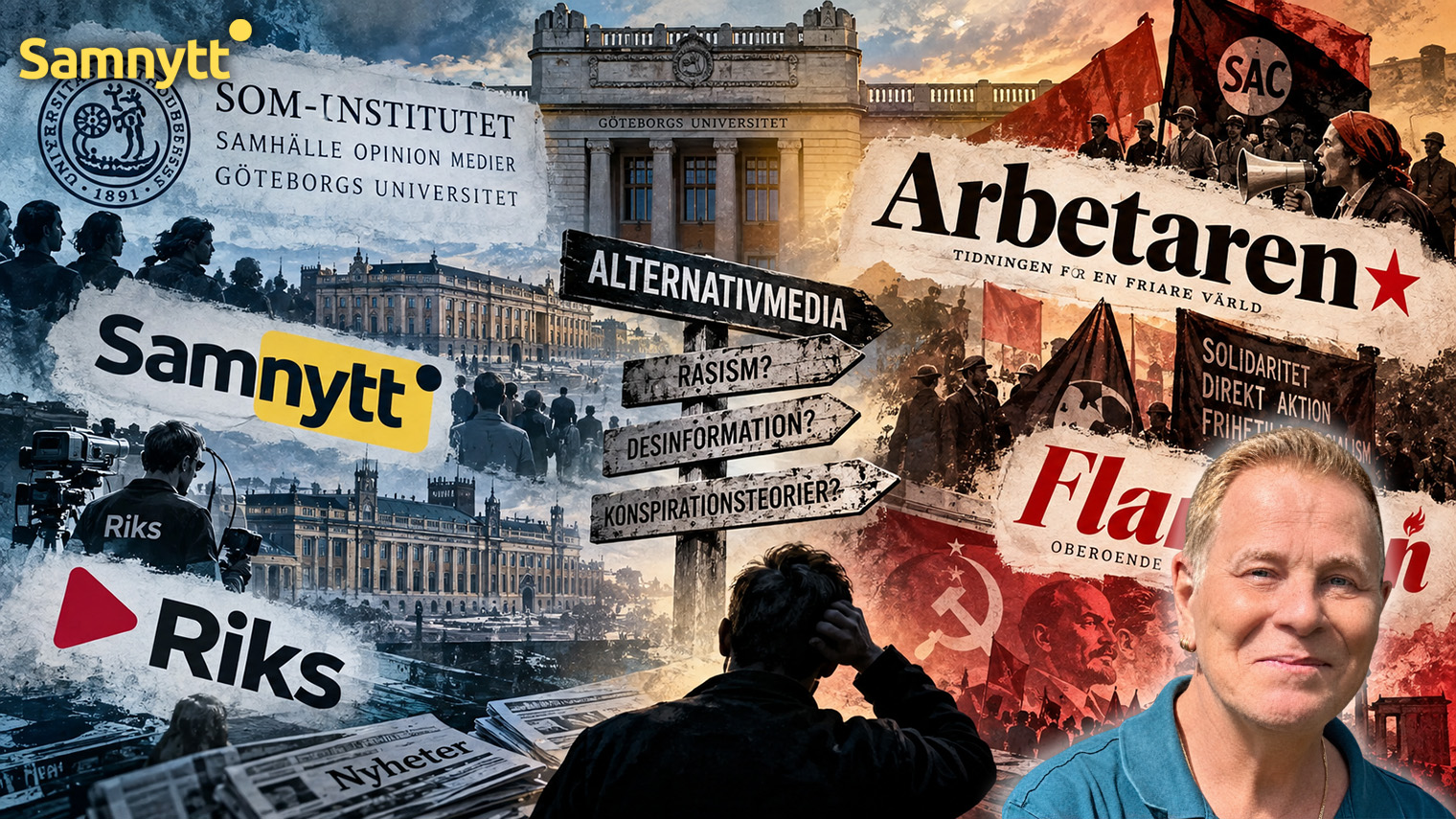
EDITORIAL • Arbetaren is upset that the SOM Institute places the newspaper in the same category of ‘alternative media’ as Samnytt and Riks. On one point, the syndicalist newspaper is actually right. It is a strange company. But not quite for the reasons Arbetaren imagines. If anyone has reason to protest the mixing, it’s us.
The SOM Institute at the University of Gothenburg has conducted a survey about the parliamentary election, asking which information sources people used. One option is ‘traditional news media.’ Another is ‘alternative news media,’ where Riks, Flamman, Arbetaren, and Samnytt are listed as examples.
This has made Arbetaren furious. The newspaper explains that the term alternative media is, in popular perception, associated with ‘racism, disinformation, and conspiracy theories,’ and writes that readers and writers at the newspaper have reacted ‘with dismay’ to Arbetaren being put in the same category as, among others, Samnytt.
Riks and Samnytt are described based on their ties to the Sweden Democrats. Arbetaren, however, presents itself as a proud, over hundred-year-old, ‘libertarian socialist’ newspaper that has never been party political. Flamman is simultaneously defended as an established and independent socialist newspaper. It’s an interesting interpretation of history.
Being Nonpartisan Is Not Being Politically Unaffiliated
Indeed, Arbetaren is not a party organ. But it’s a long leap from that to claiming the paper lacks a clear political and ideological home.
Arbetaren is owned by SAC Syndikalisterna. The newspaper itself defines SAC’s political values as its owner’s, while SAC refers to Arbetaren as its own paper, describing its content as news and analysis connected to, among other things, ‘radical trade union struggle.’
And SAC is not a politically neutral central trade union organization of the LO, TCO, or Saco type. In its own statutes, SAC defines itself as a ‘struggle organization’ whose members act with the goal of ‘taking over the administration of society.’ The organization works for the ‘socialization of production,’ control over the means of production, and the ‘abolition of wage slavery.’ That sounds rather communist to me, and probably to many others.
In the statement of principles adopted as late as 2025, capitalism is described as a system where workers are exploited. SAC calls itself anti-authoritarian, emphasizes direct action as a means to change society, and states the ultimate goal as ‘libertarian socialism’ in a society free from state coercion.
Of course, one may advocate this. You can also call the socialization of production and collective control over the means of production ‘libertarian’ if you think that equation works.
But it becomes a bit much when a newspaper owned by an organization with such an explicit system-transforming socialist project tries to make the political home of other media something disqualifying.
Samnytt is not owned by any organization. Nor do we have radical, society-overthrowing ideas. We describe ourselves as social conservative, Sweden-friendly, and are ideologically closest to the Sweden Democrats, currently one of the country’s largest parties. Riks can speak for themselves, but as far as I know, they have no desire to abolish either the state or private ownership.
And Why Defend Flamman?
Arbetaren’s argument becomes even stranger when the newspaper, of its own accord, rushes to defend Flamman. Today, Flamman is an independent socialist newspaper, and today’s editorial staff cannot be held responsible for what its political precursors did half a century ago. However, one can be criticized for not clearly distancing themselves.
But if historical political ties should be used to judge Samnytt and Riks, it’s hard to understand why the same principle suddenly ceases to apply when looking to the left and dealing with vastly more serious connections.
Flamman’s own history tells how the then Norrskensflamman was the center for the faction within VPK that opposed the party leadership’s move away from its old pro-Moscow stance. The group, according to Flamman itself, was supported by the Communist Party of the Soviet Union, the East German dictatorship party SED, and other communist parties that interfered in VPK’s internal affairs.
In 1977, the group broke away from VPK and formed the Workers’ Party Communists, APK. This was not a group that left VPK because the party was too communist; on the contrary, it was a faction even more hardline and staunchly against moving away from Moscow.
That is a historical burden that should at least urge some caution before high-handedly dividing the media world into respectable left-wing media and suspicious outlets with roots on the conservative right.
It’s especially odd that Arbetaren feels the need to defend Flamman while simultaneously portraying itself as so fundamentally different from politically profiled media that readers are expected to feel ‘dismay’ over the mixing. It doesn’t feel like a slip-up, but rather an indirect ideological positioning.
Apparently Not All Radical Traditions Are Equally Burdensome
There’s a clear asymmetry here. When Samnytt and Riks are discussed, political history, ideological leanings, and organizational ties are brought to the forefront. When Arbetaren and Flamman are discussed, the focus shifts to independence, long history, and journalistic merits.
No one should be judged solely for problematic history. But it’s not irrelevant either. Especially if one has not made a clear break with it. And the same principle must apply both ways.
The Swedish left also has a history where parts of the communist movement at various times oriented themselves towards some of the twentieth century’s worst dictatorships. The Soviet Union, East Germany, Mao’s China, and Pol Pot’s Cambodia weren’t progressive welfare states that just made some mistakes along the way.
Communist regimes abolished political pluralism and free media, persecuted dissidents and built societies where the state could claim almost unlimited power over people’s lives. In practice, the ideology has the deaths of roughly 100 million people on its conscience, through executions, purges, labor camps, and forced mass starvation.
For this reason, Arbetaren should not be carelessly lumped together with pro-Moscow communism. Syndicalism is a different left-wing radical tradition and syndicalists themselves have been in conflict with authoritarian communism. The question is why the newspaper’s editor-in-chief Amalthea Frantz does this and considers it more urgent to distance herself from the far less tainted social conservatism and its media actors.
Arbetaren’s ideological roots may not be as bloodstained as Flamman’s, but that does not make them apolitical. Even in 2026, the SAC is talking about class struggle, capitalist exploitation, direct action, socialization of production, and a future socialist society.
To simultaneously imply that it is the proximity to the Sweden Democrats that makes Samnytt and Riks problematic company requires a rather selective, not to say outright backwards, relationship with political radicalism. Gnats and camels.
Samnytt Left a System That Was Being Abused
Arbetaren also claims it is especially burdensome that Samnytt left the voluntary media-ethical system in 2023. That is correct factually. But the reason was not that Samnytt suddenly decided to throw all publishing ethics overboard.
We joined in 2020. One reason was that membership granted a presumption of meeting the requirements for media-ethical acceptability when applying for media support. But we also saw a principled value in a functioning system where media take responsibility for their own ethics rather than the state regulating journalism.
After two years’ experience, we unfortunately concluded that the system does not operate impartially. We saw how the rules were applied in a way that disadvantaged conservative media and that the system could therefore be used to limit and punish legitimate, albeit to some, uncomfortable journalistic scrutiny.
We accepted criticism when we ourselves thought we had done wrong. But the majority of decisions against us were in fact activism from Media Ombudsman Caspar Opitz, who has long harbored a grudge against Samnytt and the entire social conservative movement.
The same Opitz, as editorial manager at Dagens Nyheter, had previously pushed an unjustified libel case against us after we examined one of the newspaper’s controversial employees. The problem was not the existence of press ethics rules, but what was obviously a politicized and inconsistent application of them in a punitive expedition conducted by an MO who did not hesitate to abuse his mandate.
Leaving a voluntary industry system does not mean leaving Swedish law, the Freedom of the Press Act, or abandoning one’s own publishing responsibility. Samnytt makes active press-ethical decisions every day. In several respects, we claim to have higher press ethics than many mainstream media, with a greater respect for media consumers, while other media actors often act paternalistically.
Arbetaren is welcome to consider our judgment and decision to leave the media-ethical system a mistake. But membership in a private self-regulatory organization is not an objective definition of what constitutes a reputable newspaper. To use it as a bludgeon the way the syndicalist organ does is dishonest and betrays a lack of real substantive arguments.
Here, Arbetaren Is Actually Right
In the end, we are left with the SOM Institute’s use of the term ‘alternative media.’ What does it mean—to them, to us, and to media consumers in general?
Is an alternative medium one that doesn’t belong to the major media conglomerates? A digital medium? An ideologically profiled medium? One that challenges established editorial perspectives? Or a medium that the SOM Institute, for some reason, doesn’t want to put in the box of ‘traditional news media’?
If the same category is to contain a syndicalist newspaper over a hundred years old, a socialist newspaper with historic ties to the Swedish communist movement, and two much younger media born from a completely different, social conservative media environment, the concept has become so broad that it says very little.
So, on that point, Arbetaren has our full support. The SOM Institute should not have lumped us together. Arbetaren is Arbetaren. Flamman is Flamman. Riks is Riks and Samnytt is Samnytt. We represent different traditions, different worlds of ideas, and different publishing projects.
If Arbetaren wants to avoid being defined through its political opponents, it would be fitting to grant other media the same right. So by all means, spare us from being lumped together with left-wing radical organizations and political ideas outside the framework of democracy.
Amalthea Frantz, the feeling of being angry and dismayed is entirely mutual. We in no way want to be grouped together with your newspaper, where you call the Tidö government ‘blue-brown,’ repeatedly spread antisemitism and genocide accusations against Israel in its country’s defensive war against the terror organization Hamas in Gaza, or give your platform to the climate-criminal extremist Greta Thunberg. We respectfully decline.