Criminal immigrant clans with strong family ties are established in Kungälv and affect the sense of security in the municipality. Police describe hierarchical environments where money, loyalty, and family honor are highly valued. At the same time, several high-profile violent incidents show how children and young people have been caught up in the conflicts.
As early as 2023, it became publicly known that the police had identified two criminal, clan-based immigrant networks in Kungälv. Three years later, both remain, according to Per-Jona Laurell, acting chief of the Kungälv Ale local police area.
According to the police, one clan has been in the municipality for a long time, while the other was established more recently. According to a survey by Acta Publica, they originate from Lebanon and Turkey, respectively. Laurell describes the phenomenon as part of a much broader national, migration-related problem.
“In these family networks, there is a strong hierarchical and patriarchal structure that we talk far too little about in Sweden,” he says to Kungälvs-Posten.
The police do not claim the clans control Kungälv. However, their presence can have a clear impact on people’s perceived sense of safety.
Threats and Fear Create Silence
According to Laurell, among other things, drug crime is prevalent in these environments. People connected to the clans may also make their presence known through aggressive behavior, threats, and violence in public spaces.
ALSO READ: Migration Board Source to Samnytt: “Sweden Still Doesn’t Understand How Clan Societies Work”
When people know which individuals or families have a propensity for violence, it can lead to fear and reluctance to talk about what they’ve seen or heard. This way, a culture of silence risks emerging.
“People are afraid and worried after hearing rumors or because they’ve experienced something themselves,” says Laurell.
At the same time, money is central. The police see connections to both traditional crime and business. The latter is not necessarily criminal in itself, but according to Laurell, it’s important to draw boundaries when people involved in criminal environments also operate within the legal economy.
Three Serious Violent Incidents Involving Young People
Kungälvs-Posten’s review highlights three cases that, according to the newspaper’s mapping, are in various ways connected to the criminal clans.
In August 2024, a violent fight broke out outside Kungälvsgrillen. Four young men were attacked with a knife, and three were taken to hospital. Two initially had serious injuries. A 22-year-old man was later suspected of three attempted murders and aggravated assault. His then-underage younger brother also became a suspect.
A few months later, in December that same year, a boy was subjected to a brutal beating at Blåmesen preschool in Komarken. A gang of younger teenagers had first encountered him and a companion at Kungälv’s travel center.
ALSO READ: Hospital Staff Warns of Threats and Violence from Criminal Clans
At the preschool, the boy was attacked with punches and kicks. The gang filmed the beating, during which the victim was also stomped on the head. Evidence from a mobile phone and surveillance cameras later helped identify several teenagers.
The boy’s companion managed to flee the scene. In panic, he ran toward Kongahälla Center and crossed the E6 lanes before getting help from a security guard.
Gun Clicked by Man’s Head
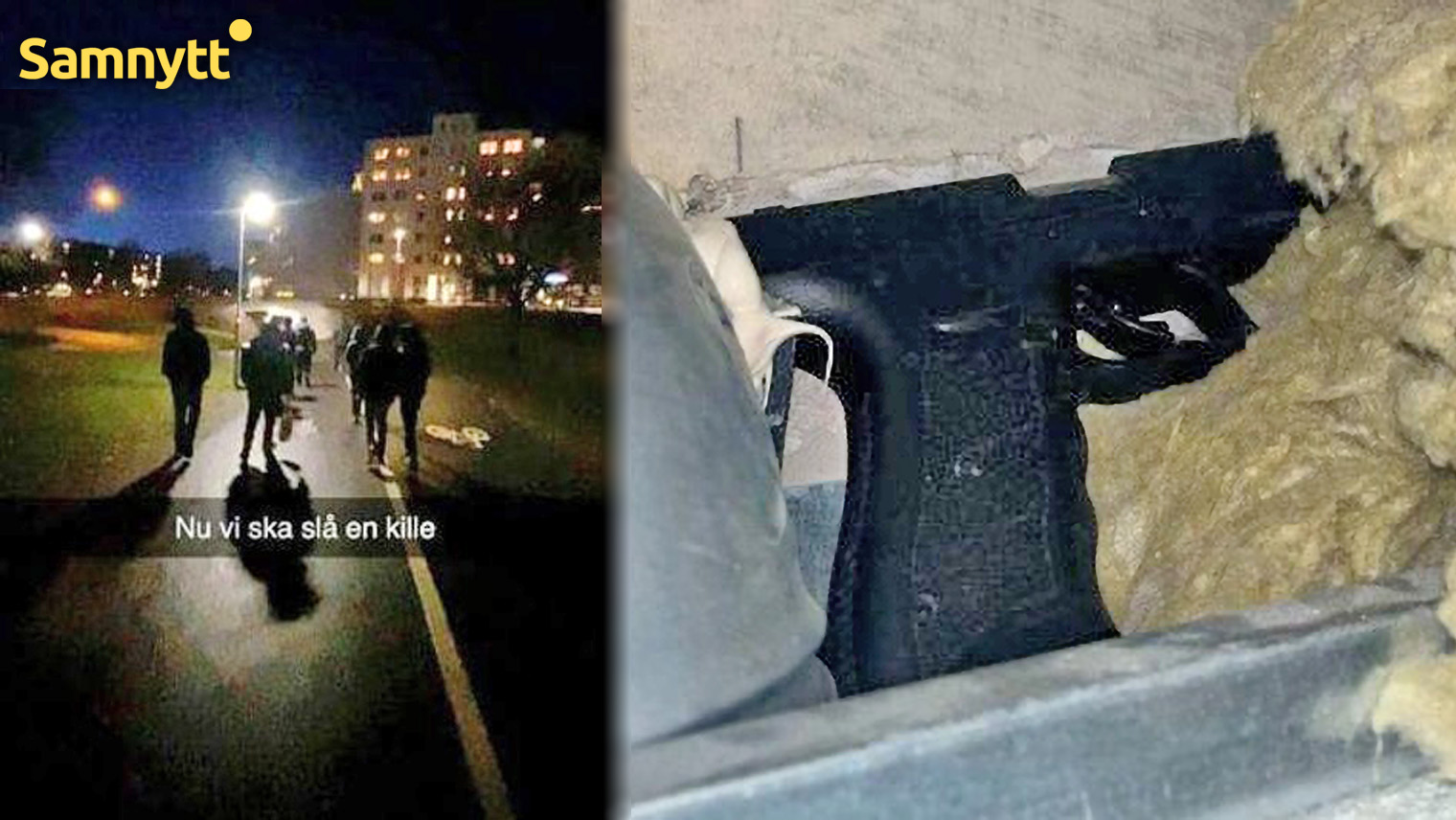
The third incident happened in Nordtag, Ytterby, in September 2025. A masked person entered a residence and, according to initial reports, pointed a gun at a man’s head. The perpetrator pulled the trigger, but the weapon clicked. He then left the home.
A few weeks later, an 18-year-old was arrested. Police found the gun hidden behind a vent in the bathroom of the home where he lived with his family.

The investigation also included information from his mobile phone. There were searches about how to convert a starter pistol into a real weapon and searches for information about the man who was attacked and his partner. The 18-year-old denied the crime.
The background to the incident was not established, but the investigation contained information about an earlier conflict over a deal involving a pair of branded shoes that turned out to be fake. Several people were reportedly involved in the fight, and relatives were called to the scene.
Honor and Fear of “Losing Face”
The police chief does not want to comment on individual cases, but generally describes how conflicts can develop in immigrant clan environments. Money and negotiations can be used to resolve disputes without violence.
Sometimes, however, conflicts go further. According to Laurell, one explanation may be that young people act impulsively and resort to violence, even if this has not necessarily been approved by older family members.
ALSO READ: Ambulance Union Warns of Clans and “Low-Level War” – Wants Armed Guards
The concept of honor is of great importance, according to his description. Incidents that might seem less serious from the outside can take on a completely different significance if someone feels their family has been insulted or that the person has been humiliated or deceived.
“In this culture, honor is very important and people do not want to ‘lose face’,” Laurell says.
Young people in particular are frequently involved in these high-profile cases. The police describe an environment where financial crime, drugs, weapons, and personal conflicts can intertwine.
Conflicts Solved Outside the Justice System
Another issue, according to the police, is that families sometimes try to resolve conflicts among themselves rather than leaving them to the police and courts. Laurell describes this as a collision between different cultural views of society.
In Sweden, there is traditionally a strong trust in the state and authorities. In other societies, the family may instead have a much stronger position and function as the main safety net.
Strong family cohesion can have positive aspects. The problem arises when it also means that laws and authorities are given a subordinate role, replaced by the families’ own rules. Police see signs of such parallel structures even in Kungälv.
One example is when a victim or a witness initially provides information to the police but later changes their story under pressure. According to Laurell, money or threats can be used in such situations to make people withdraw.
Something similar was noted in the legal process after the Nordtag incident. The man who was attacked changed parts of his earlier statements when the case reached court. For example, he then gave a different account of how the weapon was aimed. The prosecutor later considered that the man had not told the truth in court.
“You Don’t Snitch”
The culture of silence is also evident among young suspects. In several interrogations reviewed by Kungälvs-Posten, young people chose not to answer police questions. According to Laurell, there are both youths who have simply learned to keep quiet by habit, and more experienced individuals who know what information they should or shouldn’t provide in order to improve their chances of avoiding responsibility.
ALSO READ: Clan Rules Residential Area with Iron Fist
The idea that it is wrong to “snitch” or inform is not something created by today’s criminal environments, he emphasizes. However, criminals have a strong interest in keeping that norm alive, as it makes the police’s work harder.
A Surname Doesn’t Make Anyone a Criminal
At the same time, the police stress that family affiliation alone does not make a person a criminal. According to Laurell, there are examples of children who use a well-known family name to gain status or intimidate others even during school years. Through cooperation between police, schools, and social services, authorities try to identify young people at risk of becoming involved in crime.
But having a brother, parent, or another relative in a criminal clan does not mean that the young person automatically belongs to the network. Not everyone growing up in these families wants to become part of the criminal world. For those wanting to leave, police say there’s support and protection available through exit programs.
Laurell acknowledges that it can be very difficult to break away from a criminal environment, especially when crime is intertwined with one’s own family. But the possibility exists, and there are examples proving that “socio-economic factors” are not enough to blame when someone chooses a criminal lifestyle.
ALSO READ: Inside the Migration Board: Clans, Swedes in the Minority, and a Culture of Silence
At the same time, the police take people’s concerns seriously. In the police investigations reviewed by Kungälvs-Posten, there are testimonies from people who feel certain families have a lot of power and that it may seem pointless or risky to turn to the police.
This picture is not shared by police when it comes to who actually controls the municipality. But Laurell notes that the fear itself is a problem authorities must work against.
The police’s message is therefore twofold – criminal clans and parallel structures do exist in Kungälv and can affect the sense of security – but they do not stand above society or the rule of law.