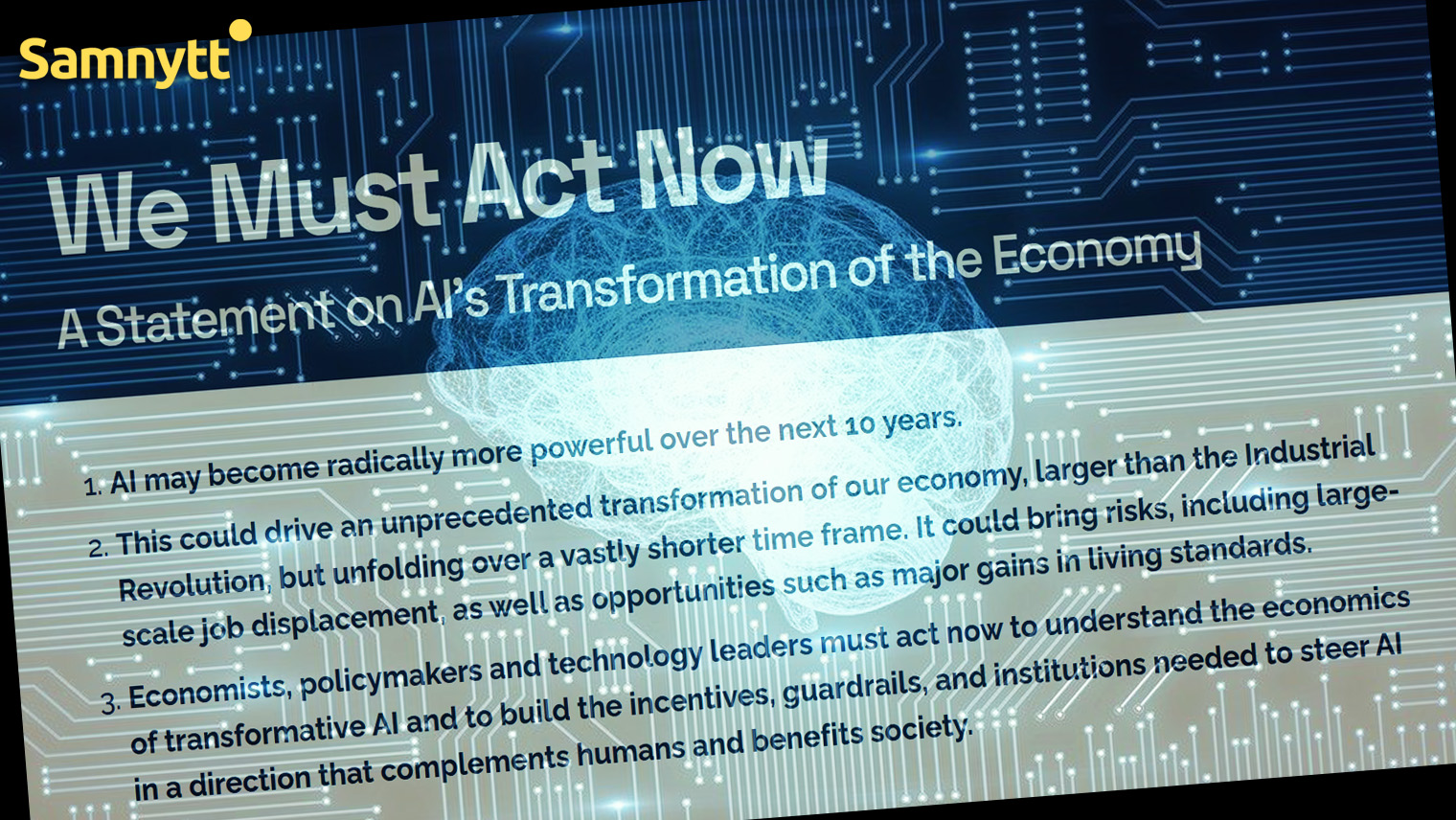
Nearly 200 economists, researchers, and tech leaders—including 15 Nobel laureates—are urging the world’s policymakers to immediately prepare for the economic and societal consequences of artificial intelligence. According to the appeal, AI could have a greater impact than the industrial revolution, but in a much shorter time frame.
A broad group of researchers, economists, and leading representatives from the AI industry have joined together in a joint statement on artificial intelligence and its potential effects on the world economy.
The initiative is backed by over 200 signatories, including 15 Nobel laureates, researchers from OpenAI, Anthropic, and Google, as well as several prominent economists. Among the names featured are Nobel laureates Daron Acemoglu, Simon Johnson, and Michael Spence alongside former Google CEO Eric Schmidt and Anthropic founder Jack Clark.
The appeal warns that AI development may proceed far faster than previous technological breakthroughs, thereby presenting the labor market and social institutions with challenges that current systems are unprepared for.
Could Transform the Economy in Just a Few Years
The researchers behind the initiative argue that earlier technological revolutions—such as the steam engine, electricity, and computerization—gave societies decades to adapt to the changes. According to them, AI could develop at an entirely different pace.
READ ALSO: AI Shapes the Future—and the West Risks Losing Control
The appeal describes a possible economic transformation that could be greater than the industrial revolution but occur within just a few years. As such, more research is called for into AI’s effects on the labor market as well as new institutions and political tools to manage the developments.
The initiators also emphasize that the technology can bring significant benefits in terms of increased productivity, economic growth, and higher living standards.
Growing Concerns for the Labor Market
Employment remains a central concern. Historically, new technologies have often replaced some professions while creating new jobs. But several researchers believe that AI differs from previous shifts in that it does not primarily automate physical labor, but also qualified cognitive tasks.
Systems can already today write texts, analyze legal documents, assist in medicine, and carry out advanced programming. If development continues in this direction, large segments of today’s white-collar jobs may be affected.
Even economists who were previously skeptical of far-reaching AI scenarios have in recent years expressed increased worry that the transition could be both faster and more extensive than previously thought.
Societies Built for Work
The broader AI debate has also raised questions about how modern welfare systems would be affected if automation reaches a level where large groups of people struggle to find work.
Today’s economic models are largely built on the assumption that people work, pay taxes, and consume goods and services. If, in the long term, AI takes over a greater share of production, questions may arise regarding both the financing of welfare and demand in the economy.
Other risks mentioned in research debates include rising economic inequality, social unrest, and political instability if AI-related gains are concentrated among a limited number of companies or actors.
AI Developers Themselves Issue Warnings
What makes the warnings particularly noteworthy is that they often come from people directly involved in developing the technology now changing society.
Nobel laureate Geoffrey Hinton, one of the pioneers of the AI revolution and nicknamed “the Godfather of AI,” has repeatedly warned that the developments could have far-reaching consequences that society is not yet equipped to handle. He has in particular pointed out the risk of extensive automation of qualified professions, as well as the difficulties in fully understanding how advanced AI systems make decisions.
READ ALSO: Why AI Pioneer Geoffrey Hinton Warns About the Future
Several leading AI researchers have also stressed that the speed of development is outpacing lawmakers, authorities, and political institutions’ ability to adapt.
Appeal to Policymakers and Business
Despite the numerous warnings, the appeal contains no concrete political proposals. Instead, the signatories call for a greater focus on understanding AI’s economic effects before the changes take full effect. They believe that policymakers, researchers, and business leaders need to act now to ensure that the technology develops in a way that complements humans and benefits society as a whole.
The message from the more than 200 signatories is that the uncertainty around AI’s future impact should not be used as an argument for inaction. On the contrary, they argue that rapid development makes preparation all the more urgent.