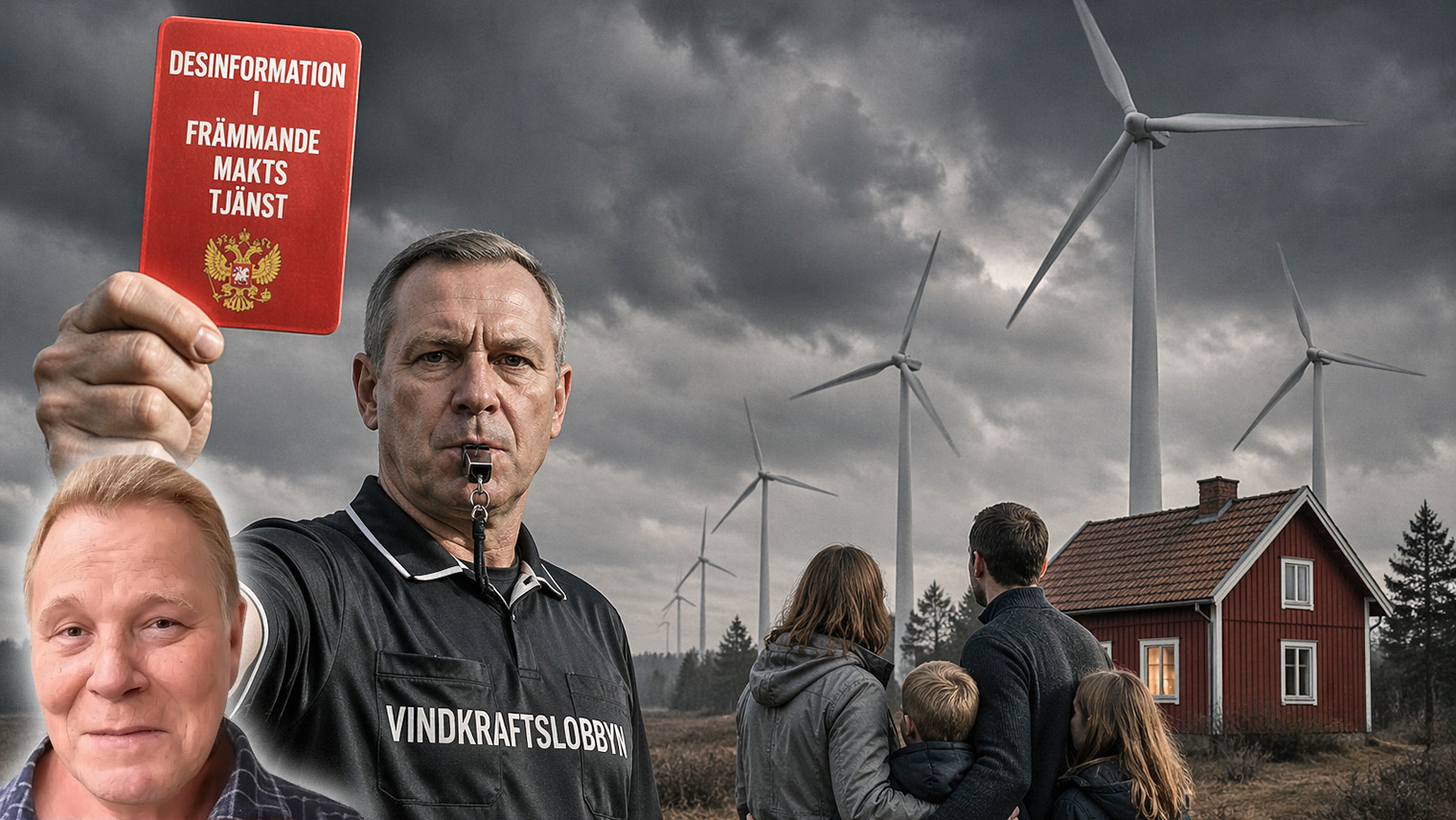
EDITORIAL • When facts become too uncomfortable and the arguments too difficult to counter, the wind power lobby chooses another path – casting suspicion on critics as security threats. This says more about the weakness of their arguments than about the critics’ motives. Instead of addressing legitimate concerns about economics, the environment, and local democracy, they now try to shift the debate towards guilt by association and moral panic.
Wind power has long been presented as an obvious part of the green transition. But behind the tall towers and political buzzwords are questions that have become increasingly difficult to dismiss.
Who takes the economic risk? Who profits? Who pays when projects fail? Why are so many companies operating at a loss? Why are guarantees, subsidies, and publicly backed funding required for continued expansion?
These are not conspiracy theories. They are normal questions in a democratic society. But instead of answering them, parts of the industry and their advocates choose to cast suspicion on those who ask.
A Classic Diversion Tactic
When criticism of wind power is linked to “Russian disinformation,” focus is shifted away from the substantive issues—which, of course, is the intent. When arguments run dry, the debate is turned into an ad hominem and meta-discussion.
Suddenly, the discussion is no longer about profitability, ownership structures in tax havens, public guarantees, environmental impacts, noise and landscape changes, falling property values, and lack of local involvement. Instead, it’s about the suspected motives of the critics.
This is a well-known method. Those who cannot win on the facts try to win by smearing their opponents.
Ordinary People Are Not Security Threats
Behind the protests and criticism of wind power are not foreign powers, but informed investigative journalists and opinion-makers, and—not least—ordinary people.
It’s about families at risk of having their local environment changed. About residents who see natural values threatened. About people worried about noise, shadows, roads, industrial landscapes, and falling values of their homes. About fishermen worried for marine environments. About citizens who feel decisions are imposed over their heads.
Dismissing such people as disinformers in Putin’s pay, out to harm Sweden, is deeply troubling on a human level and also profoundly undemocratic. Citizens have the right to protest against projects that affect their daily lives without being cast as agents of the Kremlin.
The Economics Speak for Themselves
The problems of wind power do not disappear when critics are labeled. When it’s windy in large parts of northern Europe at once, electricity prices are often pushed sharply down. When there is no wind, no electricity is produced at all. Revenues become uncertain, low, or nonexistent. Thus, dependency increases on support systems, credit guarantees, and politically created incentives.
SEE ALSO: Hidden Billion-Krona Subsidies Keep Wind Power Alive
At the same time, many projects have complex ownership structures, making it difficult for the public to see who ultimately controls the assets, where the profits go, and who is responsible if the calculations don’t add up. These are real, tangible issues. They are not resolved by campaigns about disinformation.
When Public Service Becomes a Megaphone for Special Interests
It is especially serious when public service uncritically reproduces reports from industry-affiliated actors without clearly disclosing conflicts of interest and without letting critical voices be heard. The media’s task is to scrutinize power—not reinforce it.
If publicly funded media starts serving as a channel for lobby messages, trust in journalism and in societal institutions at large is eroded. SVT and SR have long drawn a strict line against commercial interests when perceived as coming from the right. But they lower their guard when corresponding actors don green costumes and position themselves along the lines of alarmist left-wing climate activism.
Security Policy Too Important to Be Abused
Russia does conduct genuine influence operations in Europe. That is precisely why the term must be used with precision and responsibility. When every domestic political disagreement is framed as Russian influence, real threats are trivialized and citizens stop taking warnings seriously.
Crying wolf in every energy debate risks no one listening when the wolf actually comes. It is not the critics who undermine security credibility. It is those who cynically exploit security rhetoric as a debate tactic.
Desperation Exposed
As popular resistance grows, municipalities say no, and investors demand more support, the need for new narratives increases. Then it becomes tempting to claim the problem is not bad calculations, weak profitability, or local protests—but “disinformation.”
SEE ALSO: Wind Power Stalls—Now Swedes Are to Be Bribed to Accept the Turbines
But fewer and fewer people are convinced by this explanation. People see the difference between propaganda and reality. They know when their view changes, when their land is affected, and when their tax money and pension savings are at risk.
Sweden Needs a Grown-Up Energy Debate
It is entirely possible to be in favor of climate responsibility and at the same time critical of bad business, poor planning, and bad democratic processes. Sweden needs an energy debate built on open calculations, technological neutrality, respect for local communities, honest accounting of costs, robust supply security, and factual discussion without demonization.
When politicians and lobbyists can no longer defend their projects with facts, only suspicion remains. That is always a sign of weakness.
PS
When the Tidö government is accused of compromising on climate goals, it is often forgotten that Sweden, counting forests and carbon sinks, is already close to net zero in emissions of climate-impacting carbon dioxide equivalents.
This “forgetfulness” by the green-red opposition is part of the political game. When this “forgetfulness” strikes supposedly impartial and objective actors like public service media and the Climate Policy Council, it is worse—not as bad as playing the Russia card, but still dishonest and a threat to democracy.