
DEBATE • 150 years ago, the great urbanization began in Sweden. Back then, 90 percent of the population lived in the countryside. Today, 90 percent live in cities. This was not caused by the agricultural revolution or the industrial revolution.
Just because agriculture becomes more efficient doesn’t mean people have to move to the city. Factories can be built in rural areas too. Anyone who has been outside the big cities may have noticed that there are still factories in the countryside today.
Urbanization, therefore, is not an obvious or natural development but has largely been created through politics and laws. Whether this is intentional can be debated, but it’s well known that urban populations are easier to tax and control, both physically and mentally. Laws are written in the capital. By people who live in the capital. Who talk about the environment. And chant that “The whole country must live!” while simultaneously strangling it.
Cities and the countryside each have their natural advantages and disadvantages. Big cities can benefit from economies of scale and economic specialization because many people live in a small area. This provides access to a rich selection of shops, entertainment, restaurants, and education. The downside is high prices, crowded spaces, commuting, generally low quality of life, and friction with multiculturalism.
The countryside offers advantages like low land costs, ample space, outdoor activities, quality of life, homogeneity, safety, and a liberating mental distance from politicians. The main disadvantage is greater distances and limited access to typical city amenities.
Overall, there are no obvious natural advantages to living in the city, neither for individuals nor companies. But laws create economic advantages for cities, which fuels urbanization. The countryside’s natural economic advantages are nullified by laws that impose the same requirements on rural areas as on big cities.
Cheap to Run a Village School
The village school is a typical example. We constantly hear they must be closed because they are unprofitable. In reality, it’s not difficult to keep a small village school running. It would cost just as much per student in a rural school with 30 students for 1 teacher as in a city school with 1,500 students for 50 teachers (1500/50 = 30). Considering related expenses, it could even be cheaper in the countryside.
But it becomes economically impossible when the Education Act—written for large-scale operation in big cities—requires “qualified” teachers in every subject, a canteen serving halal, a school nurse handing out birth control pills and demonstrating condom use, a principal attending courses, as well as a counselor and psychologist to tend to the psychological suffering all this creates.
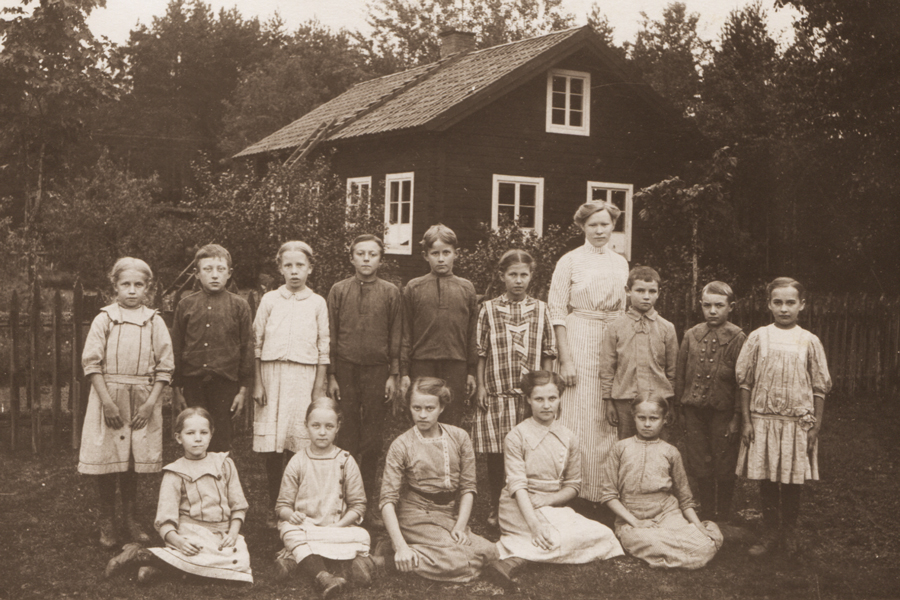
If the countryside could organize schools on its own terms—focusing, for example, on knowledge instead of bureaucracy and values—there would be no problem running a school in every village in Sweden. There are many ways to make it even cheaper, such as exercising outdoors and packed lunches. Here is an example.
An elementary school class with 30 students in Huddinge, one of Sweden’s largest municipalities, costs an average of 200,000 kronor per month! You can easily calculate yourself what it would cost in rent and a teacher’s salary every month to run a small village school without the restrictions of the Education Act.
The more law from the central government, the more standardization and large-scale operation, the harder it is for the countryside, and the more it declines. That’s why the small school becomes “unprofitable,” is closed, and students are bussed to schools run on an industrial scale. State subsidies and political slogans are no match for such powerful forces.
From Local Law and Provincial Law to the Law of the Kingdom of Sweden
With the Christianization of Sweden came the entry of writing into law. Before that, law consisted of oral traditions and local customs that evolved and adapted to local needs. Lawmen held courts where conflicts were resolved and justice was administered in ways that suited the people best. Since the law was oral, it was simple, concrete, and geographically limited in jurisdiction.
From the 10th century AD, written laws were introduced in each province. These so-called provincial laws still varied a lot between regions, but this was the first step toward centralized law. In the 1350s, the provincial laws were replaced by King Magnus Eriksson’s Law of the Land and Law of the City. The centralization of law took a big leap, ending local variations.
However, as there were separate laws for country and city, this at least recognized their different needs. In 1734, everything was replaced by the Law of the Kingdom of Sweden. One law for all. All for one law. Very convenient for the ruler, less so for the subjects.
Since then, centralization has continued unabated. We now have EU law and UN conventions at the :censored:6:cdd6bbaa89: level above us. Full-time lawmakers produce tens of thousands of pages (seriously!) of new laws for us citizens every year. A plausible theory about the fall of the Roman Empire says it suffocated under its own laws.
Local Self-Government Is Abolished by Centralized Law
In our constitution, the Instrument of Government from 1974, only traces remain of local self-government:
“Swedish democracy … is realized through a representative and parliamentary system of government and through municipal self-government.” (Instrument of Government, Chapter 1, Section 1)
In practice, little remains of municipal self-government since a number of laws dictate to municipalities what activities they must manage and how it should be done. When they have fulfilled the Education Act, Social Services Act, Health and Medical Services Act, Planning and Building Act, Environmental Code, Settlement Act (forced mass immigration), there is little local budget and discretion left.
The more tasks forced onto municipalities, the more their organizations swell. Compare today’s municipal palaces with the small but adequate town halls of our old cities. How does your local municipal palace contribute to your quality of life?
Laws Written for Cities Suffocate the Countryside
The unified law tends to be based on the conditions of the capital. That is where lawmakers live and lobbyists operate. Knowledge and interest in life outside the city walls are limited—except when it comes to natural resources, energy supply, and taxation opportunities.
When city laws are applied to rural areas, their unique competitive advantages disappear, leaving only the disadvantages. This makes the countryside unprofitable, it withers, and is depopulated. The core of the problem is the indirect costs that the law imposes. It must be the same for both city and countryside, both for large-scale and small-scale operations.
Imagine running a hot dog stand and being forced by law to hire a CEO, CFO, HR manager, environmental manager, lawyer, and company doctor. In large companies, these fixed costs are spread over many units, but in small ones, the costs are divided among just a few. This makes small-scale operations expensive per unit, and thus artificially unprofitable.
The example of the village school illustrates the core problem facing the countryside. This is repeated in many other areas. Uniform laws demand small communities provide the same services and bureaucracy as large cities, even if the villagers themselves would happily organize their community more simply.
In other words, it is the lack of self-government and local adaptation that destroys the countryside. It is the same self-government that the Instrument of Government so solemnly speaks of, but which in practice is limited to the right of residents to elect municipal councillors, who are then obliged to fulfill mandatory national laws. There are many other examples of this problem:
- Like with the village school, the same goes for the municipality itself. Sweden once consisted of 3,000 parishes. The distance between the parish assembly and residents was short. Many decisions were made locally, especially about school and welfare. Municipal reforms and uniform laws with imposed costs have made small municipalities “unprofitable” and forced mergers, so-called rationalization. Now, just 290 large municipalities remain. The distance between local politicians and members has increased accordingly.
- Like the village school, the same applies to elderly care. It becomes expensive in small-scale operations.
- Healthcare is the same. Hence the move toward ever larger hospitals instead of small clinics.
- The police are another example of a public service forced to “rationalize”—become more centrally controlled and less locally rooted.
- People in the countryside depend on cars since there is no subway. Yet both city and countryside pay the same 50 percent tax on fuel, despite it hurting the countryside more.
- The unions demand the same wages and benefits in the country as in the city, even though costs are lower in rural areas. Then it’s just as easy to locate businesses in the city.
- Small businesses face the same bureaucracy as large ones. It’s the same checks, requirements, and supervisory fees for a single hot dog stand as for a large restaurant belonging to an international fast-food chain. But while the chain can afford dedicated staff to handle everything for all restaurants, the hot dog stand owner must manage and pay for all bureaucracy himself.
- Agriculture, too, has been forced by similar costs and bureaucracy into mergers and large-scale operations. This makes it harder for people to make a living from small-scale farming, forcing them to look for other jobs—usually in the city.
More Self-Government for a Thriving Countryside
There is no mystery as to why rural areas are being depopulated in Sweden, while they thrive in other countries. It’s because Sweden is one of the most centrally governed countries in the world. The central power in the capital has little trust in rural residents. They’ve granted them voting rights, but do they really believe people can manage schools, health care, elderly care, police, justice, environment, health, etc., on their own?
Imagine when the EU has fully “harmonized” its member states. When we have uniform EU taxes, EU environmental regulations, EU education laws, EU settlement laws, and so on. Then we’ll all have to move to Brussels. Or we resist. Or wait for the monster to collapse under its own bureaucracy.
Klaus Bernpaintner
(Article previously published at Folkungen.se)