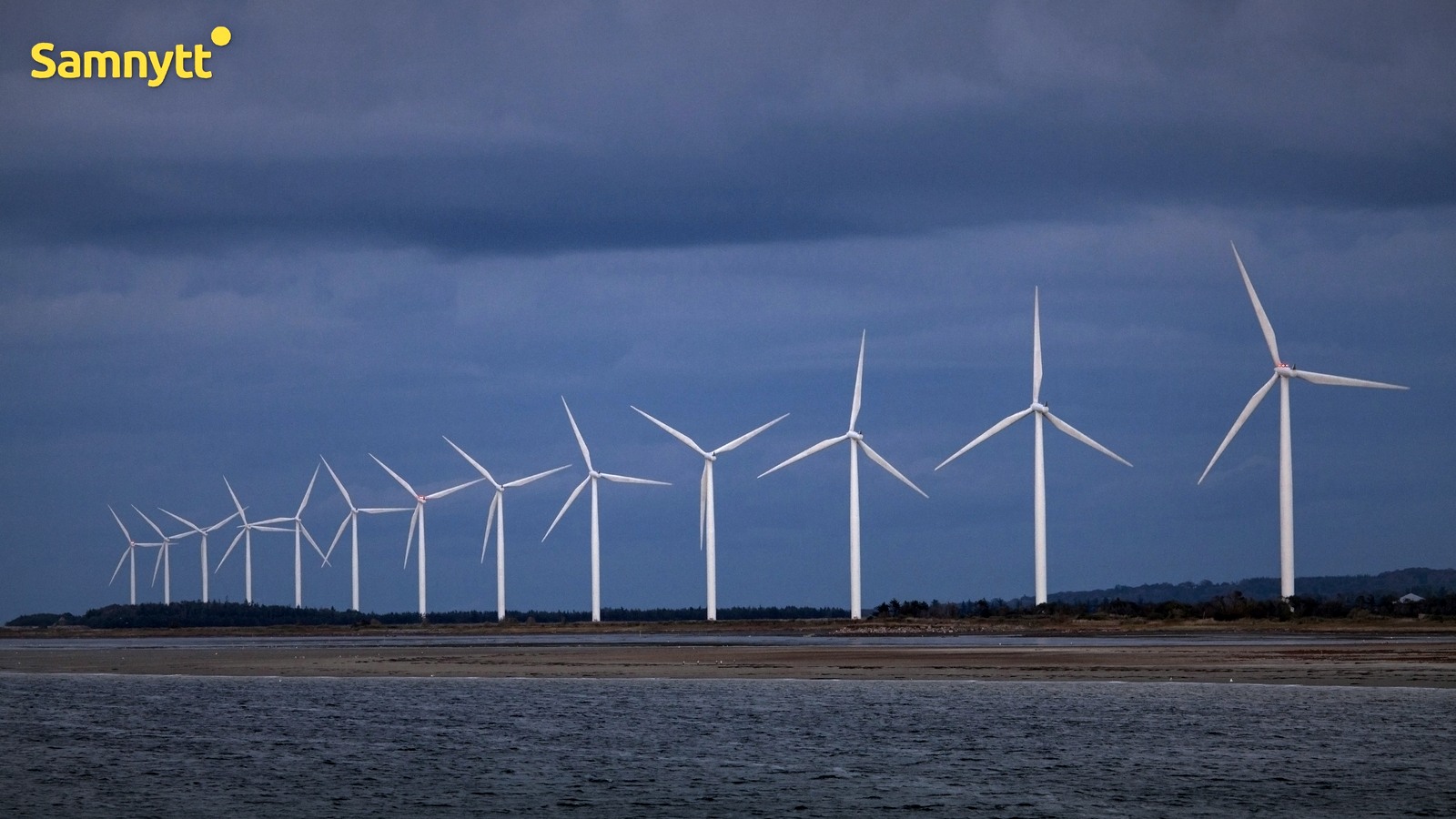
Denmark used to call itself the world champion of wind power. Today, the expansion on land has almost come to a standstill. Last year, 32 old wind turbines were dismantled, while only eight new ones were installed, resulting in a net addition that was less than the output of a single new turbine. The industry blames municipal blockages, expensive grid connections, and negative electricity prices. The solution it proposes is that the state guarantees a minimum price for electricity.
The figures come from the industry organization Green Power Denmark’s annual energy barometer. Since the beginning of 2023, 21 wind turbines have been built on land in Denmark, with a total output of 85.7 megawatts. During the same period, old turbines with a total of 47.2 megawatts have been dismantled, leaving a net gain of just 38.4 megawatts.
In 2025 alone, eight new commercial turbines were installed, totaling 27.5 megawatts, while 32 older and smaller turbines with just over 25 megawatts were demolished. This left a net addition of 3 megawatts, less than the output of a single modern land-based wind turbine of the type most often built in Denmark.
According to the Danish Ministry of Climate and Energy, there were 4,158 wind turbines on land in 2020. By August this year, there were 4,110. The total output has still risen slightly, as the new turbines are larger.
Negative Electricity Prices Consume Profitability
The explanations given by the industry itself say a lot about the challenges of the energy transition. Green Power Denmark points to long processing times in municipalities, to the national grid company Energinet falling behind with transformer stations and cables, and to politically imposed costs for new projects increasing by around 3,500 percent between 2019 and 2025, according to the organization’s own calculation. This includes higher land taxes, more expensive grid connection, and larger contributions to local schemes for renewable energy.
The connection fee is what a producer pays to connect its power plant to the grid. In Denmark, this cost has increased sharply for new wind and solar projects.
The other problem is the electricity price. When the wind blows strongly, all wind turbines produce at the same time, and then the price can fall to zero or below. Camilla Holbech, who is responsible for renewable production at Green Power Denmark, described it this spring:
– The many hours with negative electricity prices squeeze revenues and profitability for the developers who set up wind turbines and solar panels on land.
At the same time, the green share of electricity in Denmark is decreasing, as electricity usage is rising faster than expansion. So far this year, wind and solar have accounted for 62.6 percent of electricity consumption, according to Green Power Denmark, compared to 66 percent in 2024.
The Industry Wants State Price Guarantees
Now the industry, as Di reports today, is demanding that the state provides price guarantees. In a statement on Tuesday, Green Power Denmark suggested that the so-called CfD model, already used for offshore wind power, should also be introduced on land.
CfD stands for Contract for Difference. The state promises the wind power company a fixed price for electricity over a long period. If the market price is lower, the state pays the difference. If the market price is higher, the company pays the surplus back to the state. In practice, it is a price guarantee where taxpayers take on the risk of low electricity prices.
Green Power Denmark’s Deputy CEO Martin Hansen says it’s the funding that has stalled:
– A CfD model on land can cover part of the project developers’ risk and provide the security needed for them to go to the bank and secure investment loans.
The organization also wants corporate taxes from wind and solar farms to go to the host municipalities, for producers to pay less for grid connection, and for environmental permits to be valid for longer. In August, they proposed that leftover funds from the state’s support for offshore wind be used for risk sharing on land. The support cap for the two offshore parks Nordsøen Midt and Hesselø was set at 38 billion Danish kroner, and according to the industry’s own calculations, about half is expected to be used.
The Government Removed the Cap on the Number of Turbines
There is no direct response from the Danish government to the demand for price guarantees that Samnytt has found. In September, the Minister for Climate and Energy, Samira Nawa, removed the cap of 1,850 land-based wind turbines by 2040 set in 2018, stating that functioning turbines should not need to be dismantled.
Among the obstacles that the industry itself lists is not the cap. They mention costs, processing times, and electricity prices, and the answer is that the state should guarantee revenues.
Haven’t you seen Samnytt’s wind power documentary? Watch all three parts below!
Part 2:
Part 3: