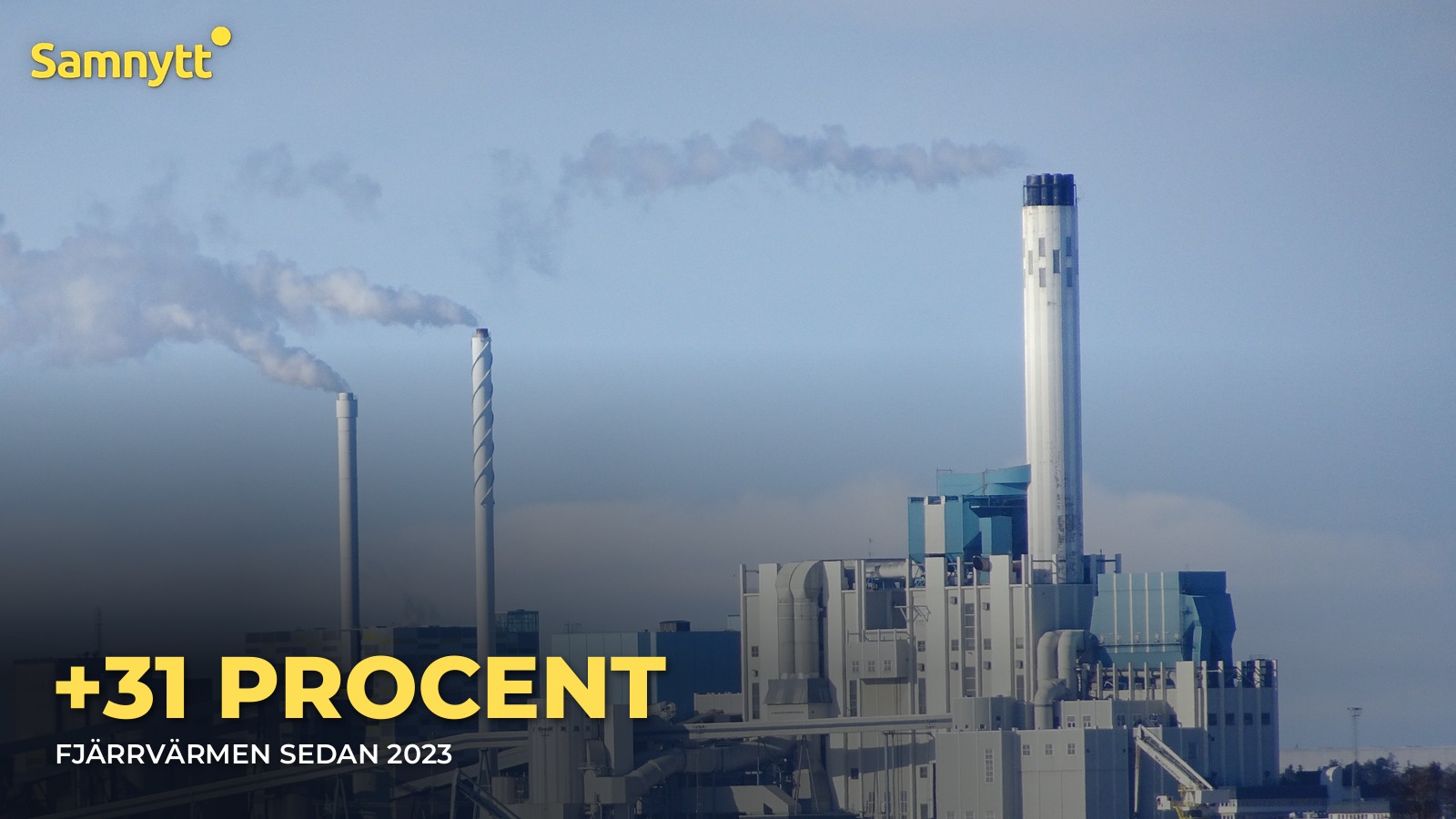
District heating has become 31 percent more expensive since 2023, and water and sewage rates have increased by 35 percent over the same period. This year, the combined costs for heating, electricity, water, and waste collection in a typical multi-family building rose by 6.9 percent, more than ten times faster than inflation. The housing organizations behind the survey point out that these are services where customers cannot switch providers.
The figures come from the Nils Holgersson Group’s annual fee report, presented on Wednesday. The report is backed by Bostadsrätterna, Fastighetsägarna, HSB, Hyresgästföreningen, Riksbyggen, and Sveriges Allmännytta. Every year, they calculate the cost to heat, supply with electricity and water, and have waste collected from the same model building with 15 apartments in all 290 municipalities in the country.
For a typical apartment of about 67 square meters, the cost this year averages 2,954 SEK per month, or just over 35,000 SEK per year. Inflation, measured as the consumer price index between March 2025 and March 2026, was at 0.6 percent. Over five years, costs for the model building have increased by 44 percent, while the general price level has risen by 25 percent.
“The costs are increasing much, much more than inflation,” says Björn Berggren, chairman of the Nils Holgersson Group, to TT.
Heating Is the Largest Expense
District heating accounts for 46 percent of the total bill, making it by far the largest expense. This year, it became an average of 4.5 percent more expensive, which is a slowdown compared to the increases of 15.2 percent in 2024 and 9.2 percent in 2025. In total, however, the price has still risen by 31 percent since 2023. During the entire ten-year period 2013–2022, district heating rose by 14 percent.
An average household in the model building now pays 1,372 SEK per month just for heating. The differences are significant. In Älvdalen, district heating costs 1,795 SEK per month, more than twice as much as in Luleå, where the same apartment pays only 787 SEK. In 28 municipalities, the price increased by more than ten percent over the past year, with the highest in Krokom and Bollnäs at 19.9 and 19 percent, respectively.
There is no relief in sight. According to the price change models presented by district heating companies in the so-called Price Dialogue, prices in the 103 municipalities involved are expected to increase by an average of four percent per year in both 2027 and 2028.
Private Equity’s District Heating Is the Most Expensive
The report points to three companies that have grown quickly in the district heating market during the 2020s: Solör Bioenergi, Nevel, and Adven. Together, they now own district heating systems in 28 percent of the country’s municipalities, primarily in smaller towns. They are also among those who have raised prices the most. Solör Bioenergi has increased prices by 51 percent since 2023, Nevel by 47 percent, and Adven by 46 percent.
Solör Bioenergi is the provider in all ten municipalities with the country’s highest district heating prices. Among the 31 larger cities highlighted in the report, there is a mix of foreign, state, and municipal owners in the more expensive half, while the cheaper half has exclusively municipal owners. Among the larger companies, Germany’s E.ON raised prices the most this year, by 10.8 percent.
READ ALSO: District heating being sold off – becomes private equity’s new cash cow
Water and Sewage Costs Soar
The municipal water and sewage (VA) rate increased by 7.3 percent this year, after record-raising hikes of 14.1 percent in 2024 and 10.7 percent in 2025. The average apartment now pays 645 SEK per month for water and sewage, compared to 602 SEK last year.
Over ten years, VA costs have risen by 82 percent, and since the year 2000 by 187 percent, compared to 61 percent for consumer prices.
This is where the differences between municipalities are the greatest. In Trosa, water and sewage cost 1,192 SEK per month for the model apartment, more than four times as much as in Fagersta, where the cost is 285 SEK.
As many as 94 municipalities raised the rate by at least ten percent, and eleven of them by 25 percent or more. Ljungby raised the most, by 61 percent, followed by Pajala at 57 percent. All ten municipalities with the highest VA costs are on the coast.
The report cites reasons such as large investment needs and higher interest rates, after the capital-intensive VA sector benefited from low rates for a long time.
Gnesta Most Expensive – Piteå Cheapest
When all fees are combined, Gnesta is the most expensive municipality in the country to live in, closely followed by Trosa. An apartment in the model building costs 3,814 SEK per month there, or 45,768 SEK per year. In Piteå, which is the cheapest, the bill is 25,836 SEK.
The difference is nearly 20,000 SEK per year for the same apartment. All ten most expensive municipalities are in the southern half of the country and have relatively few inhabitants.
At the same time, all of the ten largest municipalities are below the national average, with Linköping having the lowest cost and Uppsala the highest.
Electricity became 12.4 percent more expensive, mainly due to higher electricity trading prices even though electricity tax was reduced at the turn of the year. Waste collection remains essentially unchanged, with an increase of 0.2 percent.
If one excludes electricity trading and electricity tax and looks only at the services the report describes as real or natural monopolies—district heating, electricity grid, water, sewage, and waste—the cost rose by 5.4 percent, nine times faster than inflation.
READ ALSO: District heating prices rocket: “Surprised”
The Customer Cannot Opt Out
The housing organizations note in the report that many of these operations have a monopoly position and therefore need to be monitored, especially concerning prices.
Those living in a house with district heating cannot change their heating provider, and water and sewage are supplied by the municipality. In total, this amounts to just over 90 billion SEK per year for rental and tenant-owned apartment buildings.
Björn Berggren is calling for long-term investment plans from politicians to avoid similar price shocks in the future, but he does not believe we have reached the peak yet.
“If I were to hazard a cautious guess, I think that water and the electricity grid may continue to rise sharply,” he says.