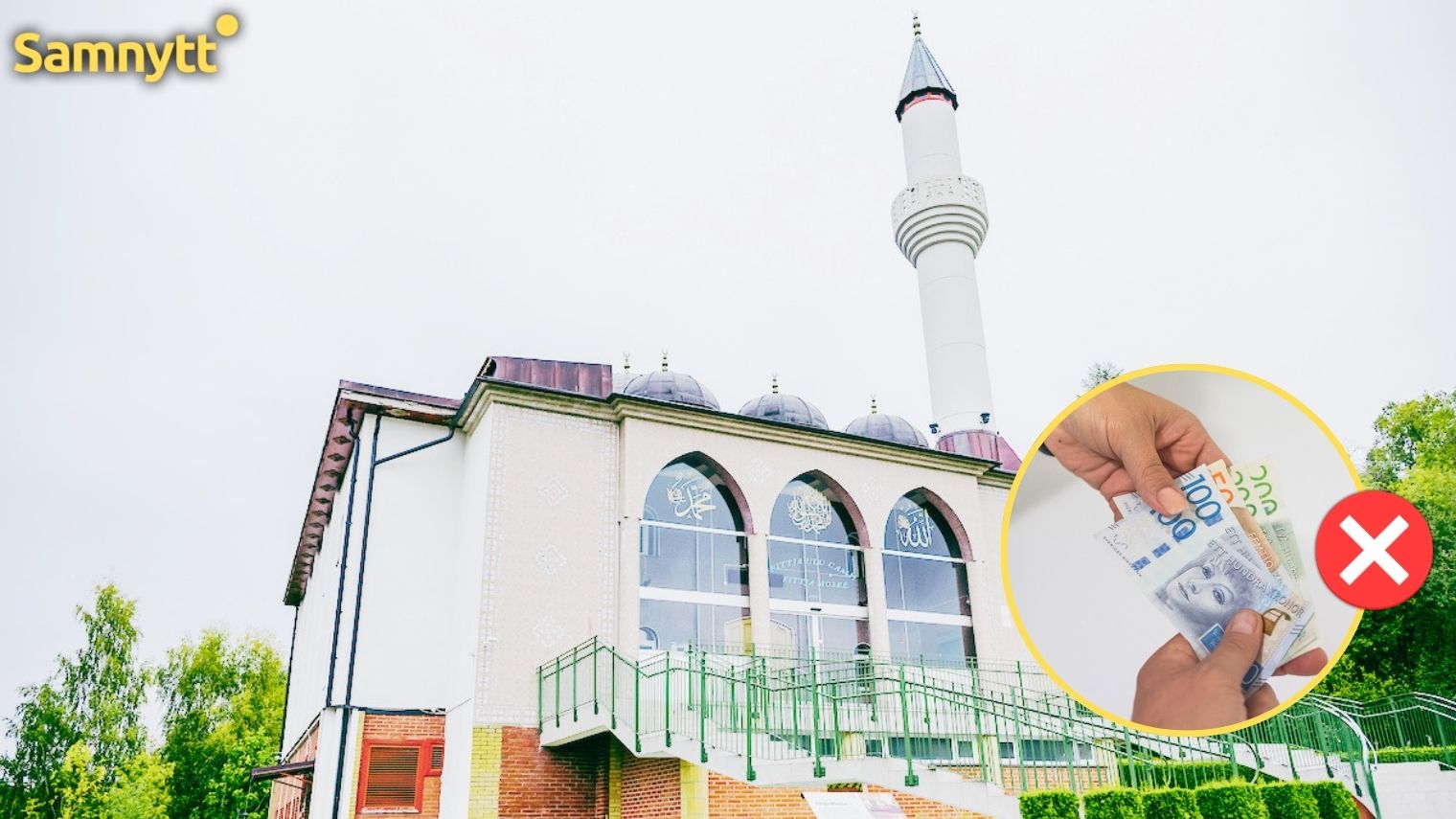
Foreign financing of religious communities and other activities in Sweden may, in some cases, be prohibited. This is proposed by the government inquiry presented to the government on Monday.
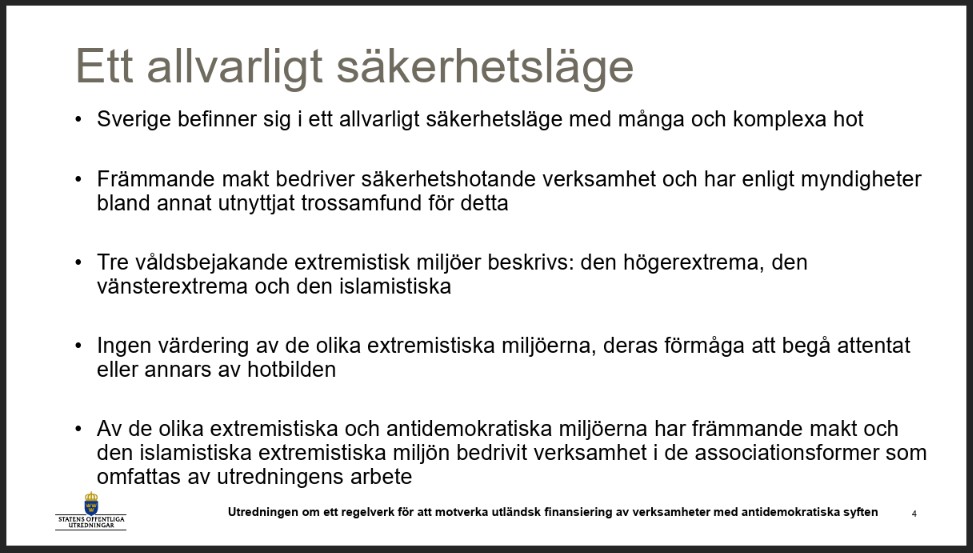
The inquiry suggests the introduction of a new regulatory framework that makes it possible to block financial contributions from foreign states, organizations, and private individuals if the funding is deemed likely to be used to promote anti-democratic aims or threaten fundamental Swedish societal interests.
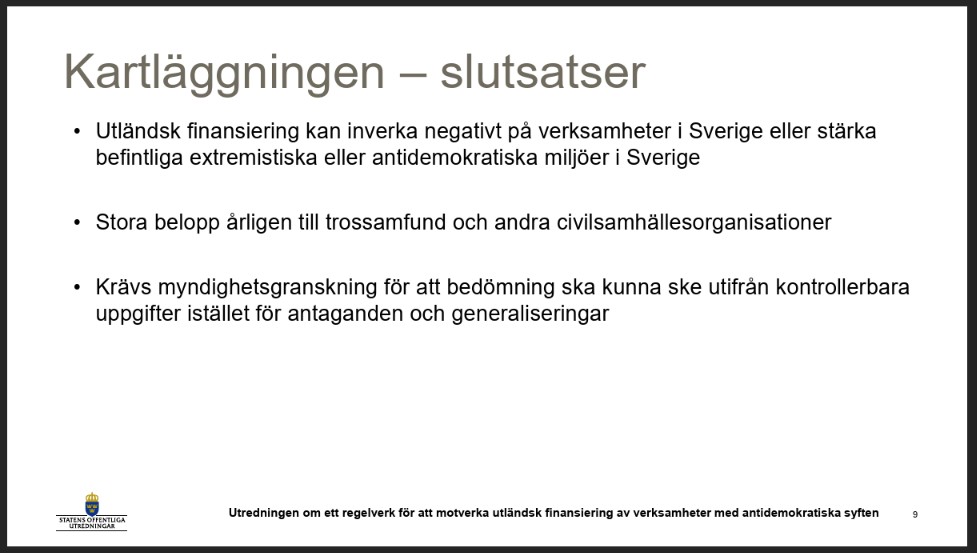
The proposal was presented by the appointed investigator at a press conference together with government representatives. According to the inquiry, there are currently shortcomings in the ability to intervene against foreign funding, even when there are concerns that the money is used to spread extremist messages or strengthen environments that counteract democratic values.
The inquiry therefore proposes that authorities should have the power to act against certain types of financing from abroad. The ban would not cover all foreign donations but would target funding from actors or circumstances where there are specific risks of influence or anti-democratic activity.
READ ALSO: SD and M in joint effort to stop Linköping’s first mosque – MP outraged
According to the proposal, funding from certain foreign states could be completely banned. Contributions from organizations or individuals connected to extremism or activities that contravene fundamental democratic principles could also be stopped.
Amounts exceeding 150,000 kronor from foreign financiers would have to be reported to a new supervisory authority. It would also be a criminal offense to accept foreign funding of more than 150,000 kronor without reporting it or to provide incorrect information about such funding.
Increased Radicalization
The Tidö government welcomes the inquiry’s conclusions. Integration Minister Mats Persson (L) says it is unreasonable for foreign actors to be able to finance activities in Sweden that risk hampering integration or spreading undemocratic values. The government will now analyze the proposals before determining whether to proceed with legislation.
“Financial support from abroad risks leading to increased radicalization of anti-democratic environments and activities with ties to extremism,” says Gunnar Strömmer (M) at the press conference.
READ ALSO: New question marks raised over new mega mosque with extremist links
The proposals have, at the same time, raised questions about how the rules can be reconciled with freedom of religion and freedom of association. However, the investigator assesses that a ban can be designed in a way that is compatible with both the Swedish constitution and Sweden’s international commitments, provided that actions are aimed at specifically designated risks and not at religions or communities as such.
The inquiry also proposes a system where certain recipients may be required to provide information about foreign contributions. The aim is to increase transparency and make it easier for authorities to detect funding that could be covered by a future ban.
Part of the Tidö Agreement
The inquiry was launched by the government in the spring of 2025 as part of the Tidö Agreement. The background was a long-standing debate about foreign funding of mainly religious communities, with concerns for several years over money from abroad being used to influence activities in Sweden.
When launching the inquiry, the government cited, among other things, claims that foreign states and organizations in some cases have funded mosques and other religious activities in Europe to spread ideologies considered opposed to democratic values.
READ ALSO: Social Democrat visited Tensta: “Of course we need to build more mosques”
The Swedish Security Service (Säpo) has also warned that foreign powers are attempting to exert influence in Sweden through various forms of financial support.
Against this background, the investigator was tasked with exploring how a ban on certain foreign funding could be designed. This work has now been completed and the proposals are on the government’s table.
Press conference:
Mosque explosion in Sweden
Until the 1970s, there were practically no mosques in Sweden. The first Muslim immigrant groups gathered in rented spaces and association premises, but with increased immigration from the Middle East, the Balkans, Africa, and Asia, the need for permanent places of worship grew. During the 1980s and 1990s, the first large mosques were built.
Today, there are hundreds of Muslim prayer rooms and Islamic centers around the country, from major cities to smaller municipalities. Several new mosques have been constructed in recent decades and more projects are planned.
This development reflects how Sweden has gone from having virtually no mosques at all to Islam becoming the country’s second largest religion and a visible part of Sweden’s religious landscape.
READ ALSO: Salafists building mosque in Jämtland: “Fundamentalist and reactionary”