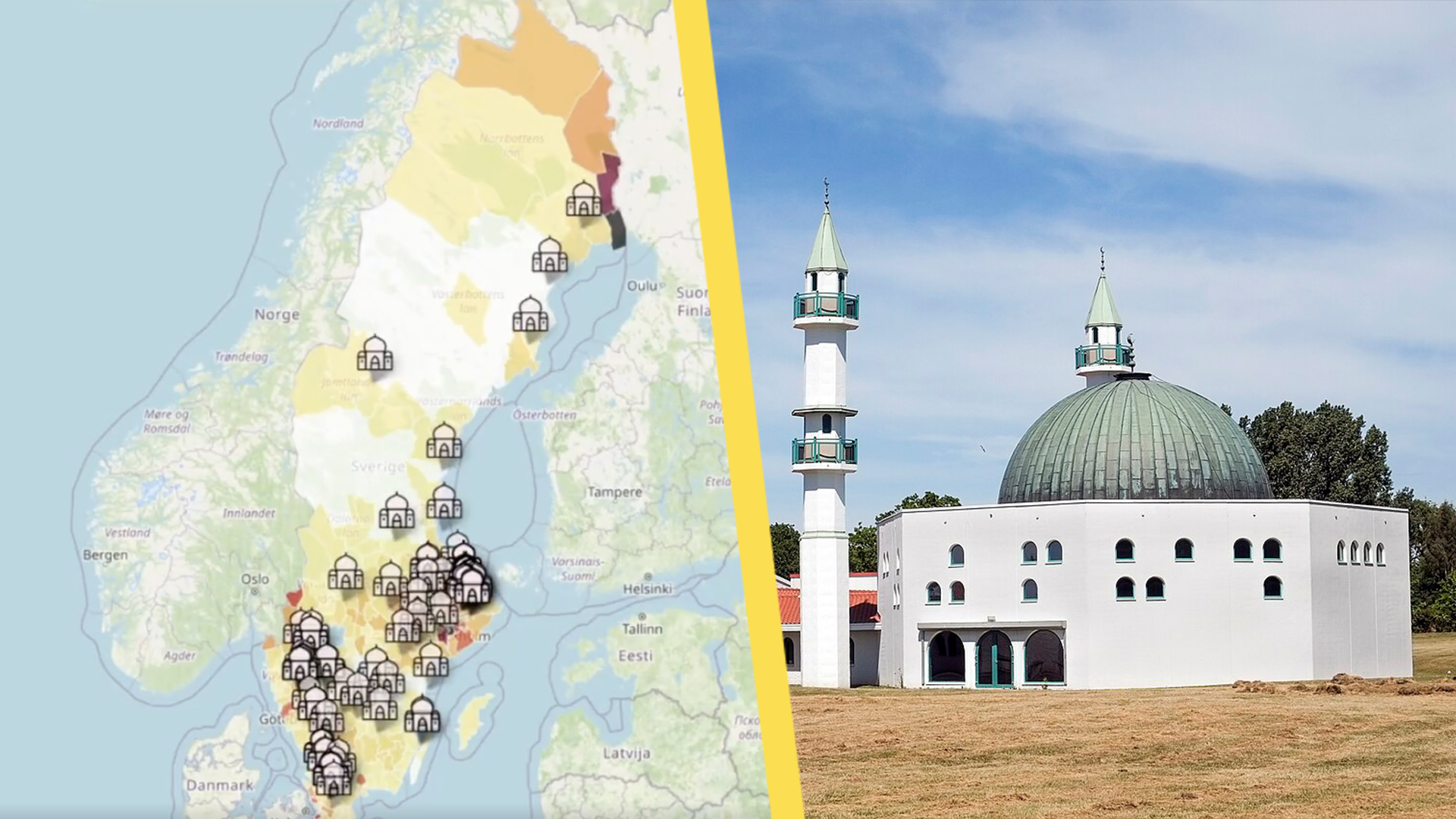
Previously, SD’s group in the EU Parliament launched the Migration Map, which has since been updated. Now, a third version is being released, with a new filter for mosques added.
Earlier, the Sweden Democrats updated their digital tool the Migration Map with several new features, including which municipalities have accepted or declined meetings with the government coordinator for voluntary repatriation, and where in the country vulnerable areas are located. Now, the map is updated with a new filter: the Mosque Map.
The number of mosques, growth rate, and similar information are now available. The list may be incomplete, so viewers are encouraged to report any mosques missing from the map.
A Tool for Understanding the Development
The Migration Map was originally launched as an interactive tool to show how Sweden’s population has changed, municipality by municipality, over the past 25 years. With data from, among others, Statistics Sweden (SCB), the development of the proportion of foreign-born people since 2000 is visualized.
Charlie Weimers has previously highlighted that Sweden’s population, as a result of immigration, has increased by about 1.6 million people since the turn of the millennium. During the same period, the share of foreign-born people has increased from just over ten to more than twenty percent.
READ MORE: SD launches the “Migration Map” – showing population changes municipality by municipality
Examples highlighted include Malmö, where the proportion of foreign-born people is said to be around 35 percent, and Stockholm, where the corresponding figure is about 25 percent. In other cities, such as Södertälje, Swedes are in the minority, and in many suburban areas, almost no Swedes live there anymore at all.
“Facts as a Basis for Debate”
According to the Sweden Democrats, the purpose of the map – and its updates – is to make statistics more accessible to the public and thus contribute to a more fact-based social debate.
The party argues that the tool enables citizens to follow the developments in their own municipality, compare with other parts of the country, and form their own opinion.
With the new version, the party also hopes that issues regarding repatriation and local political decisions will become more visible to voters.