OpenART is Örebro Municipality’s international art biennial—an extensive outdoor exhibition of contemporary art held every other year. Since its inception in 2008, the city’s streets, squares, parks, and other public spaces have been filled with artworks by both Swedish and international artists. Visitors can enjoy the exhibition free of charge—but what does it actually cost to organize?
According to Örebro Municipality, the aim is to make contemporary art accessible to everyone, foster encounters and discussions, and strengthen Örebro’s position as a cultural city. In addition to the artworks themselves, the exhibition period includes guided tours, workshops, art walks, and activities for schools and children.
In 2026, OpenART will take place from June 13 to September 6 and will be the biennial’s tenth edition. Around 40 artworks will be displayed in central Örebro, and additional works will appear through collaboration with the municipalities of Askersund, Kumla, Laxå, Lindesberg, and Nora as part of the OpenART LINKS initiative.
OpenART has, over the years, inspired both appreciation and criticism. Many view the exhibition as a notable tourist attraction and a way to make art accessible in the public space, while others have questioned the use of taxpayers’ money and some of the more controversial artworks. Debates over content and costs arise with virtually every edition.
Given Special Status
Last year, the Christian Democrats criticized the project. In a special statement within the Culture and Leisure Committee from June 2025, the party wrote that while they support the idea of OpenART, they were critical of how the project is funded. They also believed that OpenART receives preferential treatment compared to other cultural initiatives, and that the municipality is repeatedly forced to bail out the project with additional taxpayer funds.
Another point raised by the party was that the committee’s planning reserve is depleted to fund OpenART—potentially affecting other activities—and that sponsorship income has declined. The Christian Democrats therefore wanted to reduce extra support from 700,000 SEK to 500,000 SEK.
READ ALSO: Artwork with Giant Placenta Cost Taxpayers Millions
In June 2026, Municipal Commissioner Anders Åhrlin (Moderates) publicly criticized a work constructed in Stortorget, Örebro.
In early 2025, Swedish Radio reported that this year’s edition would be smaller due to reduced private funding.
SD Criticism
The Sweden Democrats in Örebro are also strongly critical and have highlighted the project:
The party maintains that while OpenART is an interesting idea—allowing for the display of artworks throughout the city’s public spaces and offering a temporary creative experience in Örebro—the artistic quality and the works themselves have sparked many reactions over the years.
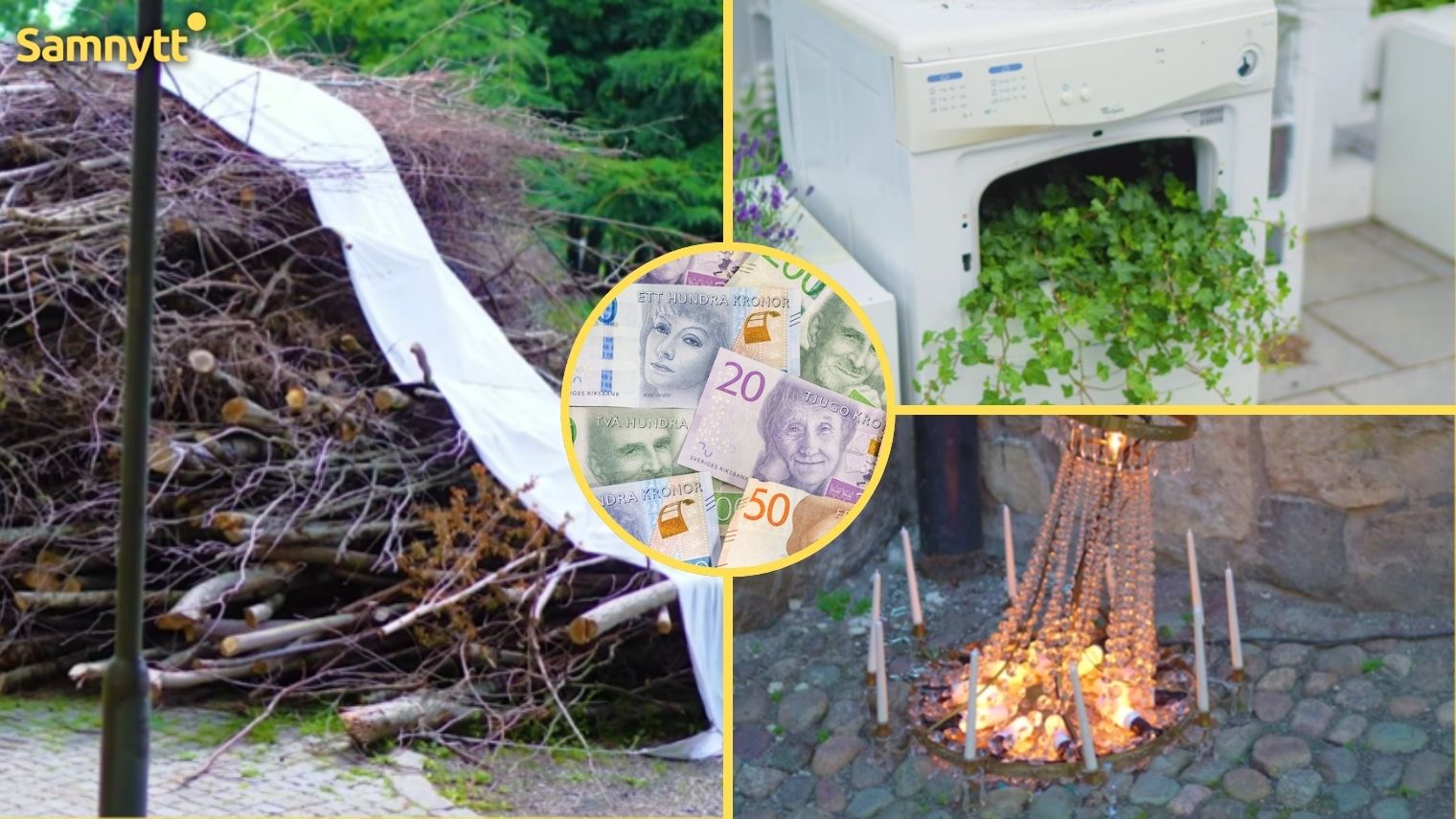
They highlight, among other things, an artwork consisting of a pile of twigs, which cost 93,000 SEK. As the public increasingly questions so-called art—including previous works such as a placenta in the Svartån River or dressing up the statue of Karl XIV Johan as a drag queen—the party argues that OpenART is becoming just another example of funding left-wing propaganda or artists who clearly do not respect cultural heritage or taxpayers’ money with unserious works.
“As politicians, we have a responsibility to manage taxpayers’ money with respect,” is the party’s position, and they believe Örebro Municipality should discontinue funding for OpenART and instead leave it to private enterprise.
Artistic Process
Samnytt requested documentation from Örebro Municipality, where Elin Persson, head of the art unit, explains that the selection of artists and works for OpenArt 2026 was conducted through an artistic process aimed at presenting high-quality contemporary art in public space. The work was led by OpenART’s artistic leadership in dialogue with curators, partners, and artists.
“In the selection, several aspects were considered, among them artistic quality, contemporary relevance, feasibility in public space, and the ability of the works to create encounters, reflection, and dialogue with a broad audience. The ambition has been to present a diversity of artistic expressions, perspectives, and experiences—with both nationally and internationally active artists,” she told Samnytt.
“OpenART offers artists worldwide a chance to apply for participation, as well as invites professional artists at their discretion. In our Open Call, we received 550 applications in 2025, which have been reviewed by the art unit’s curators, with support from two external groups from Örebro.”
READ ALSO: Municipality Sets Record—Spends 25 Million on Art
“Several participating artists were selected through OpenART’s established networks and international collaborations, while others were invited based on their specific artistic practices and assessed relevance to this year’s exhibition. In some cases, the artworks have been developed specifically for the site and in close dialogue with the city’s environment, residents, or local organizations.”
Persson adds that OpenART also works with residencies, co-creative processes, and collaborations with different community groups. For several artists, interactions with local stakeholders, associations, schools, and youth have been integral to the artistic process. Therefore, the selection is not limited to finished objects but also includes artistic projects built on participation, knowledge exchange, and relationships to the place.
“The aim has been to create an exhibition of high artistic quality that is accessible to a wide audience and helps make contemporary art visible and relevant in the public space. Through this, OpenART seeks to offer residents and visitors new perspectives on the city, as well as opportunities for encounters, conversations, and experiences that otherwise would not occur.”
The Costs
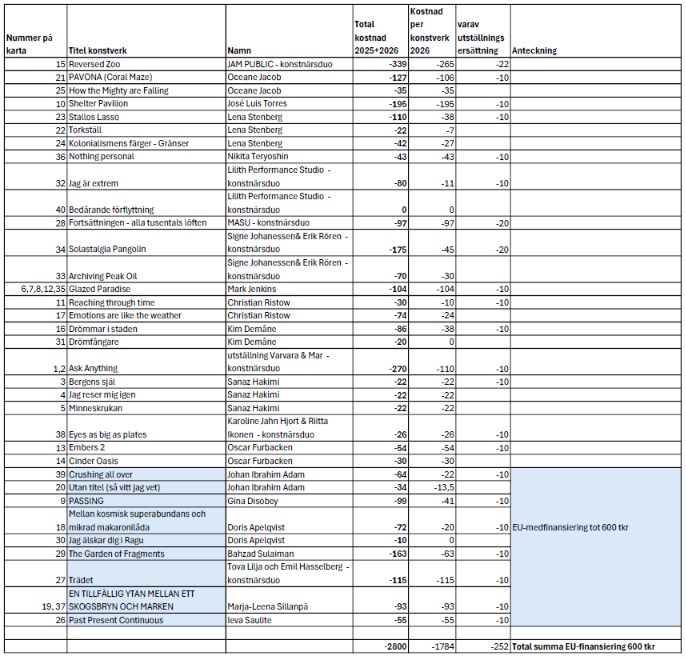
According to Persson, the total budget for artworks in OpenART 2026 amounts to about 1.8 million SEK. The budget covers some 40 exhibition sites and includes costs such as payment to artists (production support and exhibition fees), materials and other production, transport, installation, travel, and accommodation.
360,000 SEK is allocated for installation costs such as equipment rental for lifts and cranes, barriers, scaffolding, transport, electricity, and other technical requirements for installing the works in public spaces.
At the same time, Persson notes that salaries are not included in this summary.
“Employees’ work, however, is a precondition for the exhibition and includes project management, planning, coordination, permit processes, contract management, selection of art, practical implementation, installation, and public engagement. OpenART’s staff also organize and lead the construction and preparation of most works in close collaboration with artists, technicians, and other involved parties.”
Costs for individual artworks:
10 Million
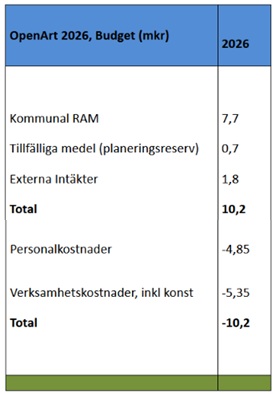
While the municipality provides 7.7 million SEK, an additional 1.8 million is raised externally, and 700,000 comes from “temporary funds” (planning reserve). This results in a total budget of 10.2 million SEK.
Of the external funds, 850,000 comes from sponsorships and 585,000 from EU funding.
Of the more than ten million, nearly five million is allocated for staff costs and the other half, just over five million, for operational costs including the art itself.
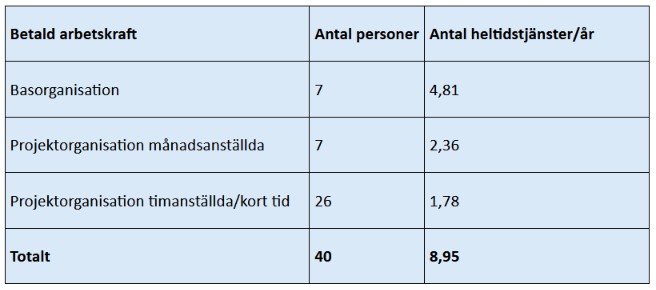
The paid workforce consists of a total of 40 people managing the project, equivalent to nine full-time positions per year. In addition, there are 20 volunteers.
Cutbacks Elsewhere
Even as Örebro Municipality invests millions in OpenART, the municipality in recent years has carried out a range of cutbacks and efficiency measures in its regular operations. The Culture and Leisure Committee, for example, has decided to reduce grants for children’s and youth activities, decrease subject courses at the Culture School, and merge operations such as Trainstation, Komtek, Technical Mill, and Bubblan. Even library services have undergone restructuring and efficiency requirements.
These savings are part of a broader effort to strengthen the municipality’s finances. In the 2026 budget, the governing majority decided on a general efficiency requirement of 82 million SEK. According to the municipal leadership, savings are to be achieved through lower premises costs, less use of consultants, and other efficiencies, while schools and social services are prioritized.
The municipality’s financial reports further show that several committees still need to make additional savings to achieve a balanced economy.
Against this backdrop, the municipality’s decision to continue funding OpenART with significant amounts has become a subject of debate, since the spending occurs as other municipal operations are forced to make cuts.
READ ALSO: Municipality Decorated with Art for Two Million: “Looks Like a Beggars’ Camp”