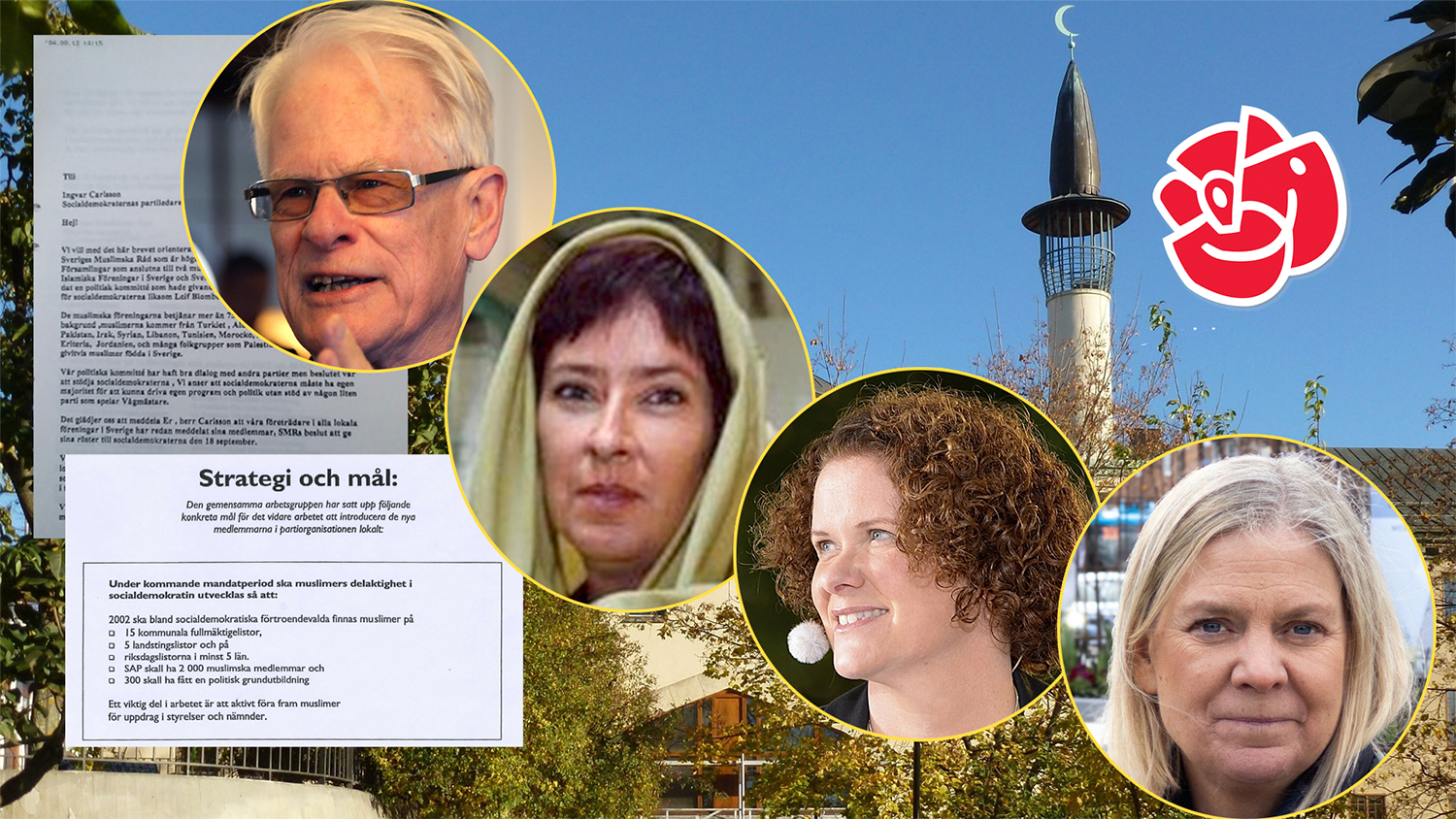
Theologian and researcher Sameh Egyptson has reviewed documents from the 1990s through 2024 that, according to him, show a longstanding political continuity in the Social Democrats’ support for the establishment of mosques. The material covers everything from contacts between the Swedish Muslim Council and the Social Democrats ahead of the 1994 election to statements from Stockholm’s finance commissioner Karin Wanngård (S) about the need for more mosques.
Sameh Egyptson, Doctor of Theology in interreligious relations and parliamentary candidate for the Christian Democrats (KD), has for several years examined the relationships between the Social Democrats, the Brotherhood Movement – now Social Democrats for Faith and Solidarity – and Muslim organizations.
In a new installment of his documentation series, he focuses on an issue that he argues has recurred for more than three decades: the establishment of mosques and other Muslim institutions.
According to Egyptson’s review, the issue was already present in contacts ahead of the 1994 parliamentary election. Representatives from the Swedish Muslim Council, SMR, then described their contacts with the Social Democrats and how their local associations were informed of a decision to support the party in the election.
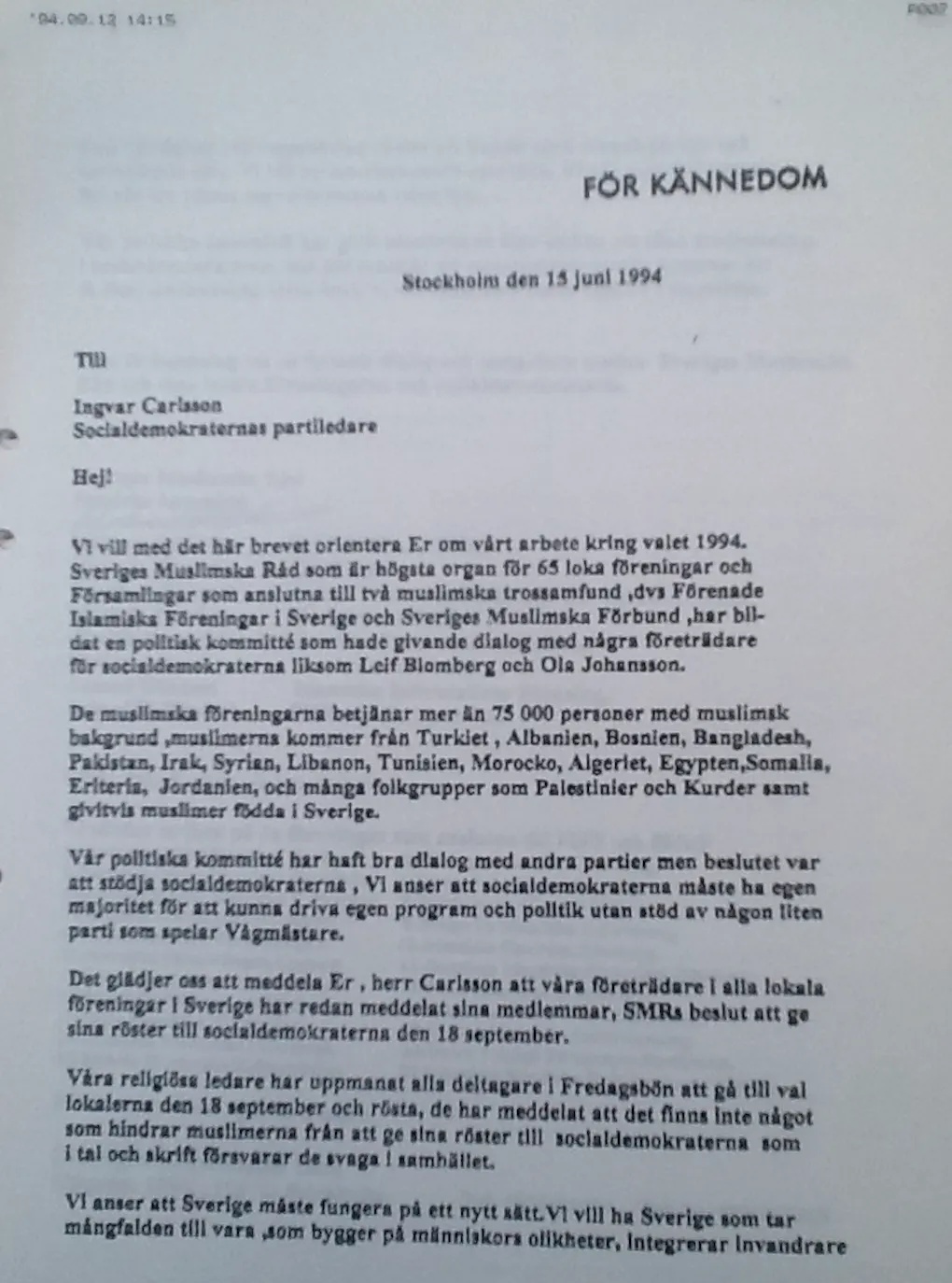
After the election, political expectations were also conveyed to the Social Democrats. Egyptson emphasizes that the documents show what the SMR representatives themselves claimed about their influence on the election result – not how many votes their mobilization actually generated.
S-contact about mosque already in 1994
The same year, according to the material, there was a more concrete link to a mosque construction in Stockholm. On October 10, 1994, the Social Democratic councilor Monica Andersson wrote to Ola Johansson of the Brotherhood Movement after a previous contact from him.
“I share your view that it is urgent that the construction of the mosque gets underway as soon as possible,” Andersson wrote.
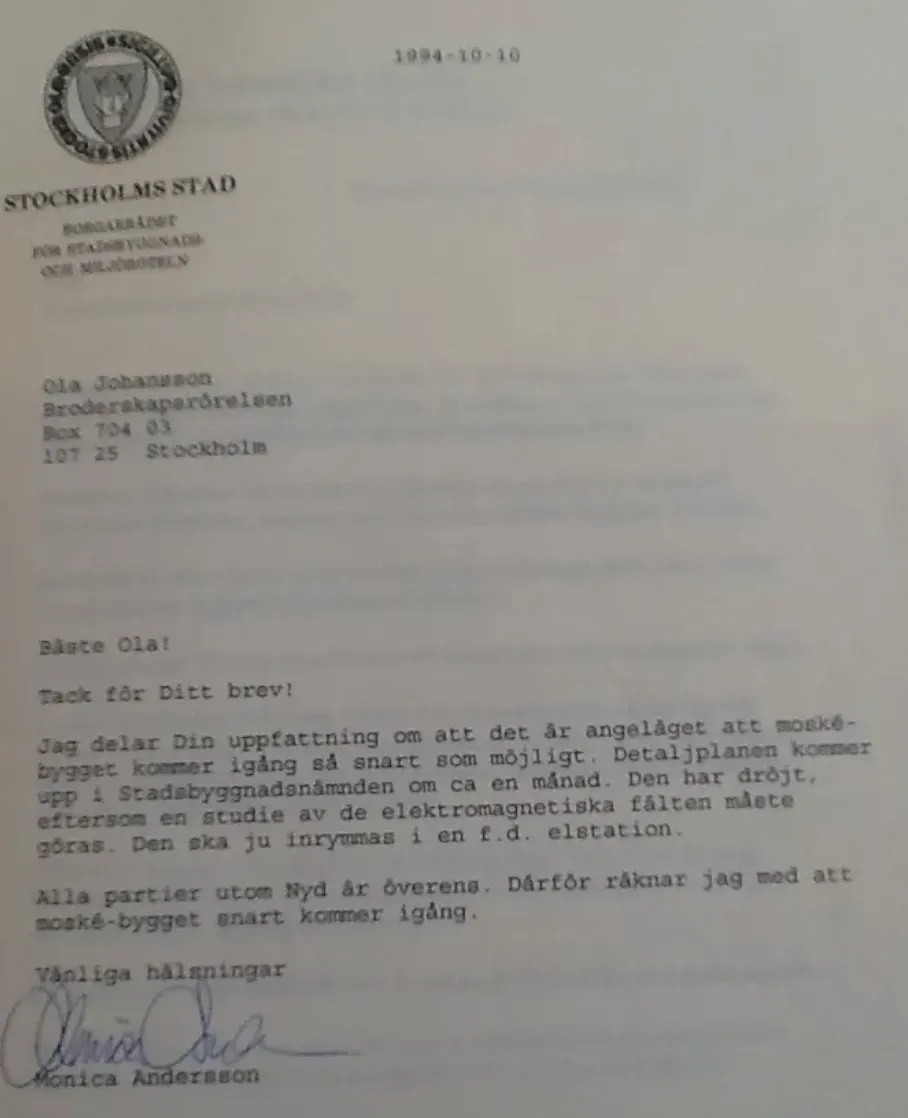
She also pointed out that all parties except New Democracy backed the detailed development plan and concluded by stating that she expected the mosque construction to begin soon. This contact took place five years before the cooperation between the Brotherhood Movement and the Swedish Muslim Council was formalized in 1999.
READ ALSO: Shocking numbers: 4200% increase in mosques in Sweden – in less than 25 years
Egyptson then points to several municipal decisions in Stockholm during the 2000s. At the same time, he highlights that a later decision to support a mosque does not in itself prove that the decision was made because of the 1999 agreement.
However, he believes the decisions can be used to study whether the political approach continued.
Land for mosques in Skärholmen, Rinkeby and Tensta
In Skärholmen, among others, Social Democratic politicians in 2006 took the initiative to enable a mosque. The following year, the Exploitation Office was tasked with searching for suitable land, and in 2009 land within Skärholmen 2:1 was allocated to the Skärholmen Islamic Cultural Association for “a mosque with associated assembly premises.”
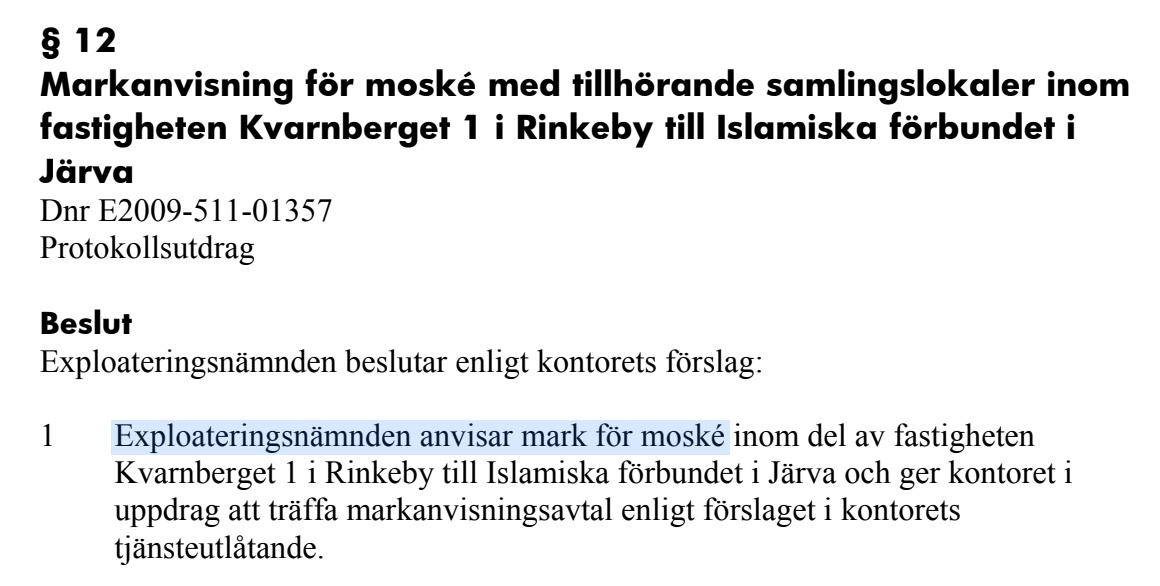
In 2010, a land allocation was processed for the Islamic Association in Järva for a mosque in Rinkeby. Social Democratic representatives presented their own proposal in which they explicitly wrote:
“We Social Democrats are positive about the plan to build a mosque in Rinkeby.”
The party reserved itself against the majority’s decision, but not because they opposed the mosque. On the contrary, the Social Democrats’ own proposal expressly supported the construction.
Two years later, in 2012, land in Tensta was allocated to the Stockholm Grand Mosque Foundation. Together with, among others, the Moderate Party, the People’s Party (Liberals), the Center Party, and the Green Party, the Social Democrats supported the decision. Egyptson, therefore, points out that this was not an exclusively Social Democratic project, but sees the decision as yet another example of the Social Democrats’ continued support for concrete mosque establishments.
Wanngård: “Of course we need to build more mosques”
Egyptson follows the timeline right up to November 2024. During a visit to Tensta, Stockholm’s finance commissioner Karin Wanngård (S) made statements about the need for mosques.
“We have countless churches but not nearly as many mosques,” she said.
“So of course we need to build more mosques as long as it is necessary for people to be able to practice their religion.”
Egyptson also emphasizes here that the statement does not prove that Wanngård had implemented any agreement from 1999. However, he considers it relevant to the issue of political continuity: when, if so, did the political orientation present during the earlier collaboration end?
Links mosques to Islamist institution building
In his doctoral dissertation Global Political Islam? The Muslim Brotherhood & The Islamic Association in Sweden, Egyptson discusses, among other things, the influential Islamic theologian Yusuf al-Qaradawi’s views on the establishment of Muslim minorities in the West.
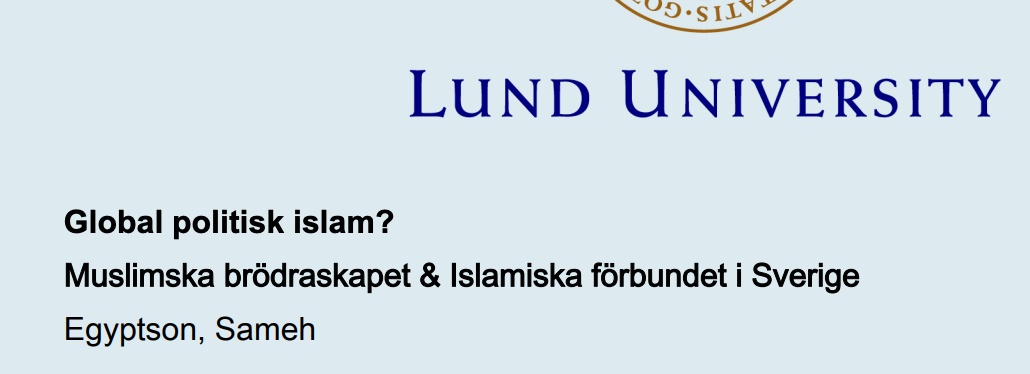
There, Egyptson describes a strategy that includes the construction of their own institutions, including mosques, schools, healthcare facilities, and cultural centers. He emphasizes, however, that this does not mean that every mosque is part of an Islamist strategy or that Swedish Social Democratic politicians have pursued the other institutions discussed in the dissertation.
READ ALSO: Jomshof’s book on Islam tops the sales charts
His point is rather that mosques, within the ideological strategy he has studied, can form part of a broader institutional infrastructure, and that political participation and cooperation with established actors can be used to facilitate the establishment of such institutions.
Wants answers from the Social Democrats
Egyptson summarizes his documentation as a timeline from Muslim organization representatives’ political demands and contacts with the Social Democrats in 1994, via the Brotherhood Movement’s mosque contacts the same year and the formalized relationship in 1999, to land allocations in the 2000s and Wanngård’s statement in 2024.
READ ALSO: Social Democrat visited Tensta: “Of course we need to build more mosques”
He is also clear about what the material does not show according to him. The documents do not prove that every Social Democratic decision about mosques after 1999 was a result of the agreement with the Swedish Muslim Council. Further documentation would be needed to establish such a direct causal link.
However, Egyptson believes the material shows a documentable continuity in the actual issue. He therefore wants the Social Democrats to answer when the agreement with the Swedish Muslim Council formally ended, what commitments ceased at that time, and whether the party regards today’s support for mosque establishments as entirely independent from the relationships and policies developed during the 1990s.
“I publish the documents so that the reader can review them for themselves, follow the timeline, and judge what they show,” Egyptson writes.
READ ALSO: After the election came the application – the Social Democrats now accused of secret mosque deal