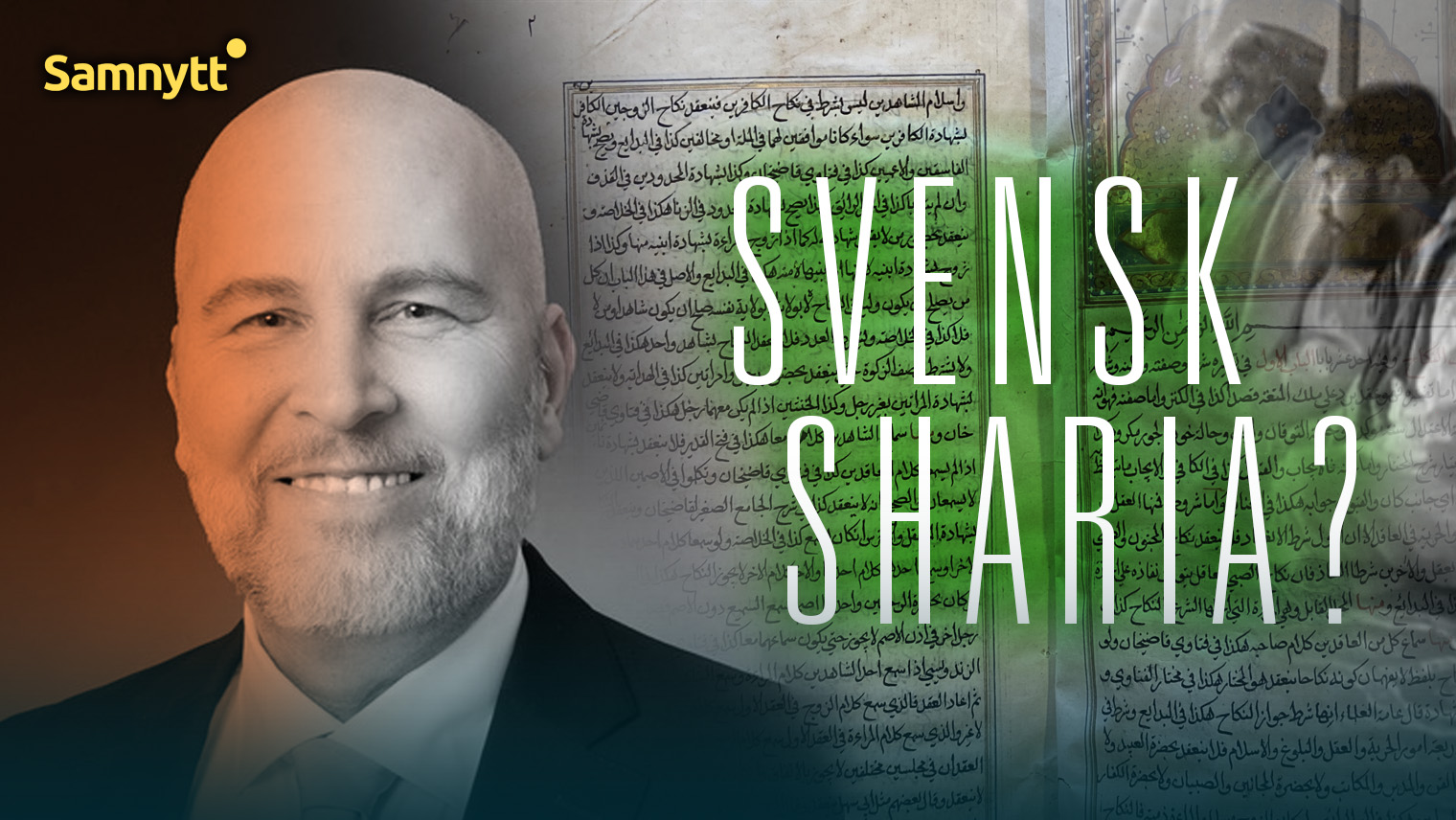
A Swedish lawyer is offering civil law decisions based on sharia – even financial settlements after divorces may be included. At the same time, the initiative aims to make agreements with Muslim congregations and mosques. Lawyer Nima Rostami and MP Alexander Christiansson (SD) warn of a broader development, where Islamic normative systems and parallel structures gradually gain a foothold in Sweden.
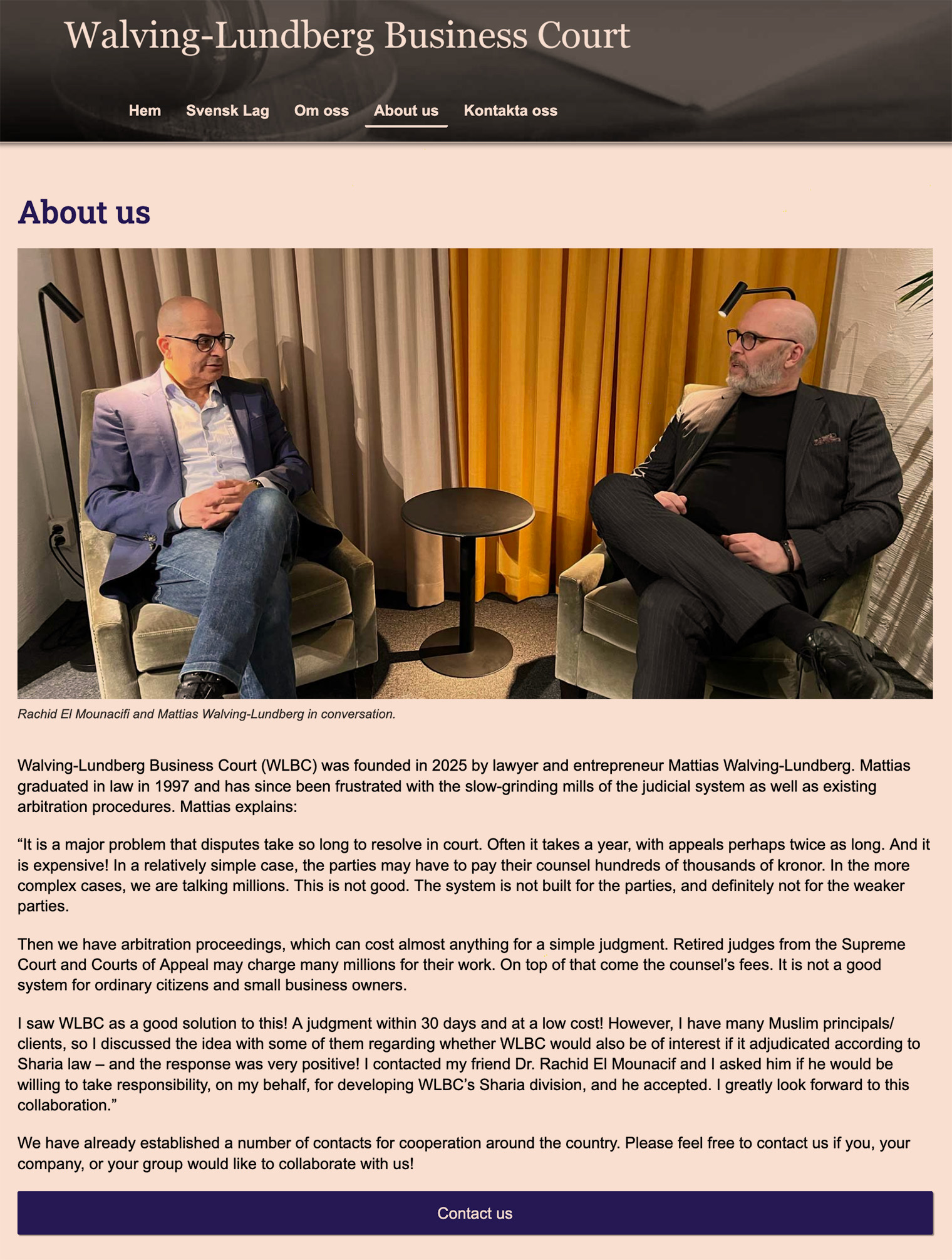
An operation openly marketed as “Sweden’s first sharia court” has been established in Sweden. Behind the initiative is lawyer Mattias Walving-Lundberg, who, through Walving-Lundberg Business Court, offers arbitration procedures where the parties may agree that the dispute be decided under Islamic sharia as the applicable law.
And the ambitions go beyond individual clients.
– We are trying to arrange agreements with larger Muslim congregations, mosques, and catchment areas, Walving-Lundberg tells Samnytt.
“Legalized Islamofascism in Sweden”
Mattias Walving-Lundberg is not unfamiliar with drawing attention. In 2023, the lawyer ran for the position of Green Party spokesperson after Per Bolund – while simultaneously advocating the introduction of the death penalty in Sweden.
– Not only can I imagine it, I think we should have the death penalty, Walving-Lundberg said at the time to Expressen.
READ ALSO: Storm over court decision: Sharia dispute approved in Vienna
He justified his stance with the development of serious crime in Sweden and argued that some crimes are so grave that the perpetrators don’t deserve to live.
The statement provoked internal criticism within the Green Party. Walving-Lundberg later highlighted the Expressen article himself and described his candidacy as the first spokesperson bid in about a hundred years to endorse the death penalty. He also sees no principal problem with multiple legal systems in Sweden.
– I have no problem with there being different legal systems in Sweden. As long as the highest legal order is Swedish, he tells Samnytt.
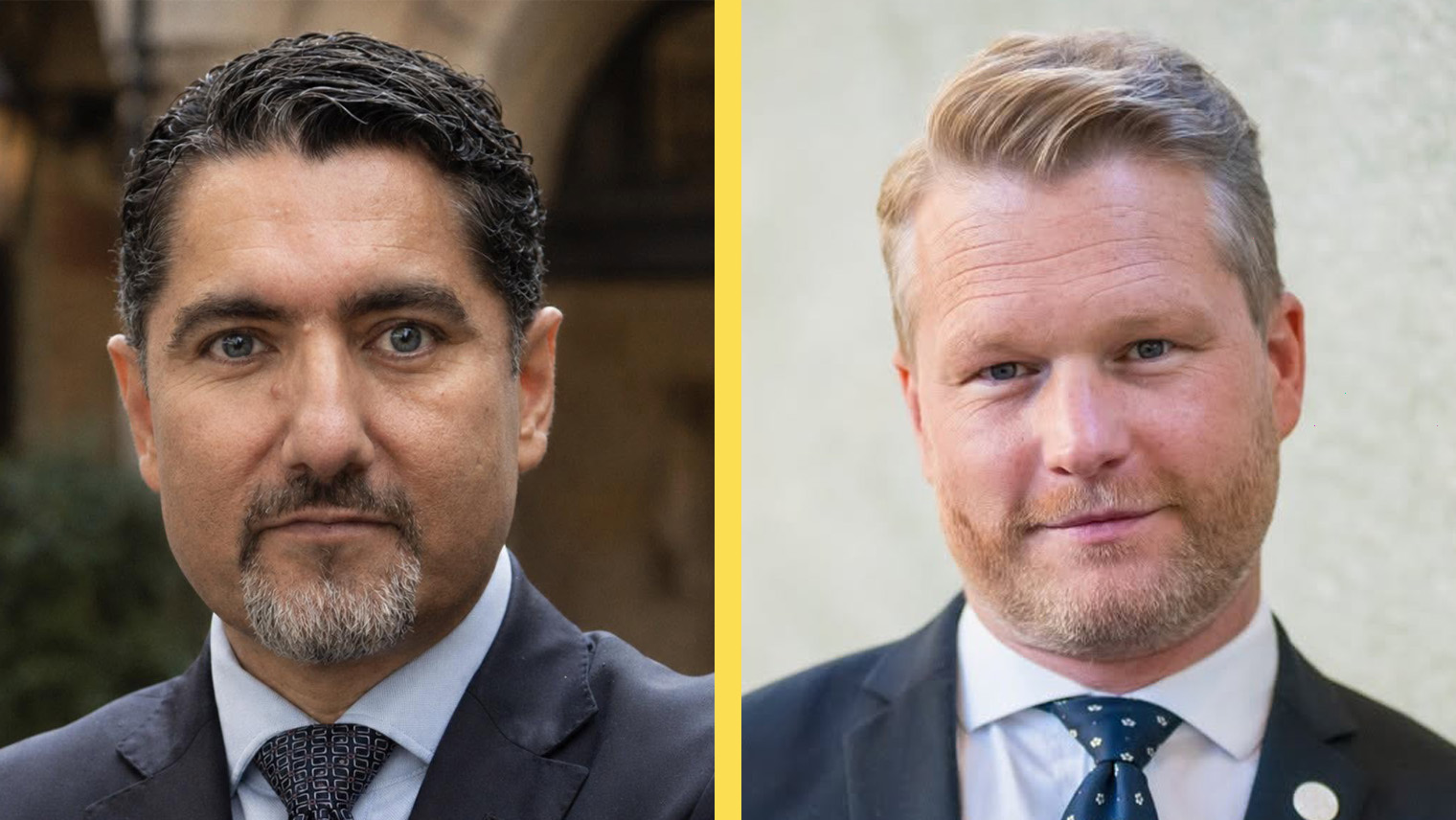
Nima Rostami is a lawyer and commentator with an Iranian background, based in Stockholm, where, since 2014, he has run Nima Rostami Law Firm. He works with, among other things, migration law, family law, and criminal cases, and has special experience with cases connected to Iran and Afghanistan.
He speaks Swedish, English, and Persian and has also been involved in legal matters concerning the Persian-speaking diaspora. Rostami is an outspoken critic of Iran’s Islamic regime and political Islam, and has repeatedly engaged in public debate on Islamism, Iranian regime influence, and Swedish legal and migration issues.
READ ALSO: The British government’s job ad: Administrator for sharia court
He reacts sharply. He warns that the construction may provide a clear path for Islamic norm systems to enter Swedish civil disputes and points especially to the risk for Muslim women living under family or honor pressure.
– The losers in this process are primarily women. Who are both under pressure and economically weak.
Rostami has since sharpened his criticism even further. On Facebook, he links the sharia court directly to the Islamisation of Sweden: “Now the Green Party member has established Sweden’s first sharia court, i.e., legalized Islamofascism in Sweden.”, he writes.
READ ALSO: Police officer Maria Rosander warns against Islamisation: “Society is eaten up from within”
Calls the operation “sharia court”
Walving-Lundberg Business Court has two divisions. One works with Swedish law, the other can apply sharia. Walving-Lundberg is clear that this is not a court in the sense the word is normally used in the Swedish legal system.
– It is not a court in the usual sense, but an arbitration institute.
But you yourself call it Sweden’s first sharia court?
– I said court to attract attention.
READ ALSO: SD’s EU group releases report on no-go zones and Islamisation
According to Walving-Lundberg, the operation only deals with civil law. It cannot convict anyone of crimes or impose Islamic punishments. But in civil law, sharia can have concrete significance.
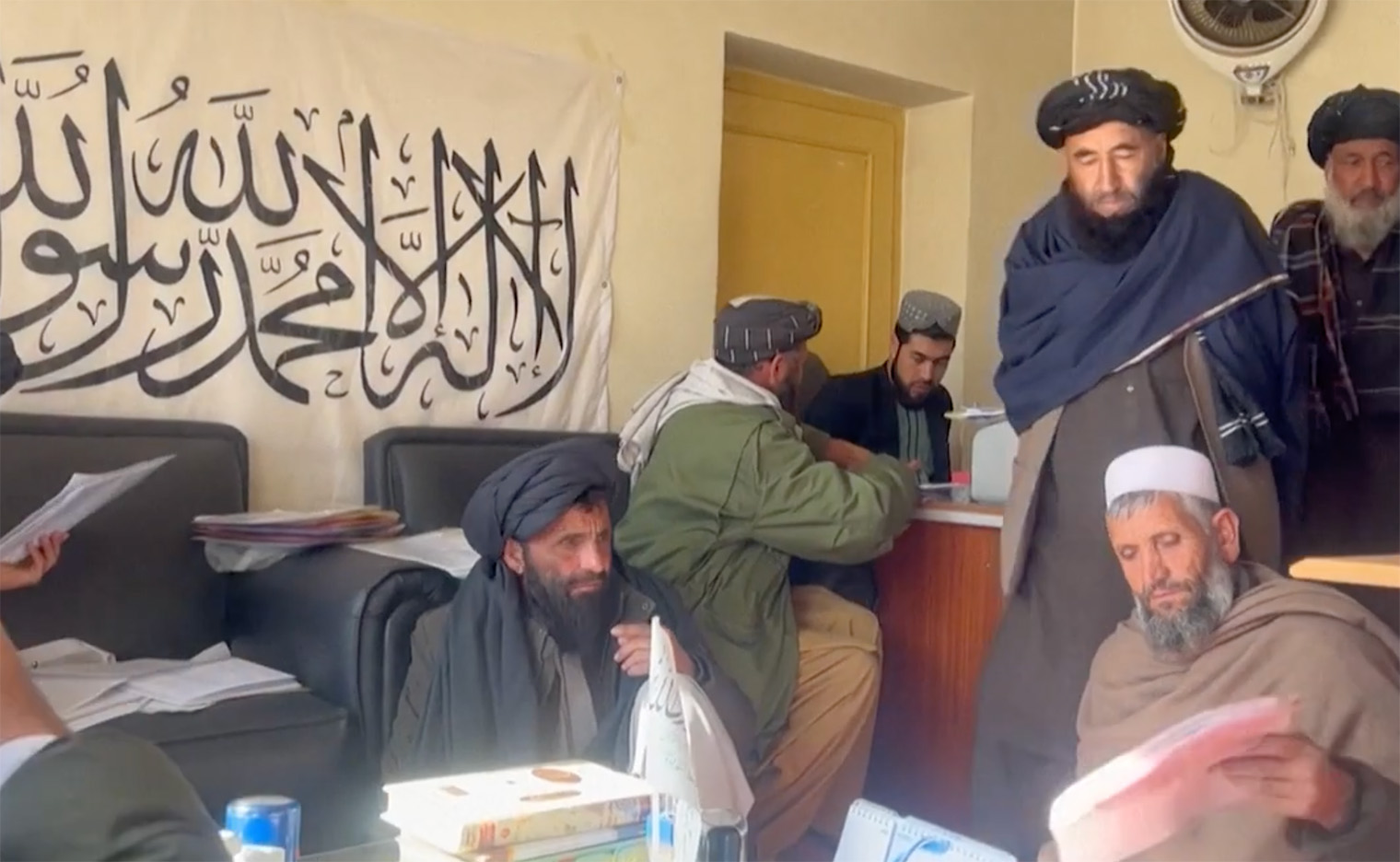
The prerequisite, according to him, is that the parties have agreed both to arbitration and on which law is to apply.
– It is Swedish law, which is very liberal, that allows this to be done with any law whatsoever.
Sharia can govern finances after a divorce
It is when the sharia court deals with family and economics that the fundamental questions become sharpest. Islamic law contains, in several areas, different rules for men and women.
READ ALSO: Police: The Islamisation of Sweden has gone on for 30 years
This raises the question of what happens when such a normative system is used to resolve financial conflicts between people living in Sweden. Walving-Lundberg confirms that the divorce itself cannot be decided by his court.
– A divorce cannot be decided by such a court.
But that does not mean sharia stays outside the divorce. On the contrary, according to Walving-Lundberg, the economic consequences may be decided on the basis of Islamic law.
– However, the financial settlement. That can be determined according to sharia law.
READ ALSO: Social Democrats singled out in report on European Islamisation
This means that a woman and a man can have their financial dispute tried from within a religious legal system where gender may affect what rights they have. When Samnytt points out that the sharia court thus may have far-reaching consequences, Walving-Lundberg confirms this.
– That’s correct.
He also points out that the arbitration procedure ultimately must stay within the bounds set by Swedish law, including via ordre public.
Ordre public is a legal principle meaning that foreign or contractually chosen laws must not be applied if the result clearly contradicts basic principles of Swedish law.
So ordre public sets an upper limit. At the same time, the fundamental question remains, whether a religious legal system that differentiates between the status of men and women should be used for financial disputes in Sweden.
For Rostami, this is one of the most serious aspects of the sharia court. He warns of situations where a Muslim woman formally agrees to a sharia-based procedure, but the decision is made under pressure from family, relatives, or religious norms.
– Then the pressure can be very intense from her own family. For example, her father and brothers, and so on.
Problems can arise in anything. But it’s up to the parties. It doesn’t matter what law you use. People feel social pressure in all sorts of circumstances.
Mattias Walving-Lundberg, lawyer, Walwing-Lundberg Business Court
That is why, according to Rostami, the argument of voluntariness is not enough as an answer.
– The ones losing in this procedure are women. Who are both under pressure and economically weak.
Downplays the risk of religious pressure
Samnytt poses the same issue directly to Walving-Lundberg.
What happens to the principle of voluntariness if a woman is pressured by her family, relatives, mosque, or imam to accept a sharia-based dispute resolution?
– Problems can crop up in anything. But it’s up to the parties. It doesn’t matter what law is used. He continues:
– People feel social pressure in all sorts of things.
READ ALSO: Jomshof (SD) warns of Swedish naivety towards Islam
As a comparison, he points out that people can also feel social pressure to marry and live according to Swedish or Christian norms.
Rostami considers that comparison insufficient. His objection concerns situations where formal voluntariness exists on paper, while a person is in an environment where the family’s or religious group’s demands may be very difficult to resist.
Seeking agreements with mosques
WLBC’s ambition is also for the operation to grow. Walving-Lundberg explains that it’s not primarily about chasing individual customers.
– We are trying to arrange agreements with larger Muslim congregations, mosques, and catchment areas.
This is a matter that gives the issue another dimension, compared to if the operation only involved a handful of business disputes. Walving-Lundberg, however, sees expansion as something positive. His argument is that Muslim disputes are already informally managed by religious authorities, and that his operation could take power from them.
– Who are we taking power from if we start judging according to sharia? Well, from the extreme Muslims, the imams.
Walving-Lundberg claims he is Christian himself and believes this makes him neutral in relation to Muslim groups.
– Then the imams can no longer rule, instead a Christian will judge, because I am Christian.
He also points to clan structures and tensions between Sunni and Shia Muslims.
– I don’t belong to any clan since I’m Christian. So therefore, my court can be trusted.
Rostami: “It’s just about money”
Rostami sees the development from the opposite viewpoint. For him, the establishment of an openly marketed sharia court is an example of how religious parallel structures can be established within the formal framework of Swedish society. He is especially critical that Swedish lawyers are participating in this development.
READ ALSO: Shocking numbers: 4200% increase in mosques in Sweden – in less than 25 years
When Samnytt asks why a Swedish lawyer would want to get involved in this field, he answers bluntly:
– It’s just about money. And repeats:
– There’s nothing else. It’s just about money.
Should we accept the existence of parallel legal systems at all? It must be that a nation has one legal system.
Nima Rostami, lawyer
Walving-Lundberg for his part highlights cost as one of his operation’s advantages. He dismisses the notion that an ordinary court process would necessarily be a cheaper alternative.
– I have never experienced proceedings costing only 20,000 in ordinary court. Even a light civil case now ends up at 100,000 – 150,000. So this is extremely cheap.
Accepting multiple legal systems in Sweden
Ultimately, the fundamental question remains. Should people living in Sweden be under the same legal order – or is it acceptable that different groups in practice resolve their conflicts according to different legal systems? Rostami is clear in his standpoint:
– Should we accept parallel legal systems at all? It must be that a nation has one legal system.
READ ALSO: “We already live as dhimmis” – Mona Walter on Islamism’s silent war against Sweden
For Rostami, it is about much more than a single arbitration institute. He sees its establishment against the background of a broader Islamisation of Sweden, where, according to him, Muslim parallel structures step by step gain greater influence alongside the institutions of secular society.
An explicitly sharia court therefore becomes especially symbolically charged – from mosques and religious norms to an operation where disputes can actually be decided with sharia as the legal reference point.
Rostami argues that the development shows how Swedish freedoms and legal possibilities can be used to establish structures that Swedish society left behind long ago.
Walving-Lundberg’s response is equally clear.
– I have no problem with there being different legal systems in Sweden. As long as the highest legal order is Swedish.
He compares it with the opportunity for companies to agree on, for example, American law in international business agreements. When Samnytt objects that sharia is not merely a foreign country’s civil law but a religious normative system, Walving-Lundberg responds that Swedish law too has religious historical roots.
– We should not pretend that Swedish law is religiously neutral. It is obviously Christian.
READ ALSO: Suspicion: Turkish Islamists are raising funds for major mosque in Stockholm
He then takes the reasoning even further, referring to the Roman Empire and Julius Caesar.
– He had no problem with different regions being governed by different laws. As long as everyone contributed with taxes and men to war. That’s my personal view. So, I don’t see a problem.
SD senior: “A step toward a parallel system”
Sweden Democrats’ MP Alexander Christiansson also sees the sharia court as part of a much larger trend. He has previously warned of the Islamisation of Sweden.
Christiansson, born 1981, has been a Member of Parliament since 2018 representing Västra Götaland County, Western constituency. He is a member of the Committee on Culture and has previously served on the labor market and business committees. Christiansson is also the Sweden Democrats’ spokesperson on cultural policy.
You have warned that Sweden is being Islamised and referred to activities where sharia is weighed against Swedish law. What have you discovered specifically?
– This development we are seeing here has already happened in the UK. What provokes me is those who claim that our warnings of Sweden’s Islamisation are a myth. That means you are either extremely unintelligent or blind.
READ ALSO: Islam expert: “Sharia laws should spread across the world”
The MP is also careful to note the legal distinction: Walving-Lundberg Business Court is not a Swedish court and has no public authority. The problem, according to him, is instead that the Swedish system permits arbitration using sharia at all.
– It points more to a trend and a development, I think. And other parties must take this development seriously, too.
For Christiansson, the issue is ultimately about one of the Swedish legal society’s core principles – that the same rights and obligations apply regardless of religion or worldview.
– We cannot allow people to be judged differently in a liberal democracy based on what worldview or religion or ideology they belong to. It should be the same for everyone.
The left and extreme feminists are complicit in introducing these patriarchal structures without realizing it. Or they realize but ignore it. It is yet another example of the paradoxes in leftist thinking. It’s emotionally driven and lacks logic. It is an incredibly naive view of what these powerful forces that Islam represents are about; it’s an ideology many are ready to die for.
Alexander Christiansson, Sweden Democrats’ spokesperson on cultural policy
He goes even further, arguing that this development must be understood against the background of what he describes as Islamists’ and Muslims’ agenda to gradually advance their positions in Sweden.
The Sweden Democrat claims that the ultimate goal is for Islamic norms and law to also influence the majority society. “This group has an agenda to take over,” he says, warning that Swedish politicians do not understand – or do not dare to take seriously – where this trend can lead.
He therefore describes it as a democracy issue rather than simply a discussion about Islam or religious freedom.
– If you want such a system in Sweden, you shouldn’t be in Sweden. Then you should go to another country where sharia law is offered. Here in Sweden, we do not do that.
Until now?
– But we should not do it. Then leave Sweden, you shouldn’t be here.
READ ALSO: British government’s job ad: Administrator for sharia court
Christiansson also suspects that the attention surrounding the sharia court is part of Walving-Lundberg’s business strategy. He describes the launch as a “huge PR trick” and believes the ultimate aim is commercial – to create attention and attract clients to the operation.
Therefore, he also sees a risk in the review itself: “He can’t get better PR than this,” Christiansson says, noting that critics can thus help Walving-Lundberg market the operation they wish to stop.
“Far too timid politicians”
The Sweden Democrats’ spokesperson on cultural policy also believes that Sweden has been poorly equipped for situations where freedoms and rights created to protect the individual are used by movements with completely different values. Freedom of religion is one example.
– Something that was good from the beginning, something rooted in our Christian values, has become something that foreign powers and direct threats against us begin to exploit in various ways. And then we must be alert and quick on our feet to change the law.
READ ALSO: Logical that Sweden’s first sharia verdict would be handed down in Malmö
According to Christiansson, there is political fear to deal with these conflicts.
– Unfortunately, we have far too timid politicians in this country who don’t dare to take these questions seriously. Even if they see them. Because I notice sometimes when talking with other politicians that they understand, but they don’t dare.
If women risk being the big losers when sharia is applied – how do you explain that left-liberal Swedish women are among those who most clearly defend or accept increased Islamic influence in Sweden?
– The left and extreme feminists are complicit in introducing these patriarchal structures, without realizing it. Or they realize but ignore it. It is yet another example of the paradoxes in leftist reasoning. It is emotionally driven and lacks logic. The Sweden Democrat continues:
– It is an incredibly naive view of what these powerful forces that Islam represents are about; it is an ideology many are prepared to die for.
Many say what binds these groups together is hatred for the Western world, is there something to that?
– Yes, I have spent quite a lot of time trying to understand these trends and how two actual extremes form a kind of unholy alliance. I believe we live in a post-Marxist society that has shaped many. He continues:
– What these forces really hate are the norms and values that made our society strong. Greta Thunberg is a good example of this.
READ ALSO: Feminism finally found its ally in Islamism
When Samnytt asks what specific legal changes the Sweden Democrats want to implement to prevent sharia-based legal procedures, Christiansson declines to pre-empt the party’s legal policymakers. He says the issue needs to be investigated, but that the starting point must be equality before the law.
On the principle question of whether an operation calling itself a Swedish sharia court should even be allowed, he is much clearer.
– Absolutely not. Of course, we shouldn’t have that. And all sensible politicians should agree.
At the end, Christiansson hears Walving-Lundberg’s arguments about Julius Caesar and the Roman Empire.
Walving-Lundberg has defended the idea of Swedish sharia courts by noting that different regions of the Roman Empire could live under different laws, how do you view that comparison?
The SD politician laughs at first.
– That’s silly. Sweden is a state. We are equal before the law regardless of where in the country you live, where you come from. If you are on Swedish soil, it should be the same legislation for all. He finishes:
– He can occupy himself with the Roman Empire as much as he wants.
READ ALSO: The societal shift nobody voted for – the concrete tracks of Islamisation in Sweden