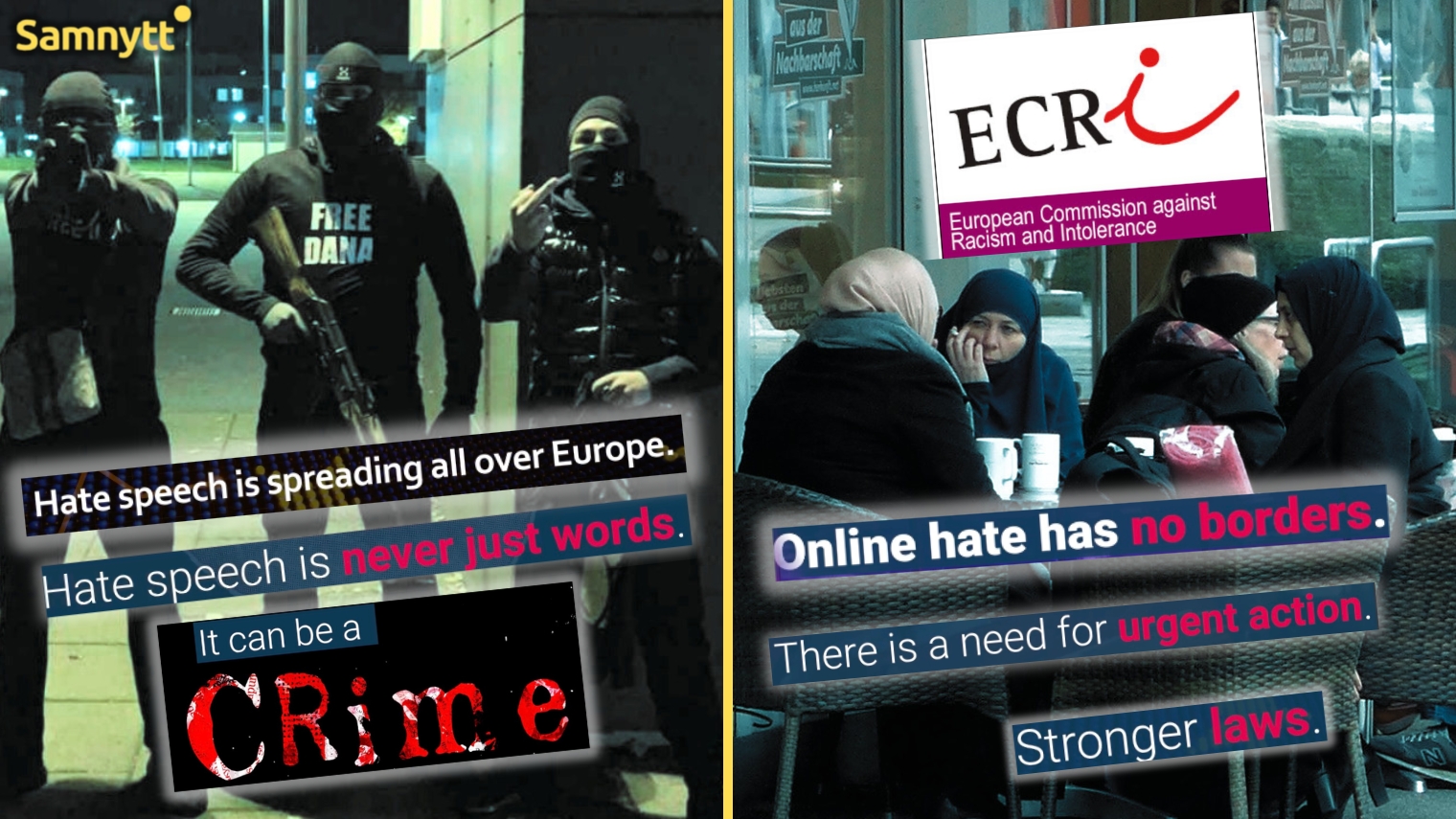
The Council of Europe’s anti-racism body ECRI describes the level of racist hate manifestations in Europe as “alarming” and believes that xenophobic rhetoric has become more common, particularly as countries draft stricter migration policies. The report also sets political statements about migrants in a context of hate speech, disinformation, and negative stereotypes. At the same time, ECRI’s conclusions are largely based on the organization’s own categorization of what constitutes racism, xenophobia, and “hate speech”—making the boundary between legitimate criticism of migration policy and unlawful or hateful agitation a central issue.
The Council of Europe’s European Commission against Racism and Intolerance, ECRI, has published its Annual Report for 2025. The report was released on May 28, 2026, and devotes its main theme of the year to what the organization describes as growing problems with “hate speech” in Europe.
ECRI is an independent monitoring body within the Council of Europe, tasked with scrutinizing racism, intolerance, and discrimination. The mandate includes, among other things, race, skin color, language, religion, citizenship, as well as national and ethnic origin.
The organization writes that it has recently observed “alarming levels” of racist and LGBTQ-related hate expressions and what it describes as an increasing trivialization or normalization of such expressions in several European countries, especially online. According to ECRI, its conclusions are mainly based on the organization’s country reviews, and the situation varies in different parts of Europe.
Ethnic and National Origin Most Common Grounds
In the part of the report most corresponding to the Swedish discussion on incitement against ethnic groups, ECRI states that ethnic or national origin are among the most common grounds for recorded hate expressions. This is followed by religion and citizenship, as well as sexual orientation and gender identity.
According to the report, antisemitic and anti-Muslim expressions still remain at significantly higher levels than before Hamas’s attack on Israel on October 7, 2023, and the subsequent war in Gaza. Roma people are also frequently targeted, for example through portrayals of the group as a threat to security or public health. LGBTQ issues, and in particular rhetoric about transgender people, are also covered but constitute only a part of the report’s broader overview.
At the same time, it is important to distinguish between ECRI’s broader concept of “hate speech” and the Swedish criminal provision on agitation against ethnic groups. Not everything ECRI counts as hate speech is necessarily punishable under Swedish law. On the contrary, ECRI advocates a regulatory framework that does not consist solely of criminal law but also includes civil and administrative provisions.
The organization believes that deficiencies in such rules in several member states have allowed hate expressions to remain widespread and to a large extent unpunished. ECRI calls for clear definitions, sanctions, and legal remedies.

Links Xenophobia to Stricter Migration Policies
A politically sensitive section of the report concerns immigration. ECRI explicitly writes that “xenophobic discourse” has become more common and that this has sometimes occurred alongside the implementation of stricter migration policies. In some cases, the organization also links such rhetoric to anti-Black racism.
READ ALSO: Record Number of Immigrants in Europe
However, the wording does not mean that ECRI in the report claims that opposition to high immigration or demands for stricter migration policy in itself is racism or hate speech. This distinction is essential. The report’s criticism concerns what ECRI classifies as xenophobic or hateful rhetoric occurring in connection to migration policies.
At the same time, the categorization itself becomes significant when immigration has become one of Europe’s major political conflict issues. ECRI does not provide a thorough analysis in this part of where the line should be drawn between tough, legitimate political criticism of migration levels and consequences, and statements that the organization classifies as xenophobic.

Political Sphere Highlighted
ECRI devotes a special section to the political sphere. Here, foreign citizens, particularly migrants, as well as Roma and Muslims, are said to be especially exposed to hate speech during, for example, election campaigns.
The organization believes that politicians use what ECRI refers to as hateful, inflammatory, or divisive narratives, sometimes based on incorrect information or negative stereotypes. According to the report, this risks normalizing hateful statements and increasing societal divisions. ECRI therefore calls on political parties to self-regulate against hate speech.
In another section, the organization writes that political disinformation campaigns in some countries have targeted, among others, migrants. Here, misuse of statistics as well as generalization or decontextualization of individual news events are mentioned as methods.
READ ALSO: How Many Millions Migrated to Europe
ECRI does not single out any specific parties or politicians in the annual report’s review of political rhetoric. Nor does it specify which countries are meant when the organization writes that hate speech against migrants in “some countries” has been part of political disinformation campaigns.
This makes it difficult, based on the annual report, to assess where ECRI in practice draws the line between tough migration policy argumentation and what the organization classifies as xenophobia or hate speech.
The report can thus be read as an attempt to influence not only legislation against direct agitation but also the norms for political debate. At the same time, this means that ECRI’s definitions and boundaries become highly significant: a migration-critical stance is not automatically a xenophobic stance, even though xenophobic statements may occur within a migration policy debate.
Wants More Regulation – Also Beyond Criminal Law
ECRI wants member states to develop more comprehensive legislation against hate speech and explicitly emphasizes that measures should go beyond criminal law. The organization also advocates national strategies and action plans, cooperation with civil society, and special efforts for groups considered particularly vulnerable.
The internet is another prioritized area. ECRI wants to see better reporting systems and closer cooperation between authorities, tech companies, and civil society organizations. The report also highlights AI-based tools for detecting, reporting, and moderating hate content, provided they are combined with human oversight and other protective mechanisms. At the same time, ECRI itself notes that regulation must be balanced against freedom of expression.
Ultimately, ECRI warns that racist and other hate expressions can precede or contribute to hate-motivated violence. Fighting them is therefore described as a prerequisite for functioning democratic societies.
EU Strategy Particularly Highlights Certain Groups
The ECRI report coincides with the European Commission’s new anti-racism strategy for 2026–2030, adopted in January. The Commission states that the strategy is to combat racism “in all its forms” and strengthen both anti-discrimination legislation and efforts against hate crime and hate speech.
At the same time, the Commission presentation particularly highlights anti-Black racism, antiziganism against Roma, antisemitism, anti-Asian racism, and anti-Muslim hate. The strategy also includes continued support for civil society organizations and initiatives against discrimination in, among other areas, education, work, healthcare, and housing.
Europe’s National Majority Populations Not Included
No corresponding explicit category for racism, ethnic hatred, or discrimination directed at Europe’s national majority populations is highlighted in the Commission’s list of the strategy’s prioritized forms of racism.
Despite the existence of a general legal protection in principle, Europe’s historical national majority populations are not mentioned as a particularly vulnerable category in the same way as the groups explicitly listed by the Commission.
The new annual report indicates the direction ECRI wants to see going forward—more extensive rules against hate speech, greater responsibility for politicians and internet platforms, and continued efforts against what the organization describes as a normalization of racism and xenophobia. In this discussion, ECRI also places parts of Europe’s increasingly heated migration policy debate.
READ ALSO: No Protection for Europeans in the EU’s New Anti-Racism Strategy