
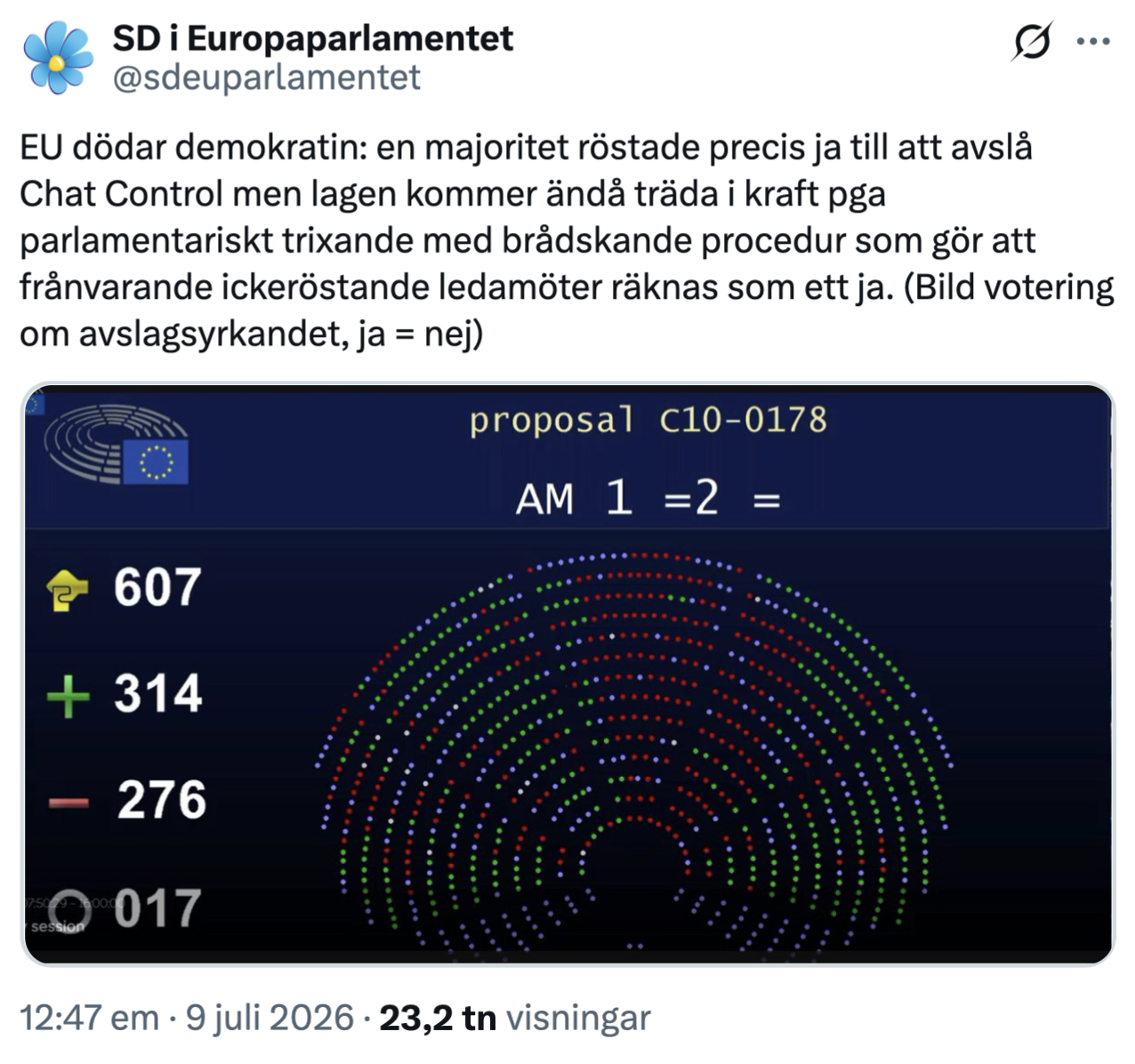
The EU Parliament has decided to extend the controversial rules that allow online platforms and messaging services to scan private communications for previously identified material related to child sexual abuse. Critics argue that these rules risk being used as a pretext for broader surveillance of citizens’ private communications. A majority of the members who voted wanted to stop the extension, but because an absolute majority of the entire Parliament was required, the proposal still went forward.
This concerns the temporary legislation commonly known as “Chat Control 1.0,” which was introduced in 2021 and gives digital platforms the opportunity to voluntarily scan communications for already identified material relating to child sexual abuse.
The reason is that the vote was subject to a requirement for an absolute majority in Parliament, meaning that a proposal must be supported by at least half of all members – not just the most votes among those participating in the vote.
In the vote, 314 members voted to reject the Council of Ministers’ proposal, while 276 voted against and 17 abstained.
READ ALSO: Despite Two No Votes – the EU Parliament Will Be Forced to Vote on ChatControl Again
Despite the fact that the no side therefore received the most votes, it was not enough to stop the proposal. In the second reading of the legislative process, 360 votes were required to amend or completely reject the Council’s position.
The Parliament therefore proceeded with an amended version of the proposal.
An important change pushed through by Parliament is that fully encrypted communication is exempt from the rules. This means that services with end-to-end encryption, such as Signal and WhatsApp, are not subject to the current scanning.
READ MORE: EU’s Mass Surveillance Chat Control Criticized by Experts
Another amendment aimed to limit scanning to cases where there is a concrete suspicion against a specific person, instead of allowing broader voluntary monitoring of communications.
This proposal also received more support than opposition among members, but fell as it did not reach the required absolute majority.
Critics Warn of Surveillance
The decision is meeting strong criticism from privacy advocates, who argue that the rules open the door to a form of general surveillance of private communications.
Patrick Breyer, former MEP for the Pirate Party, has long criticized Chat Control, saying it is wrong to search people’s messages without individual suspicion or a court order.
He has argued that the fight against child sexual abuse needs effective tools, but that general scanning risks harming personal privacy without delivering sufficient results.
READ MORE: IT Security Expert on Chat Control: “Our Politicians Have Been Completely Fooled”
Proponents of the rules, meanwhile, emphasize that the aim is to combat the spread of child abuse material and that tech companies need the ability to detect such content.
The decision comes after an unusual political process. The European Parliament had previously voted against extending the temporary rules, but the issue was later returned to Parliament for a new vote after the Council of Ministers sent it back.
Critics have questioned the process, arguing that it limited democratic scrutiny and made it possible to reintroduce a proposal that had previously been stopped.
“That Chat Control goes forward against the will of a majority of the voting members is a farce and damages democracy,” Breyer told Brussels Signal.
If the EU member states in the Council of Ministers do not accept Parliament’s amendments, a so-called conciliation procedure will follow. In that case, Parliament and the Council must try to reach a common agreement.
How the Swedish Parties Voted
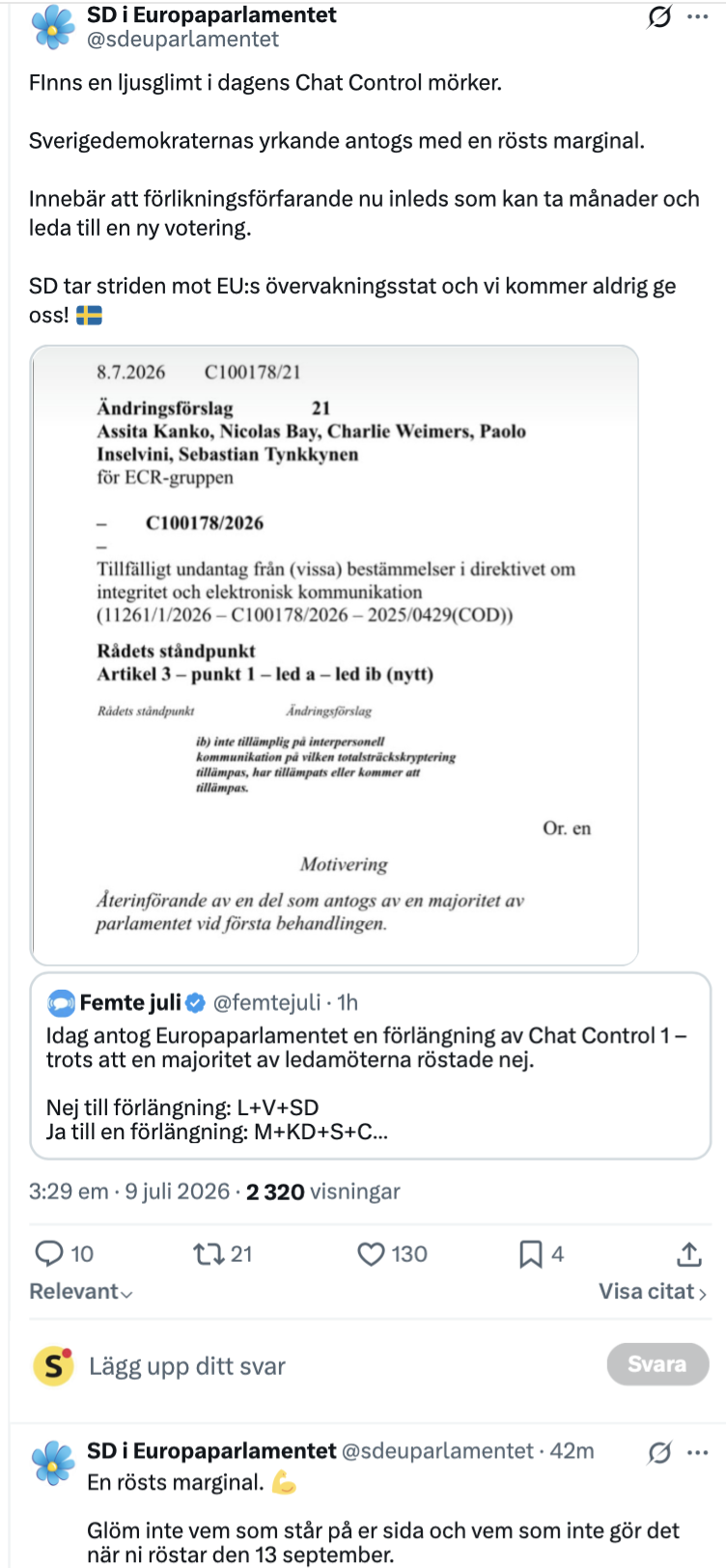
Among the Swedish parties in the EU Parliament, the Moderate Party, Christian Democrats, Social Democrats, and Centre Party voted in favor of continued scanning.
The Sweden Democrats, Liberals, and Left Party voted against an extension. The Green Party abstained from voting.
At the same time, a motion from the Sweden Democrats was adopted by only one vote. The party believes this could lead to a conciliation procedure and another vote on the issue.
In a post on X, the Sweden Democrats remind voters to remember how the parties voted in the EU Parliament when they go to vote in the national parliament election on September 13.
“The Sweden Democrats are fighting against the EU surveillance state, and we will never give up!” writes the party’s EU division, led by Charlie Weimers.
The Bigger Chat Control Issue Remains
The current vote concerns the temporary solution. At the same time, negotiations continue on the more comprehensive, permanent legislation, often referred to as “Chat Control 2.0.”
This process could have greater consequences for how digital communication is monitored within the EU and remains subject to political negotiations.