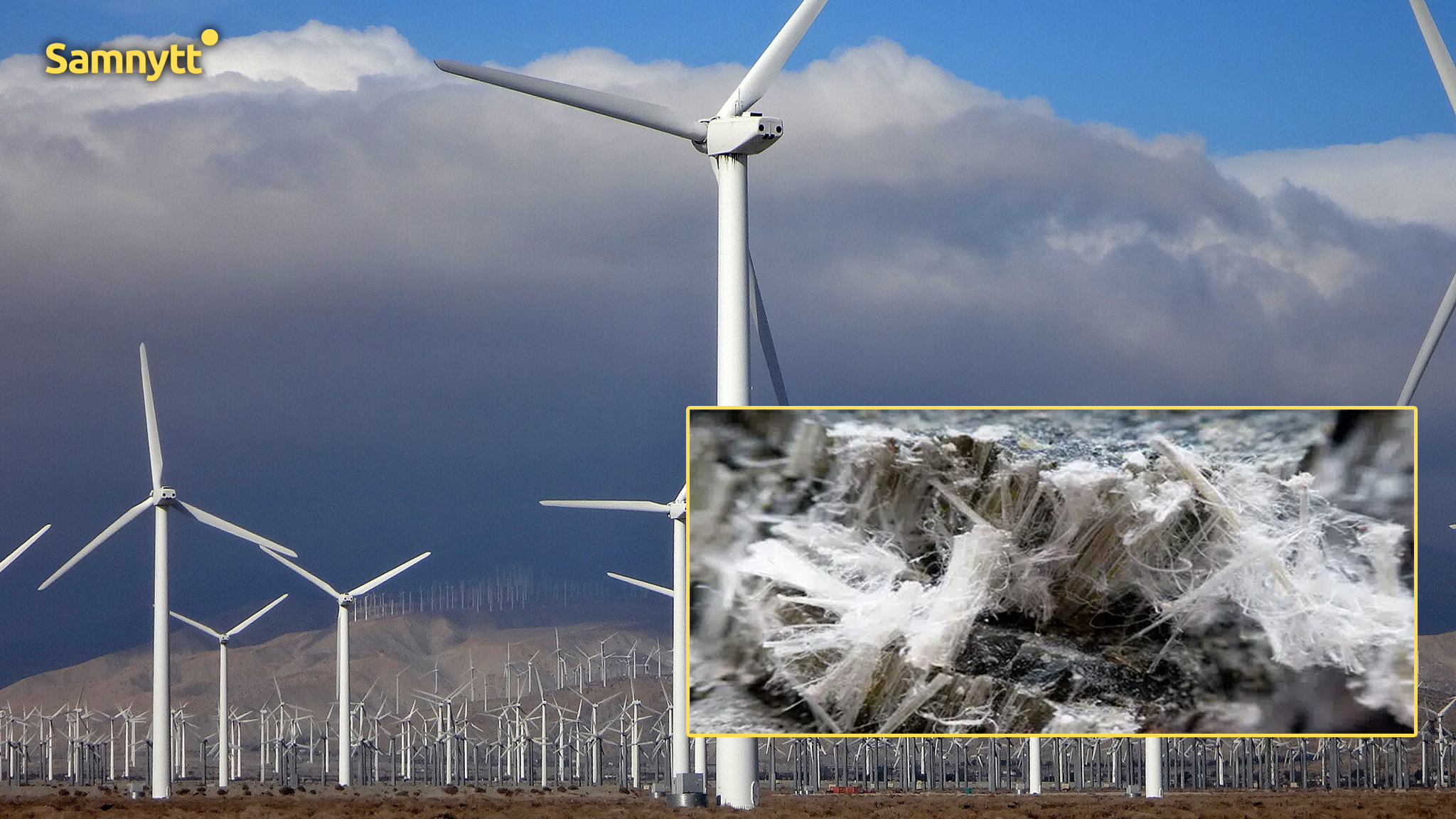
Asbestos has been discovered in components at a wind power facility operated by Sweden’s Vattenfall in Scotland. However, the company maintains that the hazardous substance poses no risk.
The asbestos was reportedly found in components of the emergency braking system for service lifts inside the turbine towers. This concerns the South Kyle Wind Farm in Scotland, a facility with 50 turbines developed by Vattenfall. According to Vattenfall’s own project website, the wind farm was inaugurated in June 2023, has an installed capacity of 240 MW, and is said to cover the electricity consumption of around 190,000 households per year.
Affärsvärlden reports that this is the same type of issue that has previously received attention at Swedish wind power facilities.
The company states that the components in question are “completely encapsulated,” and that therefore there is no risk either for workers during normal operation or for the public. At the same time, Vattenfall has launched a program to safely remove and replace the affected parts. The work will be carried out by specialized contractors and in accordance with current regulations.
“The safety of our employees, partners, and the public is our highest priority,” a company spokesperson told British media, according to Affärsvärlden.
Previous Swedish cases
The discovery in Scotland comes after several cases of asbestos in wind turbines have already been highlighted in Sweden. This spring, Affärsvärlden reported that the Swedish Chemicals Agency had launched an investigation into asbestos in brake pads used in Swedish wind farms. An inspector from the agency emphasized at the time that there is an “absolute ban” on asbestos.
Wind Power News has also reported that Swedish wind power facilities have been found to contain asbestos, referring to documents from the Swedish Work Environment Authority that Affärsvärlden has reviewed.
Asbestos has been banned for use in Sweden since 1982, but it is still present in older buildings and materials. The Swedish Work Environment Authority describes the substance as a serious health risk and warns that exposure can have severe consequences.
The fact that the material is now appearing in modern wind farms risks becoming problematic for an industry long marketed as central to the green transition. According to Vattenfall, the developers were not aware that the affected components contained asbestos, and the problem is said to originate with external subcontractors.
At the same time, the remediation efforts raise new questions about the monitoring of supply chains behind wind power expansion—and about how well the environmental and safety risks associated with this rapid growth have actually been examined.
Have you missed our three-part wind power investigation? See them below!