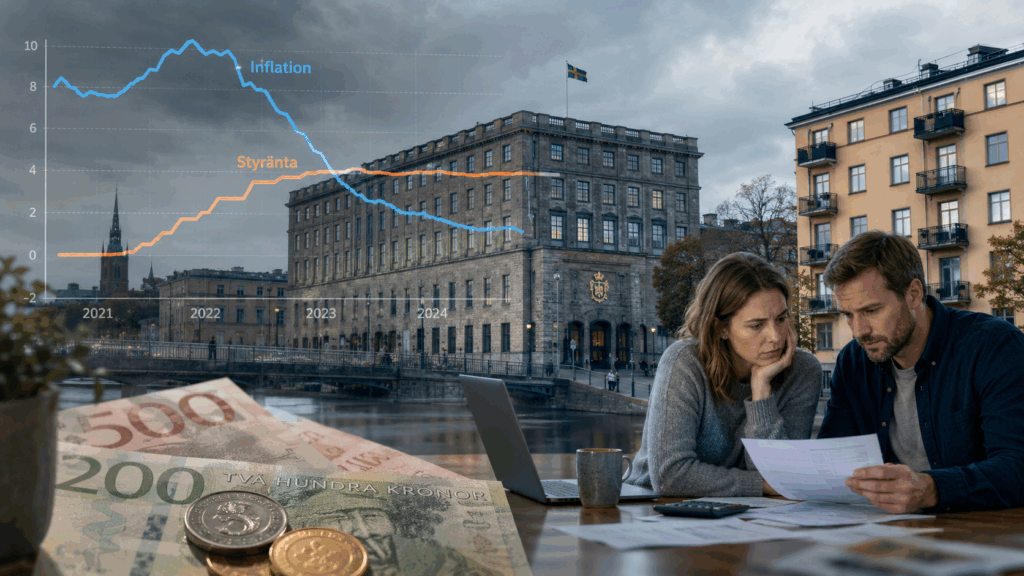
Inflation in Sweden continues to decline. New preliminary figures from Statistics Sweden (SCB) show that the rate of inflation according to CPI fell to 0.7 percent in June. But despite lower inflation and falling food and transport costs, mortgage borrowers do not appear likely to benefit from a new interest rate cut from the Riksbank.
Swedish inflation slowed in June. According to SCB’s preliminary flash CPI, the inflation rate according to CPI was 0.7 percent in June 2026, down from 0.8 percent in May. The change from May to June was 0.4 percent, and the official publication of the June figures will take place on July 15.
The KPIF, the measure of inflation primarily followed by the Riksbank, also fell. KPIF inflation landed at 1.3 percent year-on-year in June, compared with 1.5 percent in May. This means that inflation once again sits clearly below the Riksbank’s target of 2 percent, which is measured with KPIF according to the Riksbank.
SEE ALSO: REPORTAGE: Michael banned from the banking system – “Slow state abuse”
According to SCB price statistician Mikael Nordin, lower food prices and transport costs helped dampen inflation in June. For ordinary households, these are two of the most noticeable items in the daily economy: groceries and the costs of commuting to work, school, and leisure activities.
Below the Target – But No Interest Rate Relief
In another situation, inflation below the target might have increased the pressure on the Riksbank to cut interest rates. But not all economists draw that conclusion. Alexandra Stråberg, chief economist at Länsförsäkringar, told Dagens industri that while it is positive that inflation has remained below target despite the Iran war and rising oil prices this spring, the scope for a new rate cut has now disappeared.
“Earlier, we saw potential for the Riksbank to cut rates to support an uneven recovery in the economy. That door is now closed,” Stråberg told DI, according to Omni Ekonomi.
The Riksbank left the policy rate unchanged at 1.75 percent at its latest policy announcement on June 17. In its press release, the Riksbank noted that inflation in Sweden is low and that the economic outlook is somewhat weaker than normal. At the same time, it warned that supply shocks linked to the conflict in the Middle East have pushed inflationary pressures up and that the risk of too-high inflation has increased.
READ ALSO: Ekeroth: “The Banking System Must Be Fundamentally Reformed”
The executive board therefore concluded that it was “well balanced” to leave the policy rate unchanged at 1.75 percent but at the same time raised its forecast for the policy rate somewhat. The Riksbank also wrote that the probability of a rate hike later this year has increased compared to the assessment in March, according to the same press release.
For households with large mortgages, this means lower inflation does not automatically translate into lower interest costs. The Riksbank’s latest statistics show that the policy rate remains at 1.75 percent and that level applies from June 24, 2026.
Banks Nevertheless Squeeze Mortgage Rates
At the same time, there is another development that offers some hope for mortgage customers. Despite the Riksbank signaling a more cautious stance, several banks have cut their mortgage rates. Average rates fell further in June, while three-year mortgage rates in some places edged down towards 3 percent.
Lendo’s savings economist Sharon Lavie describes this as a “hidden price war” for mortgage customers. According to her, almost all players reduced rates by roughly the same amount during the month, which she interprets as banks now competing harder for new mortgage clients, reports Omni Ekonomi.
This means that households’ actual interest rates can be affected by more than just the Riksbank’s policy rate. For those with a mortgage, it may therefore become even more important to negotiate with the bank or compare offers, even if the Riksbank does not cut rates. The major relief that many mortgage borrowers had hoped for – a new rate cut from the Riksbank – now appears to be delayed.
Overall, today’s inflation figures show a Swedish economy where price increases have clearly slowed. Food and transport costs are pushing down inflation, KPIF is below the Riksbank’s target, and household purchasing power is receiving some support from the slower pace of price increases.
But for mortgage borrowers the news is less cheerful: the Riksbank is still concerned about new inflation risks, and economists no longer believe the recent fall in inflation is enough to open the way for a new interest rate cut.
READ ALSO: Ekeroth: “The Anti-Money Laundering Law Has Become a Weapon Against the People”