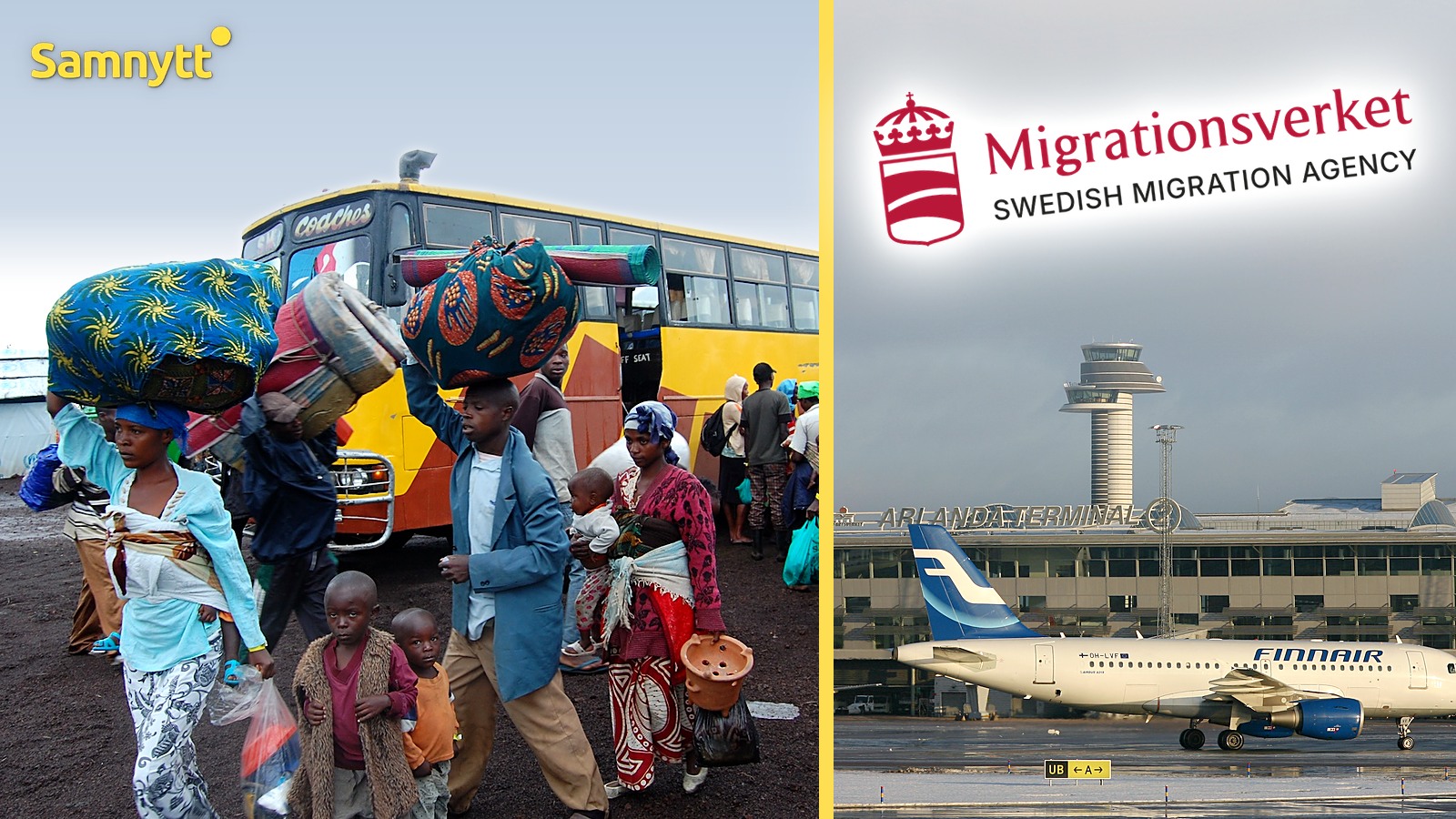
While Sweden is governed by a caretaker government and no one yet knows who will become Sweden’s new prime minister, the Migration Agency is raising the number of quota refugees to be brought here this year. The authority now estimates that between 450 and 500 quota refugees can be transferred before the turn of the year, compared to about 350 in the assessment made at the beginning of October.
The increase is due to the Migration Agency’s decision to also select refugees in Rwanda, where the UN refugee agency UNHCR operates a transit camp for people evacuated from Libya.
The new estimate was presented by the Migration Agency on Tuesday. According to the authority, the conditions for both this year’s selection and the reception in Sweden have become clearer, and for this reason they now expect to be able to transfer more people than previously thought.
“The assessment is now that between 450 and 500 quota refugees can be received before the turn of the year. We have updated the assessment after deciding to select refugees in Rwanda who are covered by UNHCR’s so-called Emergency Transfer Mechanism,” says Johan Norman, Head of Department at the Migration Agency.
Quota refugees are selected by UNHCR from among people who are outside their home countries. Once the Migration Agency has granted a residence permit, they travel directly to the Swedish municipality designated to receive them.
Evacuated from Libya to Rwanda
What the Migration Agency calls the Emergency Transfer Mechanism is known by UNHCR as the Emergency Transit Mechanism. It is a transit center in Gashora in Bugesera District, south of Rwanda’s capital Kigali, which opened in 2019 through an agreement between the Rwandan government, the African Union, and UNHCR, with support from the EU.
Asylum seekers and refugees who have been stranded in Libya—many of them in detention—are flown there while they wait for a third country to receive them. Those evacuated are mainly Eritreans, Somalis, Sudanese, Ethiopians, and South Sudanese, but there are also people from, among other countries, Cameroon, Nigeria, Mali, and Chad, according to UNHCR.
Sweden is already one of the largest recipient countries. Of the just over 2,600 people from the camp who had been resettled up until this summer, 297 had come to Sweden. This is confirmed by Rwanda’s Ministry of Emergency Management.
Only Canada, France, and the United States had received more. The most recent group landed in Kigali in August and consisted mainly of Sudanese and Eritreans.
How many of the new places will go to refugees in Rwanda, and which nationalities they have, is not specified in the Migration Agency’s information.

Government response delayed by ten months
The reason the quota of 900 will not be filled this year is that the government’s announcement on direction came too late. The Migration Agency submitted its proposal in December last year, but the response from the Ministry of Justice did not arrive until early October. The authority has stated that it needed the decision by mid-September at the latest in order to complete the full quota.
While waiting, two out of four planned selection trips had to be canceled. The announcement means that the selection will primarily concern Congolese refugees in Uganda and Afghan women and girls in Turkey. About two-thirds are to be women and girls, and vulnerable groups such as LGBTI people will be prioritized.
Rwanda is not a new selection country for Sweden. Last year, the selection also took place in Uganda, Tanzania, and Rwanda and mainly concerned refugees from the Democratic Republic of the Congo, according to the government’s announcement in February 2025.
From 5,000 to 900 per year
Under the Social Democratic government, the quota was 5,000 places a year. After the 2022 election, the level was reduced to 900 as part of the Tidö Agreement between the governing parties and the Sweden Democrats, and this level has been in effect since 2023.
Since July, quota refugees are also granted temporary residence permits instead of permanent ones. Those granted refugee status receive a permit for three years, while those considered to be in need of alternative protection receive 13 months. About 90 percent of those assessed within the quota are allowed to stay.
READ ALSO: Here are the parties that do not want to decrease quota refugee immigration – but to increase it
The Green Party, the Left Party, and the Centre Party all want to return to 5,000 a year, with the Centre Party wanting it to happen gradually. The Left Party also wants next year’s quota increased by 550 places to compensate for what could not be achieved this year. The Social Democrats say they remain committed to 900, but have pointed out that everything is decided in government negotiations.
The government issue decides next year
Next year’s level will be determined by whoever takes power. According to TT, the Migration Agency hopes that a new government will allow the authority to receive the places not utilized this year by means of a supplement in next year’s regulatory letter.
Currently, Centre Party leader Elisabeth Thand Ringqvist, whose party wants to raise the quota, is exploring the possibilities for a centrist government on the Speaker’s behalf. She is due to report to the Speaker on October 26.
READ ALSO: Stegrud (SD) warns: The red-green parties want to stop expulsions – even with ties from 20 years ago