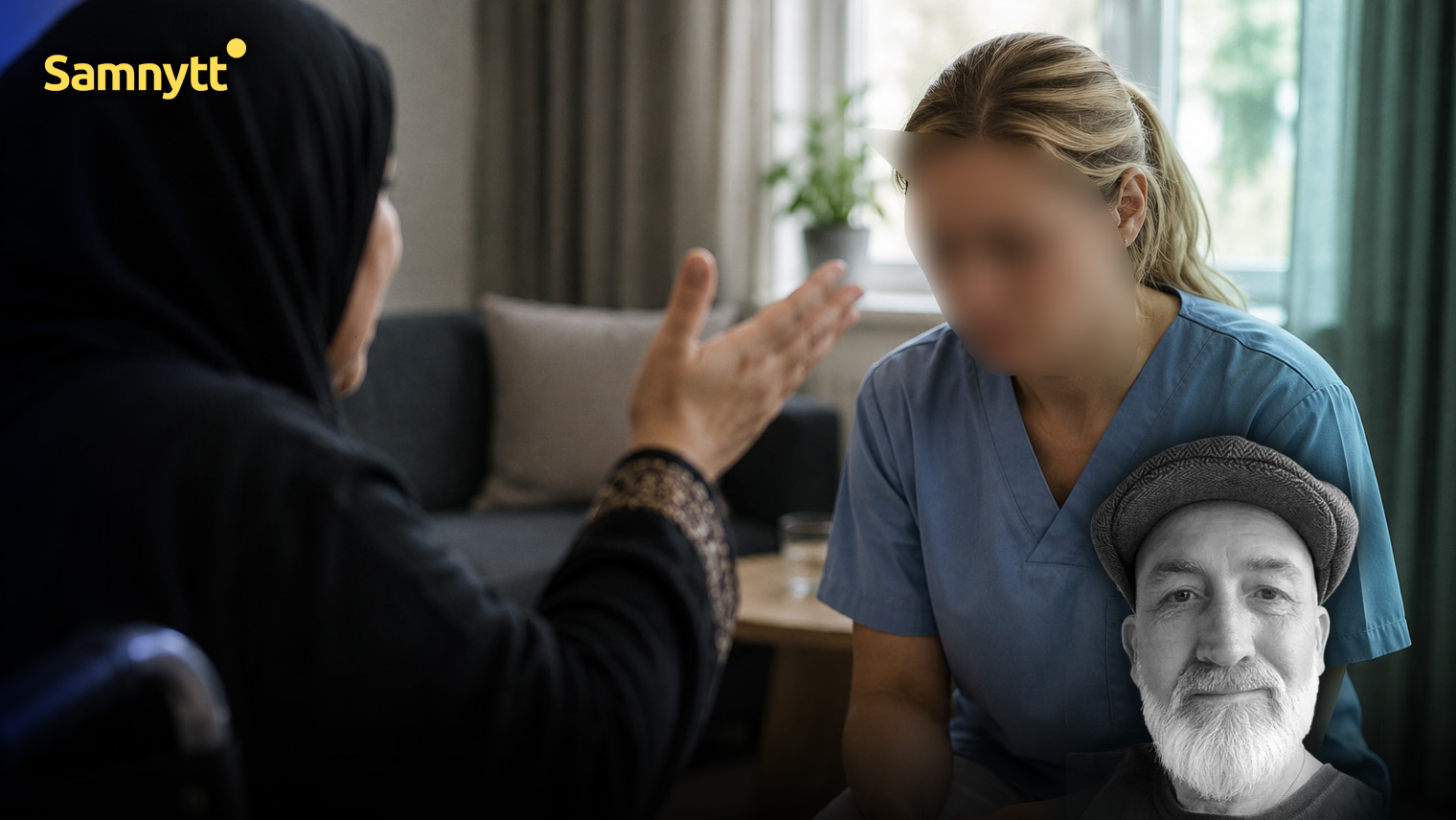
COLUMN • For several months, I have been investigating Swedish elderly care. I thought the biggest problems were rape, staff shortages, minute management, and language barriers. Then I met a nurse assistant who said she almost felt compelled to apologize for not speaking Arabic. That’s when I realized the problem is much deeper than that.
I got stuck on a single sentence. In my work, I have interviewed nurse assistants, doctors, pensioners, and relatives about Swedish elderly care. I have written about elderly people who have been assaulted, about rapes in nursing homes, about language barriers, staff shortages, and a kind of care that increasingly seems to be losing its human core.
I have met elderly Swedes who didn’t understand the staff, and staff who didn’t understand the elderly. Many of these stories have been both upsetting and hard to forget. But sometimes it’s not the big scandals or the most dramatic events that linger the longest. Sometimes it’s a single, seemingly insignificant sentence that refuses to leave you.
This time it came from a young Swedish woman working in home care.
“– You almost feel like saying – sorry I don’t speak Arabic.”
I have written about language barriers, labor immigration, and how the government wants to make exceptions from salary requirements to fill gaps in an already heavily pressured sector. Often it has been about elderly Swedes who didn’t understand the staff because the staff couldn’t speak Swedish. But this interview was about something else. Or perhaps rather something reversed—and likely the next step in the same development. It was about what happens when the shared cultural and linguistic foundation begins to disappear.
Jonas Andersson
It is actually a completely absurd sentence. She works in Sweden. She is Swedish and speaks Swedish. She is educated to help people through the Swedish elderly care system. Still, she is the one who ends her workday feeling she should apologize. Not because she did a bad job. Not because she was rude or careless. But because she doesn’t speak a language other than Swedish.
READ ALSO: Several New Deaths in Home Care
That sentence says more about today’s Sweden than hundreds of pages of government reports.
Yes, over the past months, I’ve produced several reports about elderly care. I’ve interviewed nurse assistants who told me that sometimes when they see the day’s schedule, they either start to laugh or cry, because they know from the outset it’s impossible to manage all the visits.
I’ve spoken to Dr. Nils Littorin, who described how elderly care over the past decades has shifted from human care to an operation where staff dash between about thirty scheduled interventions every day—and where older women risk being raped.
I have written about language barriers, labor immigration, and how the government wants to make exceptions from wage requirements to patch holes in an already badly stressed sector. Often, it has concerned elderly Swedes who didn’t understand the staff because the staff couldn’t speak Swedish.
READ ALSO: Lönn: The Terror-Immigrants of Homecare Shatter the Myth that Work Solves Integration
This interview, however, was about something else. Or perhaps rather about something reversed—and probably the next step in the same development. It was about what happens when the common cultural and linguistic base begins to vanish.
When the shared culture disappears
The young woman explains that many Swedish pensioners become noticeably happy when she comes to their home. Not because she is necessarily more skilled than her colleagues, but because everything just comes naturally.
They instantly understand each other. Conversations flow without misunderstandings. They share the same language, the same frames of reference, and the same obvious cultural experiences.
READ ALSO: Authorities Advertise in Arabic: “Important to Get Through”
She tells of an older woman who says she’s attending a “herring evening.” For the older woman, there is no need for an explanation. Herring is herring. Midsummer is midsummer. Christmas dinner is Christmas dinner. These are words and traditions that have been obvious an entire lifetime.
But a foreign colleague didn’t even know what herring was. The old woman had to begin explaining that it was about a type of fish.
It may sound trivial. I don’t think it is.

This isn’t really about herring. It’s about recognition. About being able to talk to the person who comes into your home without first having to explain your entire life.
How did we get to a place where Swedish elderly care is expected to function in Arabic, while Swedish staff are left bearing the consequences when communication breaks down? How did it become natural that the nurse assistant should feel guilty for not speaking Arabic, instead of asking why people who have lived in Sweden for many years still cannot make themselves understood in Swedish?
Jonas Andersson
The nurse assistant then describes a completely different home visit. There, she meets an older woman from the Middle East who barely speaks Swedish, and who demands that only Arabic-speaking staff visit her. When communication fails, the woman becomes frustrated and angry.
READ ALSO: Homecare’s Gang-Connected Eritrean Raped 82-Year-Old Woman in Her Home – Avoids Deportation
The nurse assistant tries to understand, asks questions, wants to make sure she’s helping in the right way. But instead she’s met with anger over not understanding. Several times, colleagues or relatives have had to be called to interpret what the woman actually meant.
The Swedish home care worker gets scolded and treated like dirt.
Should Swedish elderly care operate in Arabic?
On one occasion, the misunderstanding became so great that the woman said she had fallen. According to the nurse assistant, she hadn’t fallen at all—she had just landed awkwardly in her chair. Yet she felt that suspicion was quickly directed at her, because no one could really sort out what had actually happened.
Of course it is human to want to be understood when you are old, ill, and dependent on help. We all probably share that wish. But the bigger question is another.
How did we end up in a situation where Swedish elderly care is expected to function in Arabic, while it’s the Swedish staff who bear the consequences when communication fails?
How did it become natural that the nurse assistant feels guilty for not speaking Arabic, instead of us asking why people who have lived many years in Sweden still can’t make themselves understood in Swedish?
Swedish elderly care was once built for people who had lived their entire lives in Sweden. People who shared language, history, and culture. Today, the trend is increasingly going in the opposite direction. It is no longer self-evident that those who move here are expected to adapt to Swedish society. Instead, it is society that, step by step, is expected to adapt itself to people from all around the world.
Jonas Andersson
And why should we even pay for their care in Sweden? These are questions that are almost never raised.
The political debate always focuses on more hands in healthcare, more training places, more recruitment, and more labor immigration. Far less often do we discuss that care is built on something much greater than distributing medicines or helping someone get dressed.
A country that has flipped its perspective
Care is about understanding the nuances in a conversation, being able to make small talk while coffee is brewing, getting a joke, a holiday, or a tradition without everything having to be translated. It’s about the elderly person feeling that the person coming through the door truly understands her world.

When the shared foundation disappears, care itself is transformed.
Swedish elderly care was once built for people who had lived their entire lives in Sweden. People who shared language, history, and culture. Today, the direction seems increasingly to be the opposite.
It is no longer self-evident that those who move here are expected to adapt to Swedish society. Instead, society is step by step expected to adapt to people from all corners of the world.
READ ALSO: Sveriges Radio Launches Program in Arabic
And perhaps that’s why that particular sentence keeps echoing in my head.
“You almost feel like saying – sorry I don’t speak Arabic.”
No. I repeat: No! It’s not the nurse assistant who should feel guilty.
It’s a society that for a long time has flipped the perspective. And its responsible politicians.
Get 50% Off Today
123 083 33 50