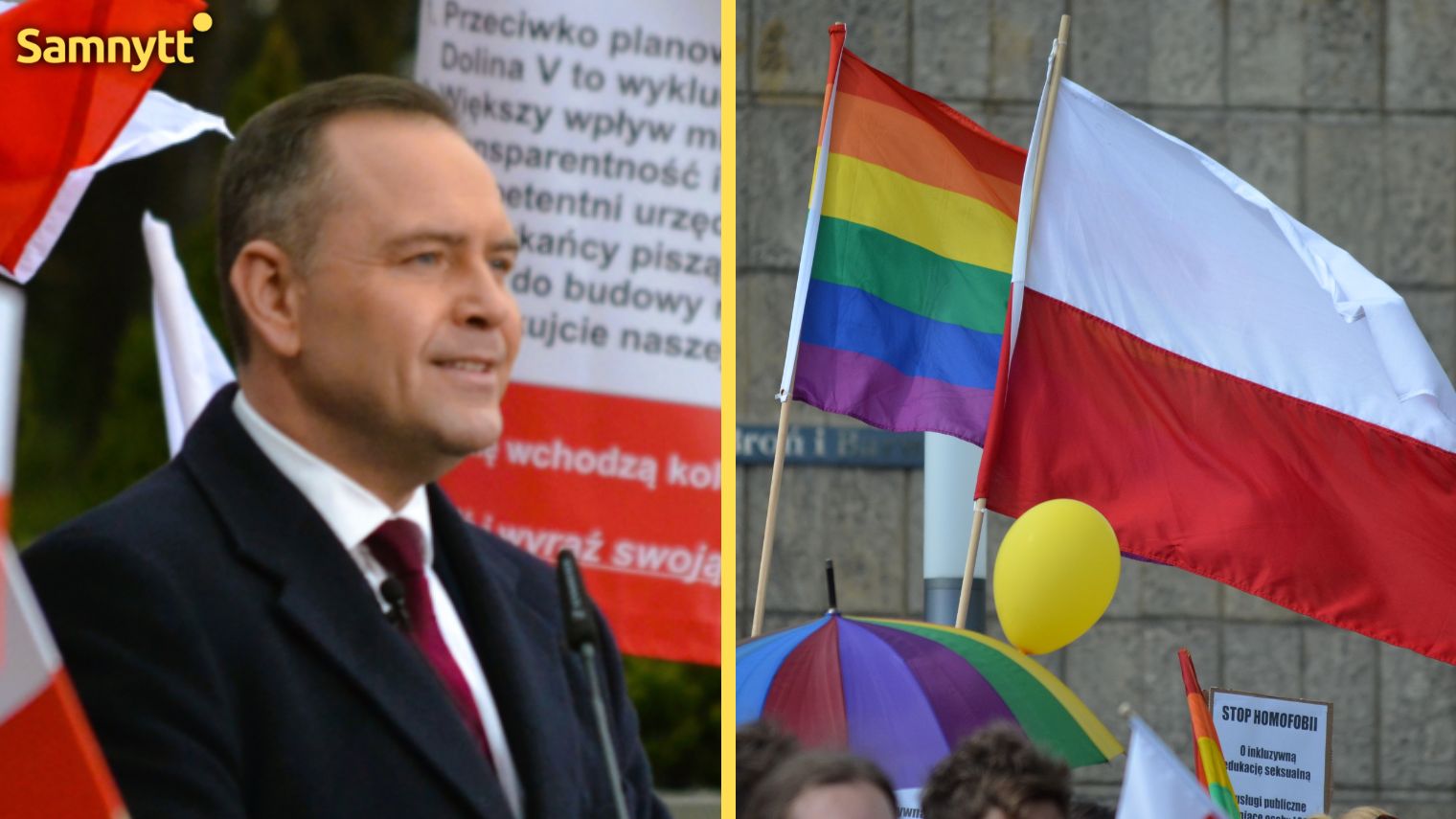
Polish President Karol Nawrocki has vetoed the government’s bill to introduce registered partnerships. The decision marks a new setback for Prime Minister Donald Tusk’s government, which had made the reform one of its key election promises but lacks the qualified majority needed to override the president’s veto.
The law would have granted unmarried couples—including same-sex couples—a range of legal rights, such as joint property ownership, access to medical information, and the right to make decisions in case of illness or death.
Nawrocki justified his decision by arguing that, in his view, the proposal risks undermining the Polish constitution’s protection of marriage as a union between a man and a woman. He has previously stated that he would not support solutions that result in “quasi-marriage.”
SEE ALSO: Poland’s new president refuses to accept EU’s migration pact
Donald Tusk reacted sharply to the announcement, describing the president’s veto as an expression of contempt for people’s right to a normal life. Since the president’s veto can only be overturned by a three-fifths majority in the lower house of parliament, the bill is now considered to have very slim chances of coming into force.
Karol Nawrocki, who is backed by the conservative opposition party Law and Justice (PiS), has positioned himself as a defender of traditional family values and the Polish constitution. His presidency is expected to mean continued conflicts with Tusk’s more EU-friendly government on issues such as social policy, the judiciary, and migration.
Tough Stance on Migration
Migration has meanwhile become one of the most hotly debated issues in Poland. Both the previous PiS government and several leading conservative politicians have argued for a highly restrictive immigration policy and have opposed the EU’s relocation mechanisms for asylum seekers.
In the political debate, representatives have repeatedly warned that Poland risks developing in the same direction as countries such as Sweden, Germany, France, and the United Kingdom if it accepts large groups of migrants from the Middle East and Africa.
Poland is also often highlighted as one of Europe’s safer countries. In recent years, the country has experienced significantly fewer Islamist terror attacks than several Western European countries that have received large migration flows since 2015.
SEE ALSO: From poor cousin to European powerhouse: Poland’s economic rise is transforming the continent