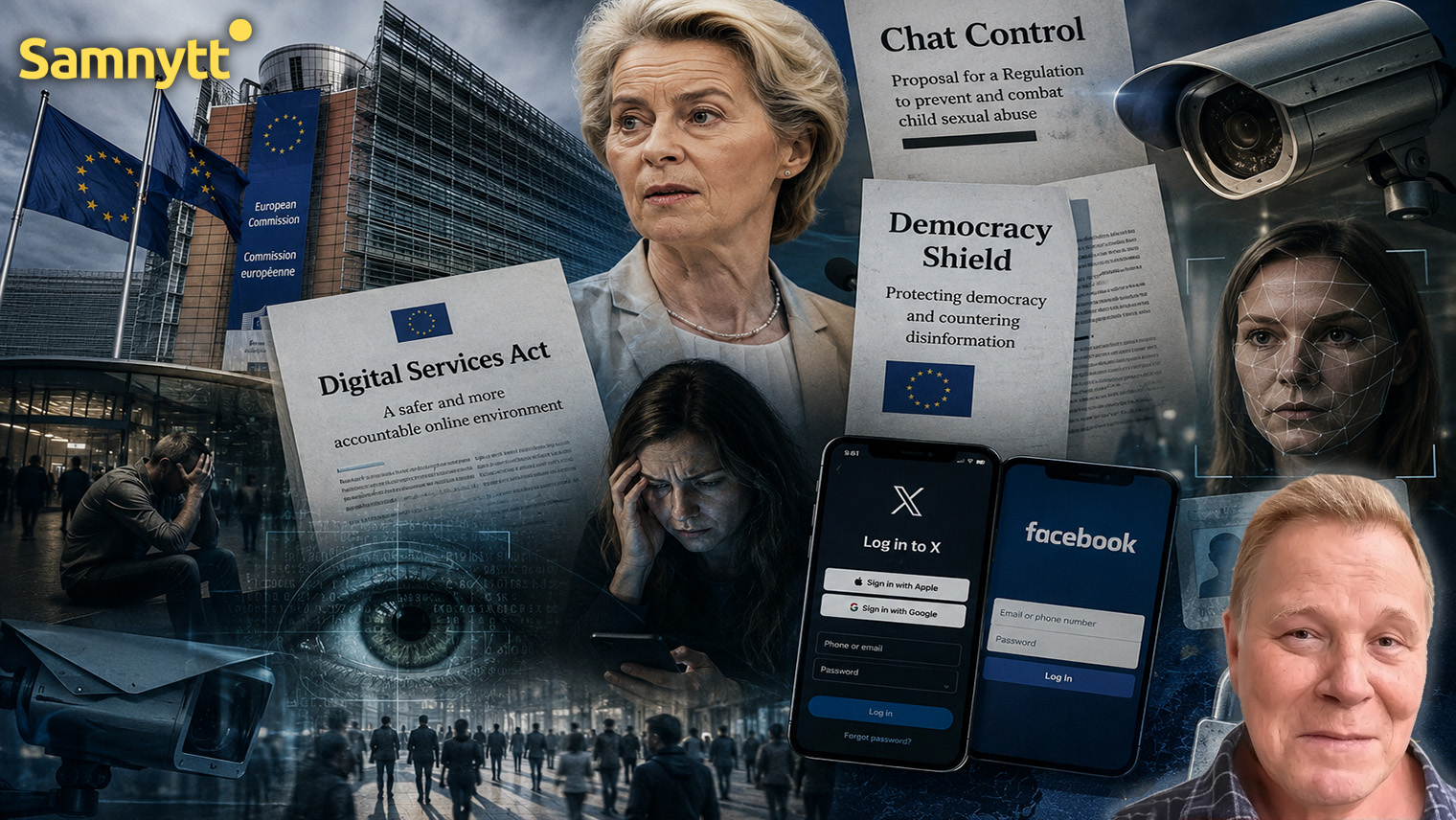
EDITORIAL • When the President of the European Commission, Ursula von der Leyen, talks about age restrictions for social media, it initially sounds both reasonable and sympathetic. Children must be protected from grooming. Children must be protected from bullying. Children must be protected from algorithms that exploit their attention and affect their mental health. Who would object to that? The problem is that those who listen carefully discover that it’s not just about children, but about everyone. It’s about your freedom and privacy.
To control children’s access to social media, someone would have to control the identity of all users. What is sold as protection for minors turns, in practice, into a system for identifying the entire population. And that’s what the real debate should be about.
A problem used to legitimize something else
There are real problems online that minors may need protection from. Children can be subjected to abuse, bullied, drawn into destructive environments, or exposed to content they’re not mature enough to handle.
But that does not automatically mean the state should know who everyone online is. On the contrary, the first question should be why responsibility is so quickly moved from parents, schools, the justice system, and digital platforms to supranational authorities in Brussels.
READ ALSO: Ekeroth: When EU Friends Dismantle the Rule of Law, Swedish Media Suddenly Go Silent
When a child suffers online, that is indeed a problem. But the obvious solution should not be that hundreds of millions of Europeans must present ID to read, write, or discuss on social media. When someone proposes that, it’s reasonable to be suspicious and consider possible hidden agendas.
Age verification is identity control
The EU Commission likes to talk about age verification. On the surface, it sounds innocent. But how do you verify someone’s age without also verifying their identity? The answer is, in practice, you can’t.
A system that knows whether you are 13 or 18 also knows who you are. A system that can decide who gets access to digital platforms is also a system that can exclude people or impose sanctions in ways incompatible with free democratic principles.
Technology does not alter this fundamental principle. Whoever controls identity also controls access. And whoever controls access, in turn, controls the public conversation.
The pattern is getting harder to deny
If this were an isolated initiative, concerns might seem exaggerated at first glance. But this is not an isolated initiative. In recent years, the EU Commission has repeatedly presented proposals that mean greater insight (read: intrusion) into citizens’ digital lives.
“Chat Control” is justified in a similar way, with the fight against child sexual abuse. Critics have warned that the proposal erodes the right to private communication. And that right is, of course, technology-neutral and does not disappear simply because a growing share of our communication is shifting from analog to digital.
READ ALSO: Ekeroth: The Ballot Box Popped the Myth—that’s Why Peter Wolodarski Is Furious
“Democracy Shield” is justified by the fight against disinformation and foreign interference. But who decides what is legitimate criticism, what is propaganda, and what is “harmful information”—the EU Commission? The Digital Services Act has given authorities and large platforms new tools to direct what content should be limited, deprioritized, or removed.
Each individual initiative is presented as reasonable. Each is said to be necessary. Each is, officially, about protecting us. But when all the pieces are put together, a different picture emerges: a Europe where increasing parts of public and private life are to be monitored, registered, filtered, and controlled.
Freedom rarely disappears all at once
History is full of examples of control systems introduced for good reasons: security, safety, crime-fighting, child protection, national security.
No one in power says the goal is to restrict freedom or democracy. On the contrary, everyone claims that these measures protect freedom and democracy. Yet it is freedom and democracy that are pushed aside when new control mechanisms are introduced.
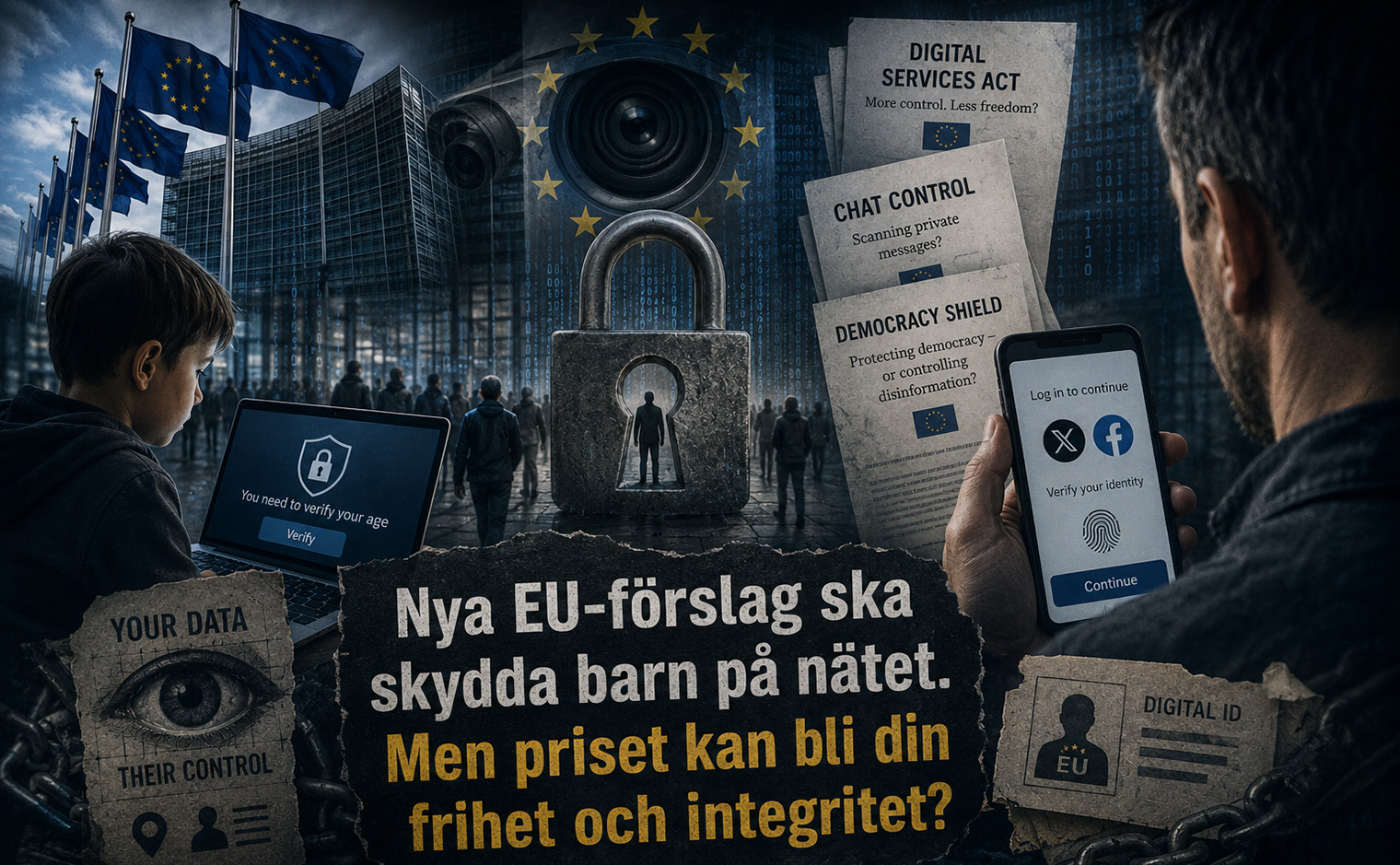
The great danger to an open society is rarely a sudden dictatorship. The real danger is that people gradually become accustomed to showing ID, giving up data, registering, verifying themselves, and allowing themselves to be surveilled—because the purpose sounds noble.
Freedom rarely disappears through one dramatic decision. It vanishes piece by piece. And this process has been underway for quite some time now in Europe, driven mainly by left-liberal actors who have seen their power and interpretive dominance over reality—long taken for granted—being challenged.
Whose responsibility and right is it to raise the children?
The EU Commission’s rhetoric is built on the premise that children must be protected. But protected from whom? Criminals? Of course. Bullying? Naturally. Harmful algorithms? That seems reasonable, too.
But when did the conclusion become that the state should therefore take over tasks that traditionally have belonged to others? Parents have the primary responsibility for their children. Schools are responsible for their pupils. The police and the judicial system are responsible for combating crimes against children. Social media platforms are responsible for ensuring that children aren’t harmed on their platforms.
But in modern European politics, every societal problem sooner or later seems to end up at the same conclusion: more surveillance, more rules, and more control from central institutions. It’s hard not to see a pattern.
Anonymity is not a problem—it is a protection
Proponents of online identity requirements often speak of anonymity as if it were suspicious. But historically, anonymity has been one of the most important safeguards of freedom—not only when voting in general elections.
Whistleblowers. Dissidents. Journalists’ sources. People who criticize those in power. People under social pressure or threat. All depend on the ability to express themselves without having to present identification first.
From Russian media to European Ministries of Truth?
The EU has already shown it is willing to go further than earlier generations of European leaders might have imagined. Russian state media have been blocked within the Union. Many applauded the decision. Others wondered if the state—or superstate—should really decide what information adults in a democratic society are allowed to access?
Democracies are based on the expectation that citizens will evaluate information, weigh arguments against each other, and make their own decisions. Infantilizing citizens is to undermine the foundation of democracy.
READ ALSO: Ekeroth: Now the EU Wants Even More Power—SD Should Stop It
When those in power begin to filter which sources people can access, their behavior starts to resemble practices long common in authoritarian systems rather than free societies. And the real issue isn’t what today’s decision-makers intend—they may believe their goals are good—but that they hand over tools to tomorrow’s leaders, who may have entirely different agendas.
The real question behind the stated one
Ursula von der Leyen says the question is not whether children can access social media, but whether social media can access our children. That’s a clever turn of phrase. But it leaves another question unanswered.
How much access should the state have to its citizens? How many control systems are acceptable before people start to feel they’re no longer living in a free democratic society? Is the idea that we’ll get used to it, just like the boiled frog, as long as change comes one step at a time—not dictatorship at once, but eventually?
How much privacy is it reasonable to relinquish in pursuit of safety and security—perhaps just an illusion—that our politicians could even turn against us? How much of democracy can be sacrificed to protect democracy? Is it strange to suspect that these actors have something else in their sights than our collective well-being?
When the rhetoric rings hollow
Children must be protected. Crime must be fought. Democracy must be defended. But a society that always chooses control over freedom will eventually lose both. Greater minds than mine have stated this before. Good for a small nomenklatura, bad for the large majority.
READ ALSO: Dagerlind: When the EU Wants to “Handle” Hungary – a Union That Lost Respect for Its Own Voters
When every new surveillance tool is justified with the same best of intentions and you sense that something is wrong, that the words sound discordant and hollow. When you wonder why democratic transparency seems to only work top-down—from power to you—but is blocked by secrecy and national security whenever you seek to scrutinize those in power.
When no one can oversee the overseers, chances are you’re not the conspiracy theorist you’re accused of being, but that you are in fact right—uncomfortably right. Loving both your children and your freedom and privacy is no contradiction.