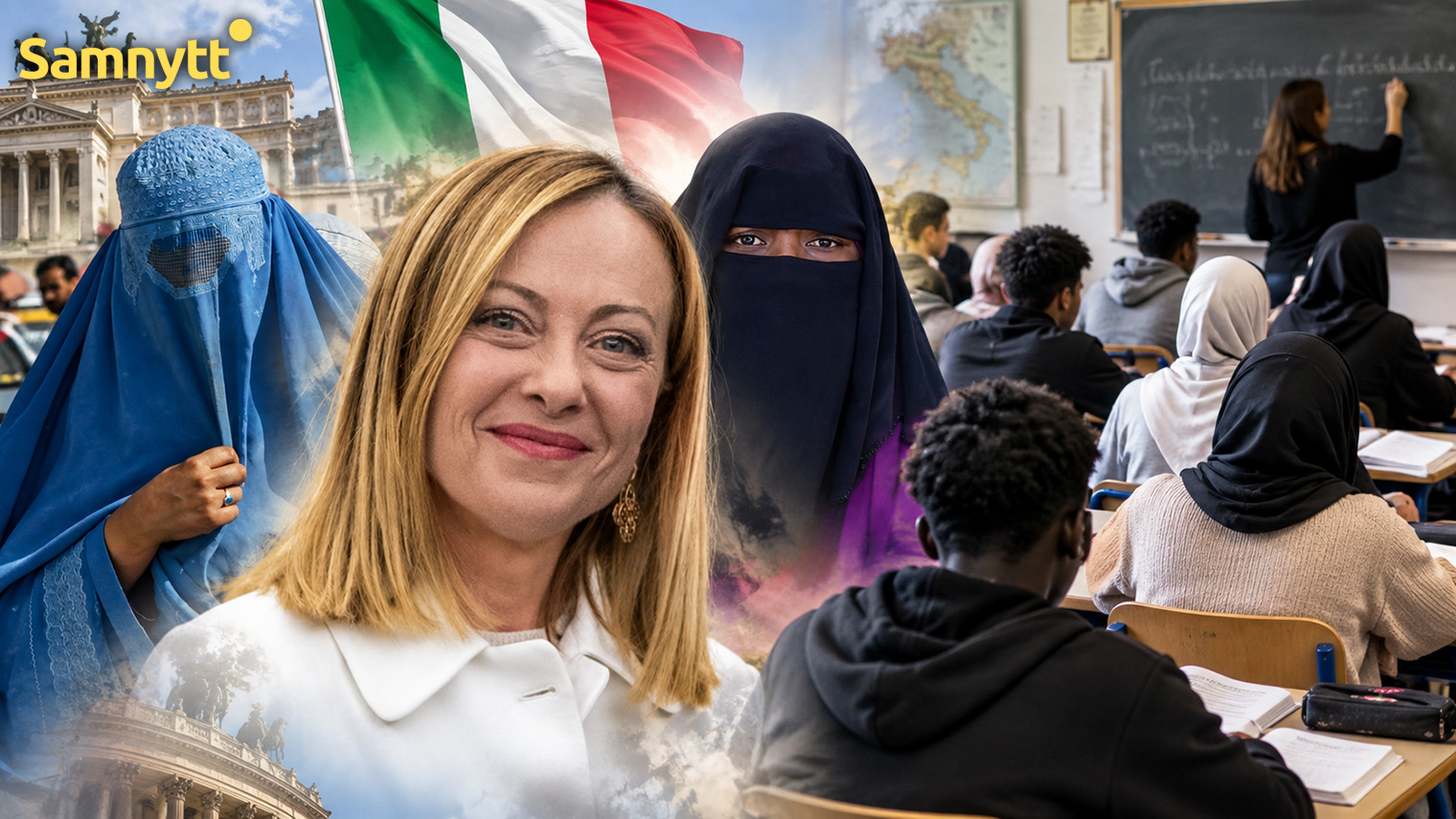
Italy is banning the burka and niqab in the country’s schools. At the same time, Giorgia Meloni’s government is introducing a cap on how many students with insufficient grounding in the Italian language can be placed in the same classroom. The government justifies the measures on the grounds of equality, security, and the need to prevent so-called “ghetto classes.”
On Thursday, the Italian government approved a comprehensive school decree that, among other things, includes a ban on full-face-covering Muslim veils in schools. The regulations are formally written to ban participation in school activities with the face covered in such a way that identification is impossible.
Prime Minister Giorgia Meloni has explicitly pointed to the burka and niqab as the garments covered by the ban. The hijab, which covers the hair and neck but leaves the face visible, is not affected by the ban.
Violations of the rules can result in fines between €200 and €1,000. If the violator is a minor, the sanction is directed at the guardian.
“Equality Is Not Negotiable”
The government justifies the ban both by the need to identify individuals in the school environment and by the rights of women and girls.
– No one in Italy can decide that a young woman must hide herself. Equality between men and women is not negotiable, Meloni has said regarding the decision.
When the proposal was presented, she also stated that students must attend school with their faces visible and that cultural and religious traditions from other parts of the world cannot be used as arguments to force girls and women to cover themselves. The burka covers both the body and the face, usually with a net in front of the eyes, while the niqab leaves the eyes visible.
ALSO READ: Portugal bans full-face veils in public places
How widespread the practice is in Italy is unclear. Estimates cited in Italian media indicate there are only a few hundred women across the country. However, the government has chosen to introduce a general rule as a principled stand for the school environment rather than deciding the issue case by case.
Cap Against “Ghetto Classes”
At the same time, the government is tightening rules concerning how students with insufficient grounding in the Italian language are distributed among schools. A cap of 30 percent is introduced for certain students without Italian citizenship.
In the earlier years of primary school, the cap applies to students not born in Italy or who have not attended at least two years of Italian preschool. In higher grades, the cap applies to students without Italian citizenship who have not successfully completed at least three years in the Italian school system.
Education Minister Giuseppe Valditara emphasizes that the language issue is central to the reform. According to him, there are currently about 34,000 Italian classes where more than 30 percent of students have foreign citizenship.
He also points to marked differences in academic results—what in Italy is called “implicit school dropout”—that is, students completing school without achieving expected knowledge; according to the minister, this is 5.7 percent among Italian students and 10 percent among foreign students.
– Our goal is to put the Italian language at the center as an important tool for integration. Knowing Italian means being integrated, Valditara said after the cabinet meeting.
The idea is that students who do not yet master Italian will be more evenly distributed among nearby schools. Where it is not practicable to keep to the 30-percent limit, such as in highly segregated immigrant-dominated areas, exceptions may be made and extra Italian instruction will instead be provided.
Parents are also affected. The government wants to strengthen requirements on parents whose lack of language skills makes it harder for their children to integrate, while free Italian language courses will be offered.
Meloni: Everyone Should Have the Same Opportunities
Meloni describes the reform as a way to combine integration with clear demands. “A cap of 30 percent in classes for students who do not master Italian sufficiently, more tools to learn our language, and a ban on burka and niqab in school,” she wrote after the government’s decision.
Oggi abbiamo approvato in Consiglio dei Ministri il decreto sulla scuola.
Un limite del 30% nelle classi per gli studenti che non conoscono adeguatamente l’italiano, più strumenti per imparare la nostra lingua e stop a burqa e niqab a scuola.
Strumenti di buonsenso che non… pic.twitter.com/JEbie74wYy
— Giorgia Meloni (@GiorgiaMeloni) September 24, 2026
She described the measures as “common sense” and argued that they should counteract the emergence of “ghetto classes” and provide students with equal conditions.
“This is the direction we want to continue in—a school that integrates without giving up its rules, that helps those with greater difficulties, and that gives everyone the chance to start from the same point.”
Left-Wing Opposition: “Witch Hunt”
The decision has been met with criticism from the Italian left-wing opposition. Democratic Party leader Elly Schlein has called the reform a “new witch hunt at the expense of children.”
Critics also argue that the 30-percent rule may be difficult to implement in areas with a large proportion of residents of foreign background, although this is addressed in the legislative change. Other objections concern the risk that children might have to be placed in schools farther from home when students are distributed between different schools.
The government rejects the criticism and instead highlights that the concentration of students with weak Italian skills hinders integration and teaching. Valditara describes language as the very prerequisite for students to be able to participate in school on equal terms. Meloni sums up the government’s position as integration not meaning that Italian society should abandon common rules.
ALSO READ: Survey: Strong Popular Support for Ban on Full-Face Veils
The decree was approved by the Council of Ministers on September 24 and must be ratified by parliament within 60 days to remain in effect. Meloni’s governing coalition has a majority in parliament. Several of the practical changes to how new classes are to be formed are intended to take effect from the academic year 2027/2028.
Italy – government decision to ban full-face veils in schools.
Portugal – law banning full-face veils in public spaces.
France – general ban on face-covering garments in public spaces since 2011.
Belgium – ban on face-covering clothing in public spaces since 2011.
Bulgaria – introduced a ban on face-covering clothing in 2016.
Austria – has required since 2017 that faces must be visible in public spaces.
Denmark – banned clothing that covers the face in public places in 2018.
Netherlands – has a more limited ban including schools, hospitals, public buildings, and public transport.
Norway – bans full-face veils in, among other places, the education sector.
Switzerland – after a referendum, has implemented a national ban on covering the face in public places.