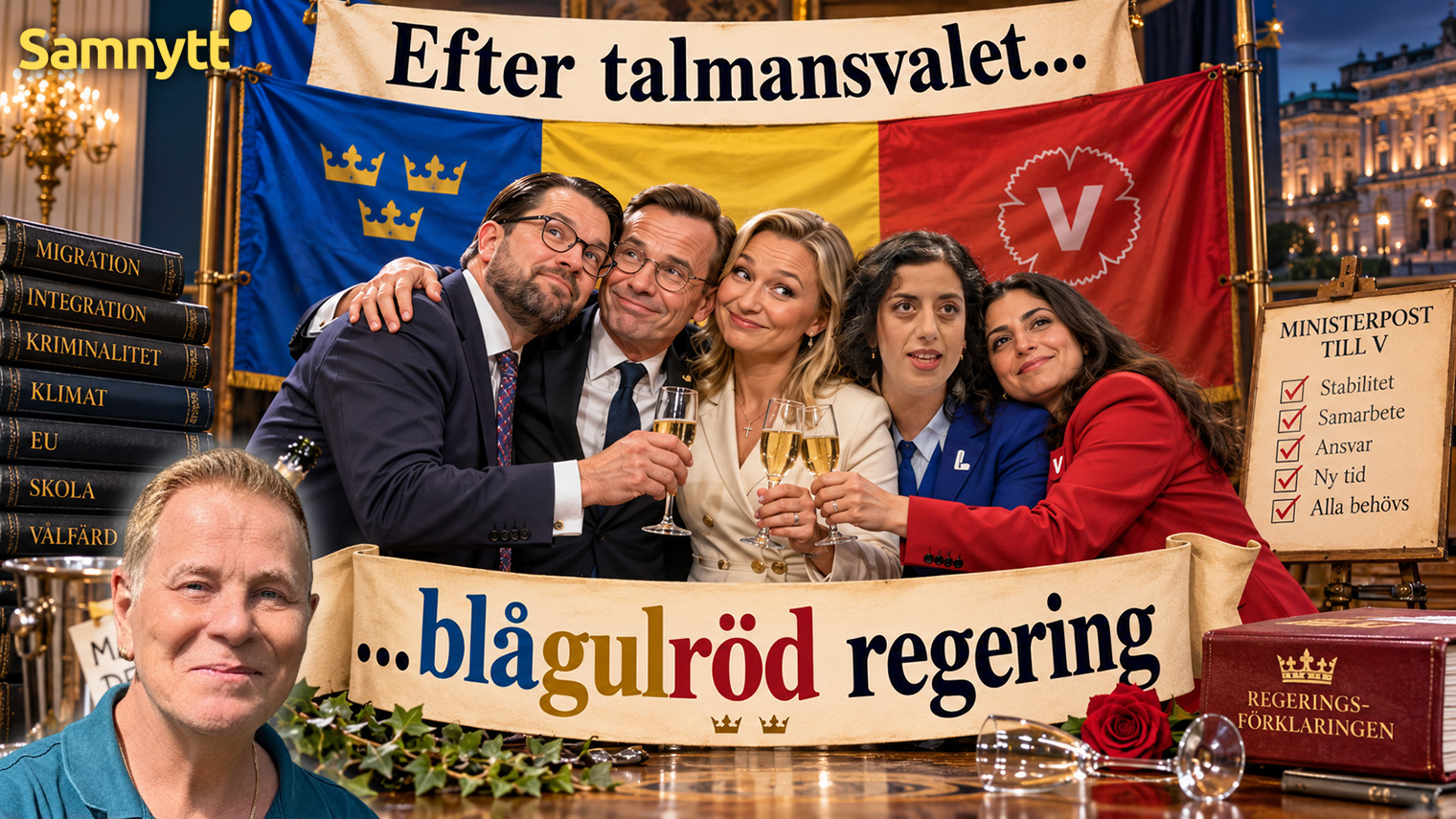
EDITORIAL • The Left Party has already crossed the bloc boundary by supporting the choice of Speaker. With government formation turning into one of the most difficult in modern Swedish politics, it’s time to turn over every stone—even those that initially seem politically unthinkable. The voters have spoken. Now it’s up to the parties to make something of the result.
It’s easy to laugh at the question. That’s also what happened, slightly surprised, at the Christian Democrats’ press office when I asked it: Could the Christian Democrats, under any circumstances, consider forming a government with the Left Party if the alternative is that the Tidö parties fail to form a government at all?
However, they couldn’t provide an immediate answer. And perhaps that reaction itself says something about Swedish politics right now. Some combinations are still seen as so far-fetched that asking about them almost sounds like a joke.
But the parliamentary situation after the election isn’t particularly funny. Together, S, V, MP, and C hold 176 seats. M, SD, KD, and L have 173. The problem is that mandates on the same side of the traditional bloc line can’t automatically be converted into a government.
The Left Party demands to be in any government it allows to take office. The Centre Party says no to a government that includes V. On the other side, the Sweden Democrats have made it clear that last term’s arrangement—where the party supported the government but stayed outside it—was temporary. After the election, according to their manifesto, SD will either be a government party or an opposition party.
It’s hard to recall an election where the voters’ verdict created a more difficult government issue. Maybe it’s time to start asking questions that normally aren’t asked.
V Crossed the Bloc Divide
On Monday, something also happened that made the question less absurd than it would have been just a few days earlier. The Left Party chose to support the Moderate Party’s Andreas Norlén as Speaker over the Social Democrats’ Johanna Haraldsson. Norlén won the closed vote with 200 against Haraldsson’s 146.
The Left Party explains that Norlén has the experience required for a very complicated parliamentary situation. Vice Chair Ida Gabrielsson, among others, has noted that Norlén previously helped usher in both Stefan Löfven and Magdalena Andersson as prime ministers.
But it’s hard to detach the decision from the ongoing government negotiations. Magdalena Andersson certainly didn’t. Even before the choice of Speaker, she returned her exploratory mandate and explicitly pointed to the Left Party’s statement. She said she currently sees no possibility to form a government and ironically spoke of a new constellation between V and M.
Dadgostar, of course, denies that a new bloc has been formed. She’s right about that. But something else did occur—the Left Party has shown that it can cross bloc lines when it deems the situation requires it. Why should that principle necessarily be limited to the Speaker’s position?
What if V is Asking the Wrong Party for Ministerial Posts?
The Left Party has never had any ministers in a Swedish government. But it has, over long periods, functioned as a support party for Social Democratic and red-green governments.
On the other side of the bloc line is the Sweden Democrats in a corresponding situation—they’ve never had ministerial posts, but in the past term acted as a support party for a broadly conservative government.
The Left Party wants ministerial posts that seem impossible to obtain within its intended governing bloc. Why is it so obvious that V must ask Magdalena Andersson for those posts?
I’ve posed the question of such a cross-bloc solution to the parties. The Left Party has declined to answer. Maybe that’s not surprising. To start discussing ministerial posts with the Tidö parties a day after the Speaker showdown would be political dynamite.
The Sweden Democrats don’t say yes to such an arrangement either. The party refers to their earlier statement that they won’t allow a government they themselves aren’t part of. But they also tell me they have no red lines against any party.
The latter isn’t an improvisation. In SD’s platform, it explicitly says that the party draws no red lines against cooperation with other parties, but is willing to cooperate wherever it gives the best opportunity to achieve their electoral policies.
That is neither a yes nor a no to sitting in the same government as V, and it’s not something they can decide alone either, but something that would have to be negotiated with M, KD, and L.
But there’s an interesting symmetry. V says its mandates should not be used to install a government that leaves them outside the ministerial offices. SD says the same.
Politically the parties are very far apart, both ideologically and in a number of policy issues. But when it comes to the value they place on their voters’ mandates, they at least seem to understand each other’s position.
No One Needs to Give V the Finance Ministry
The obvious objection to this entire line of thought is that a government with, for example, M, SD, KD, L, and V would contain almost grotesque political contradictions. That’s true.
On issues like migration, taxes, the labor market, criminal policy, the EU, and aspects of energy and foreign policy, the differences are huge. Such a government would require compromises that would likely enrage both left-wingers and Tidö voters.
But there’s no law of nature saying that in such an experiment, the Left Party must get the finance ministry, the Ministry of Justice, or control migration policy. A typical Swedish government includes 22–24 ministers. Perhaps one or some of these the Tidö parties could entrust to V without fear that the party would turn Sweden into a communist one-party state.
If, in the end, the alternatives are between not being able to form a government at all and trying a very unusual coalition, it should at least be possible to investigate whether there are less central ministerial positions and limited policy areas where the contradictions are manageable.
They don’t even have to be areas where all five parties are in agreement. By definition, coalition governments consist of parties that compromise. The Tidö cooperation is itself an example of this.
The question for V would then be which is more important—ideological orthodoxy about which parties can share a cabinet table, or the chance, for the first time in party history, to actually get ministers and direct power.
For the Tidö parties, the calculation is the reverse—is limited leftist influence in narrowly defined areas worse than not being able to form a government at all? Which alternative do they think the blue-yellow voters would prefer? The question must, at the very least, be asked in the current, otherwise totally locked position.
The Red Lines Have Created the Deadlock
The strange thing about Swedish government formation is that almost everyone seems to be waiting for someone else to abandon what they promised before the election. The Centre Party wants a change of government but not with V in it. The Left Party wants to change government but not if it is left outside it.
SD wants to continue the Tidö cooperation, but not another term as a support party outside the government. And in the middle, the Social Democrats and Moderates are trying to produce workable government alternatives.
The result so far has been total deadlock. On September 18, Magdalena Andersson was tasked by the Speaker to explore the possibility of forming a government that could be tolerated by the Riksdag. Ten days later, she returned the assignment, stating that the conditions are not there at present.
That’s why neither side can afford to just look at the other’s problems. The Tidö parties must also ask themselves what they will do if their own governmental option proves impossible. Keeping on saying no isn’t a governing policy.
The Voters Have Not Failed
There is finally a fundamental question here that is bigger than the Left Party, the Sweden Democrats, or who gets which ministerial post. The voters have already done their job.
They had no obligation to deliver an election result that suited the parties’ pre-constructed government options. Nor were they obliged to respect the politicians’ red lines. They voted. Now parliament has the composition it has.
It’s up to the politicians to handle that. Before an election, parties can declare which parties they would prefer to govern with, whom they don’t want to cooperate with, and which demands are absolute. After the election comes a different responsibility—to try to turn the voters’ decision into a functioning government.
Parliamentary democracy cannot be reduced to a sandbox where eight parties sit in their own corners and announce which other children they refuse to play with. In a normal parliamentary situation, clear bloc boundaries can be both understandable and desirable. But when none of the intended options work, every stone must be turned. Even the strangest ones.
A blue-yellow-red government might prove completely impossible. There are obviously plenty of political reasons against it. But that’s different from refusing to even investigate the matter just because the idea sounds absurd, or because of dogmatism or pride.
A few days ago, even the idea that the Left Party would choose the Moderate Speaker over the Social Democratic candidate would have sounded odd. On Monday, the party did just that.
The man they helped elect is Andreas Norlén—and they did so with the argument that he’s a Speaker whose experience is needed because Sweden is in an unusually difficult parliamentary situation. It was a choice outside the box. It signals that V might be able to think even further outside it.
Norlén has untied difficult parliamentary knots before. This time, the biggest task might be to get the parties to realize it’s not the voters’ job to solve the knot for them, and that all color combinations need to be considered.