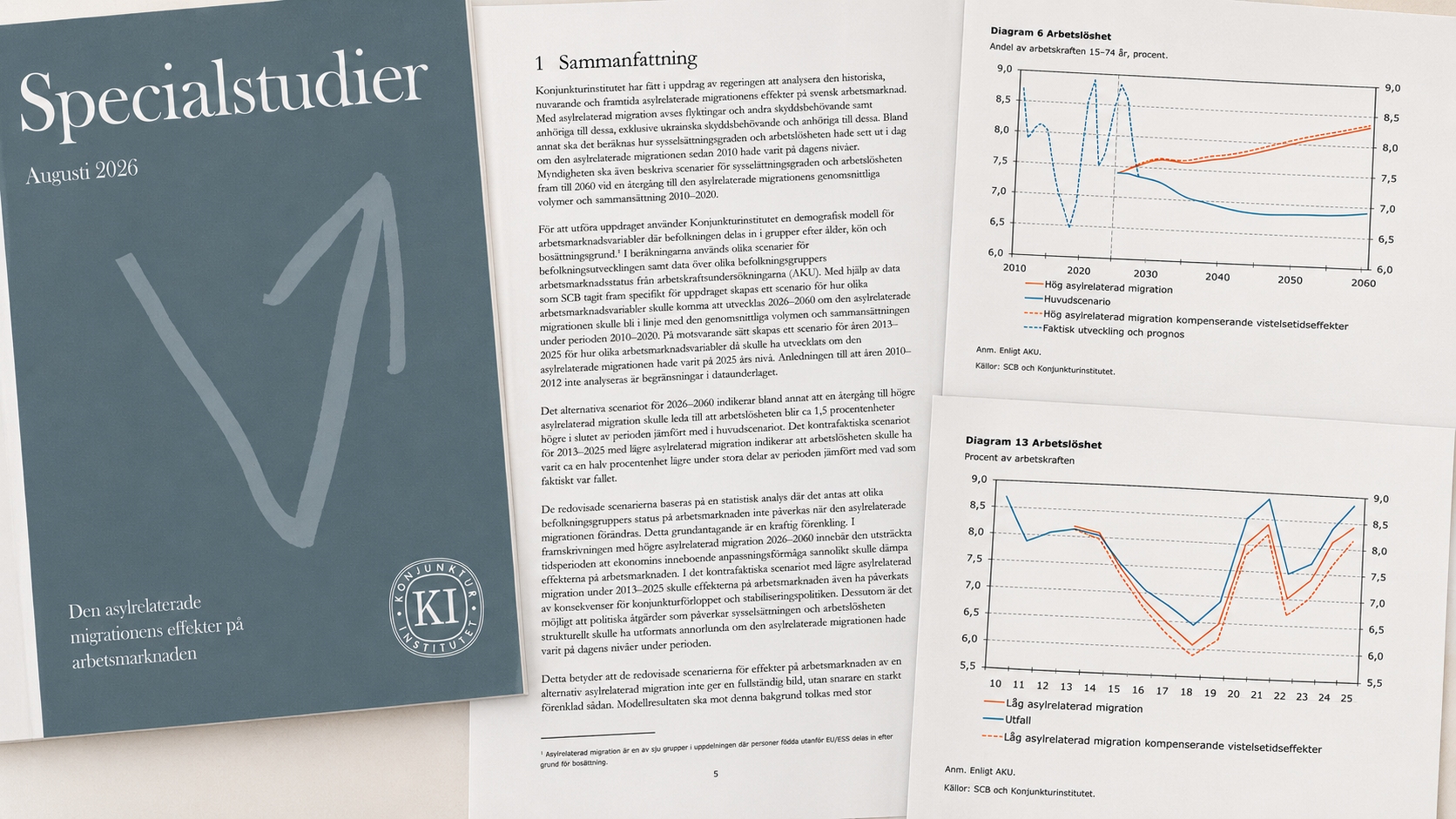
If asylum-related immigration during the years 2013–2025 had remained at today’s significantly lower levels, unemployment would have been about half a percentage point lower during much of this period. This is shown by a new study from the National Institute of Economic Research (Konjunkturinstitutet, KI). The agency has also calculated what would happen if Sweden reverted to the higher immigration levels of the 2010s—in that case, the long-term difference in unemployment would be around 1.5 percentage points.
On behalf of the government, the National Institute of Economic Research has analyzed how asylum-related migration has affected and may affect the Swedish labor market. In the study, asylum-related migration refers to refugees and other people in need of protection, as well as their family members. Ukrainians who have arrived as people in need of protection are not included.
For the historical part, Statistics Sweden (Statistiska centralbyrån) developed an alternative population scenario in which asylum-related migration from 2013 onward is assumed to have stayed at the 2025 level. This is then compared to the actual development in the labor market. KI’s model shows that unemployment in such a scenario would have been about half a percentage point lower during much of the period 2013–2025.
Higher Unemployment if Returning to Previous Levels
The agency has also made a similar calculation for the future. In this alternative scenario, asylum-related immigration from 2026 is assumed to return to the average volume and composition Sweden had during the 2010–2020 period.
The difference gradually increases. By 2060, unemployment in the scenario with higher asylum-related immigration is estimated to be about 1.5 percentage points higher than in KI’s baseline scenario. The number of unemployed also rises markedly, while unemployment drops in the baseline scenario.
An important explanation, according to the report, is that unemployment is significantly higher among people who have arrived through asylum-related migration and their family members than among the population as a whole. Therefore, when the share of that group in the population increases, overall unemployment is also affected.
KI also concludes that the employment rate will be lower in the scenario with higher asylum immigration. The economic dependency ratio—in other words, how many people without work each employed person must support—also becomes somewhat higher.
KI Warns of High Uncertainty
At the same time, the agency emphasizes that the calculations should not be regarded as exact forecasts. The model is static and mainly based on how different groups currently fare in the labor market.
In reality, the economy changes. Higher immigration affects, among other things, demand, the number of jobs, wages, and political decisions. Over several decades, KI therefore assesses that economic adaptation would likely moderate some of the negative labor market effects shown by the model.
KI therefore writes that the results should “be interpreted with great caution” and should mainly be seen as an indication of the scale of the effects rather than as precise estimates.
At the same time, both sets of calculations point in the same direction: lower asylum-related migration results in lower unemployment in the model, whereas a return to the higher levels of the 2010s results in higher unemployment.