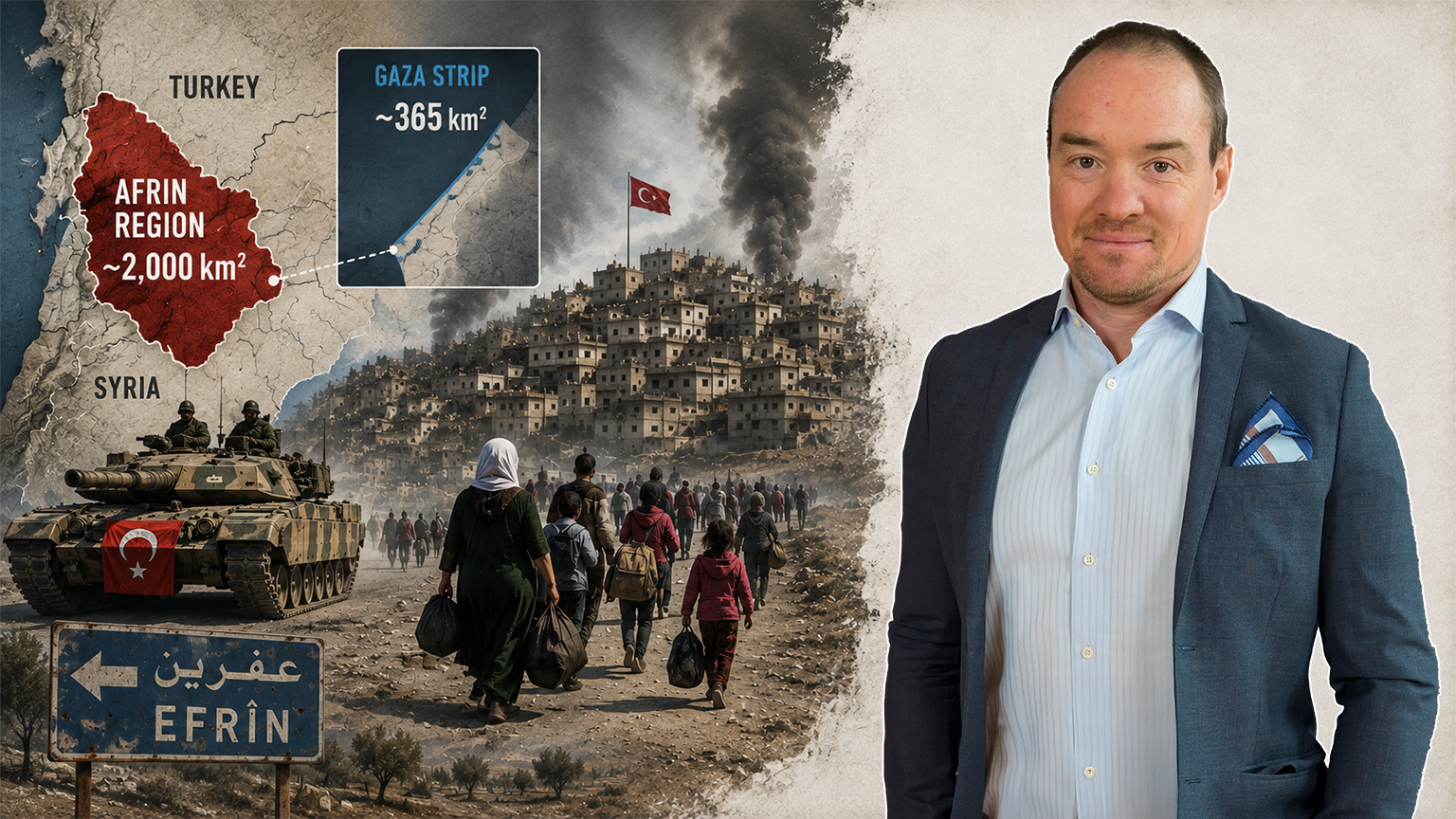
EDITORIAL • Imagine the following: a militarily superior neighboring state crosses an international border and conquers a region where another ethnic group makes up the majority of the local population. Over a hundred thousand people are forced to flee, homes and land are seized, and people from other parts of the country move in. The area’s demographic composition begins to change under the control of the new power. What are the international reactions? Well, that depends entirely on the “sender”.
You don’t need much imagination to picture the reaction if Israel had done this to the Palestinians. But this time, it isn’t about the Jewish state—it’s about Turkey and the Kurds in Afrin, Syria—and that is when things got significantly quieter.
Israel is constantly, and falsely, accused of occupation, expulsion, colonization, and demographic change. These accusations have become slogans for a global pro-Palestinian movement that fills streets and universities. But when Turkey actually invaded a Kurdish area in a neighboring country—driving much of the population into exile and letting others move into their homes—the global mass mobilization was absent. Afrin is a rather obvious example of how selective the indignation against Israel is.
Turkey Crossed the Border
Between 2016 and 2019, Turkey carried out three major military operations in northern Syria.
First came Operation Euphrates Shield in 2016–2017, when Turkey and its Syrian allies took territory between Jarabulus, al-Bab, and Azaz. Then came Operation Olive Branch in 2018 against the predominantly Kurdish Afrin. The following year, Operation Peace Spring began, and Turkey took another border strip between Tal Abyad and Ras al-Ayn.
It is Afrin in particular that is of interest for this comparison. When the 2018 offensive ended, Turkish forces and their Syrian allies had taken about 2,000 square kilometers and hundreds of communities, according to the International Crisis Group.
For comparison, according to the UN, the entire Gaza Strip covers about 365 square kilometers. So, the area that fell into Turkish hands during the Afrin offensive was roughly 5.5 times larger than all of Gaza.
The European Parliament later demanded that Turkey cease what the Parliament explicitly described as the country’s “illegal occupation of northern Syria and Afrin.”
137,000 People Displaced
The offensive also had enormous consequences for the local population. On April 18, 2018, the UN reported that around 137,000 people still remained displaced from Afrin district following the military operations that began on January 20.
Afrin was one of Syria’s most distinct Kurdish core areas. There are higher estimates for the number of displaced Kurds, but those are harder to verify and, in fact, unnecessary. 137,000 people fleeing from a region with a strong Kurdish character is a remarkable enough figure.
What occurred after the military victory is at least as interesting as the offensive itself.
Kurdish Homes Received New Inhabitants
After the conquest, reports came in about extensive looting, confiscation, and takeover of property. The European Parliament noted in 2019 that armed groups supported by Turkey had reportedly seized, looted, and destroyed Kurdish civilians’ property in Afrin. The Parliament demanded that the displaced inhabitants be compensated and not permanently deprived of their assets.
The same report addressed an even more sensitive issue: the reports that Turkey attempted to change the demographic balance in Afrin by transferring Syrian Sunni Arab refugees from Turkey to the Kurdish-dominated region.
It is quite a remarkable combination. A neighboring country crosses the border and conquers a Kurdish area. A large part of the population flees, Kurdish property is seized, and there are reports that people from another ethnic group are being moved in.
And these were not just allegations made in the chaos directly after the offensive. Three years later, the European Parliament condemned the transfer of Syrian refugees to northern Syria with the aim of changing the demographic character of a predominantly Kurdish area.
The irony is hard to miss. Occupation, expulsion, seized homes, and demographic change—these are the same words that frequently appear in campaigns against Israel. Yet Afrin never became an international symbol.
Even Palestinian Arabs
The story also contains an almost absurd detail. Among the people who ended up in Turkish-controlled regions of northern Syria during the Syrian war are Palestinian Syrians—that is, Palestinian refugees and their descendants who previously lived in Syria.
There have been Kurdish claims that around 10,000 Palestinian Arabs have been settled in Afrin. However, this particular figure cannot be reliably verified, but what is significant is that Palestinian Arabs are indeed among those who ended up in the Turkish-controlled regions, even as the larger demographic transformation is much better documented: The European Parliament has both described the influx of Sunni Arab Syrians and later condemned population transfers intended to alter the demographic character of a predominantly Kurdish area.
Where Are the Mass Demonstrations?
This leads to the obvious question: where are the demonstrations for the Kurds of Afrin?
Where are the university occupations and tent encampments? Where is the boycott movement against Turkey? Where are the demands that Turkish artists and athletes be banned and companies blacklisted?
Sure, Turkey has received diplomatic criticism. The UN has documented the expulsions, and the European Parliament has used language that can hardly be described as cautious. But that’s not the point. Compare the diplomatic criticism with the popular and political mass mobilization that has been directed against Israel.
Nothing similar ever happened around Afrin. A region more than five times larger than Gaza could be taken over, over a hundred thousand people could be driven into exile, and the region’s demography altered, without the issue becoming a global moral campaign.
And Then There Is Sudan
The contrast becomes even sharper when looking at Sudan. Since 2023, the country has been torn apart by a war that has developed into one of the world’s largest humanitarian disasters. Tens of millions of people have needed aid, and millions have been driven from their homes.
Yet nothing like the same mobilization is seen: no tent camps on every Western university, no global cultural boycott, and no endless attempts to turn every sports or music event into a platform for Sudan.
It is almost as if some conflicts are more “useful” than others.
Israel Is Held to a Different Standard
The difference is particularly striking since the current war in Gaza did not begin with Israel one morning deciding to invade a neighboring region.
On October 7, 2023, Hamas and other Palestinian terrorists crossed the border from Gaza, murdered around 1,200 people, and took more than 250 people hostage. Israel then went to war to destroy Hamas’ military capabilities and prevent the group from repeating the attack.
Still, it didn’t take long before much of the international public discourse had turned Israel from the attacked party into the main target of demonstrations, boycotts, and demands for international isolation.
This is where Afrin becomes so troubling for those who claim that mobilization is only about universal principles.
Turkey does not need to be accused of doing exactly what Israel is accused of. The comparison doesn’t require that. It’s enough to note that Turkey crossed an international border, took a predominantly Kurdish region, and then received such harsh criticism for expulsion and demographic change that the European Parliament eventually termed it an illegal occupation.
Yet no global movement ever arose with Afrin as its symbol.
When Principles Become Selective
If these major protests were truly driven by a consistent abhorrence of occupation, expulsion, and demographic change, Afrin is hard to explain away. The same activist environments that can mobilize thousands of people within days against Israel never managed to make the Kurds’ fate a comparable issue.
The collective double standard is so clear that the question must be asked.
Israel is the world’s only Jewish state. When it is Israel at the center of attention, it seems every accusation can trigger a global moral mobilization that is absent when other countries are responsible for acts that the same movement claims to despise.
Afrin is an unusually clear example of this. Not because the conflict is identical with Gaza, but because the difference in reaction is so vast.
It’s nothing but very selective morality. And when that selective morality again and again reaches its highest intensity just when the Jewish state is in the crosshairs, it is only reasonable to ask where criticism of Israel ends—and where antisemitism begins.