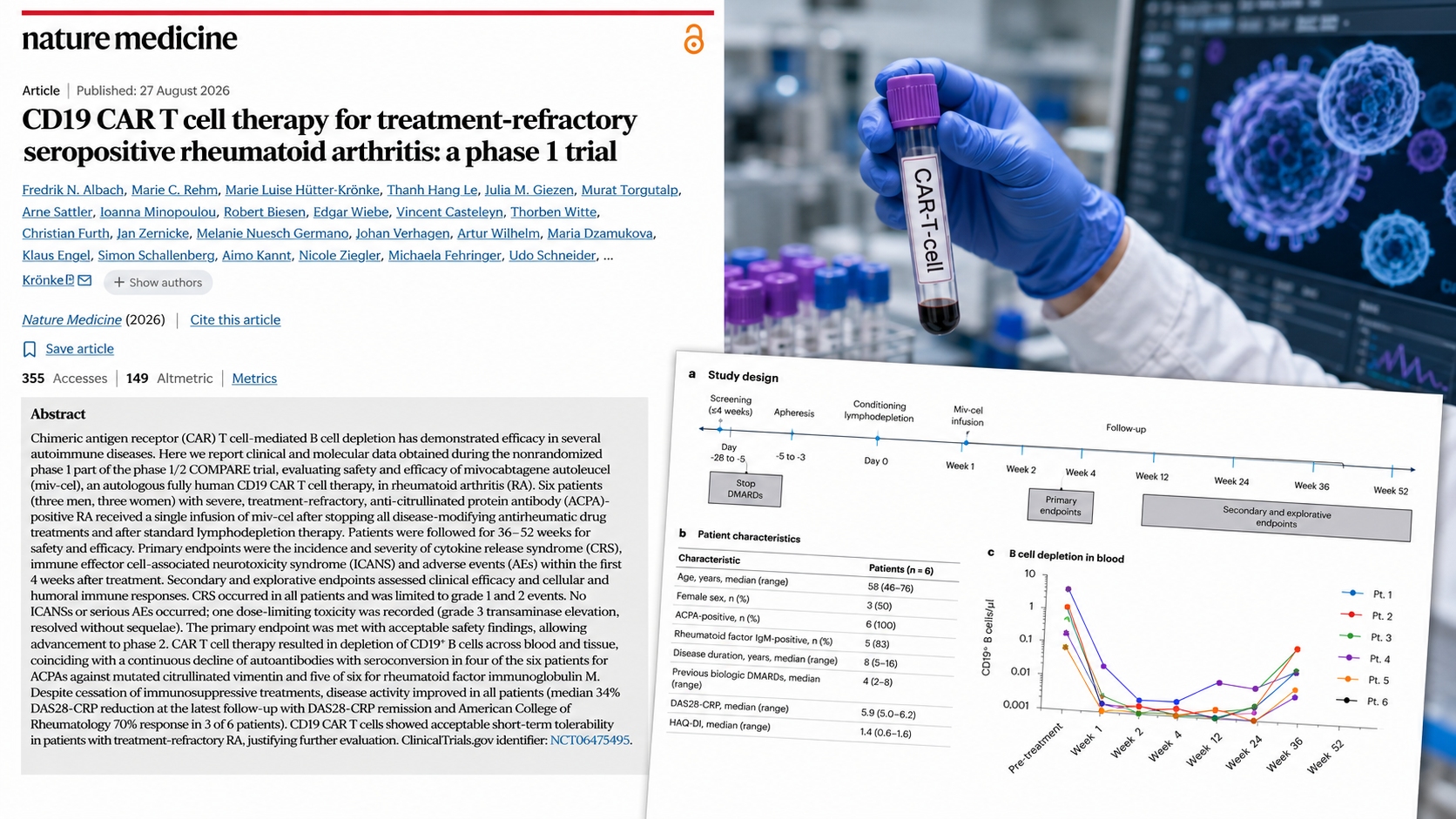
A treatment developed for cancer is showing promising results even against severe rheumatism. In a new study, all six patients experienced reduced disease activity after CAR-T therapy – and three achieved remission. At the same time, the researchers emphasize that the trial is very small and still in an early phase.
The study, published in Nature Medicine, involved six people – three women and three men – with severe seropositive rheumatoid arthritis. All of them had disease that remained active despite prior treatments. The researchers used the treatment mivocabtagene autoleucel, a form of so-called CD19 CAR-T therapy.
CAR-T has become especially known as an advanced cancer therapy. The principle is that the patient’s own T cells are removed and genetically modified so they can recognize and attack certain cells.
In several blood cancers, the cells are programmed to seek out the protein CD19, which is found on B cells.
Clear results
B cells also play a central role in several autoimmune diseases, as they can produce the antibodies that attack the body’s own tissues. The researchers are therefore trying to use the same technology to essentially eliminate parts of the wrongly activated immune system.
The six patients received a single infusion and were then monitored for between 36 and 52 weeks. During the trial, their regular disease-modifying rheumatic treatments were discontinued. The results were clear.
Disease activity decreased in all six patients. At the most recent follow-up, their disease activity, measured using DAS28-CRP, had decreased by a median of 34 percent.
Three out of six achieved remission by the same measure, and at the same time reached ACR70 – which means an improvement of at least 70 percent according to an established set of criteria for rheumatoid arthritis.
Autoantibodies disappeared
The researchers could also see a significant reduction in the B cells targeted by the treatment, both in the blood and in tissue.
The disease-related autoantibodies also decreased continuously. In four out of six patients, one type of ACPA antibody examined disappeared, while five out of six became negative for rheumatoid factor of the IgM type.
The treatment is not without risks. All six developed so-called cytokine release syndrome, a known side effect of CAR-T, but the cases were limited to grade one or two. The researchers reported no cases of the serious neurological complication ICANS, and no serious adverse events. One patient had a significant but temporary increase in liver enzymes.
However, the results are not sufficient to determine that the treatment is effective against rheumatoid arthritis. This is only the first part of a phase 1/2 study, with just six patients and no control group. The primary goal of this phase is to study safety.
Nonetheless, the researchers believe that the results justify proceeding with trials in phase 2.