
Almost every other pastor in Sweden today uses artificial intelligence in their sermon preparations. For some, it’s about language review, research, and brainstorming – but for others, this development is deeply troubling. Is AI just one neutral tool among many, or is something essential at risk of being lost when a sermon is partially shaped by a machine? Has God gained competition from another higher consciousness?
Humankind has always sought the all-knowing – in God, in the scriptures, in tradition. Now, artificial intelligence introduces a new kind of knowledge source in this landscape: a system that, within seconds, can compile Bible commentaries, analyze original texts, compare translations, and suggest interpretations. For some, AI appears almost as a higher, more intelligent consciousness than humanity itself – always available, never tired, never uncertain. Virtually godlike.
The question thus becomes not only technical but deeply theological: What happens when the sermon is no longer primarily shaped through prayer to God and existential experience, but in dialogue with or prayer to an algorithm? And can the living word of God truly be conveyed by something that lacks both body, soul, and faith? Or are these, on the contrary, qualities that echo the divine?
Every Other Swedish Pastor Uses AI
The Christian daily newspaper Dagen conducted an extensive survey among Swedish pastors. A total of 423 people responded to the question: “Do you use Artificial Intelligence (AI) in sermon preparations?”
The results show that 208 pastors – 49 percent – have used AI at least once. Of these, 26 say they use it often, 61 that they use it occasionally, and 121 that they do so only on rare occasions.
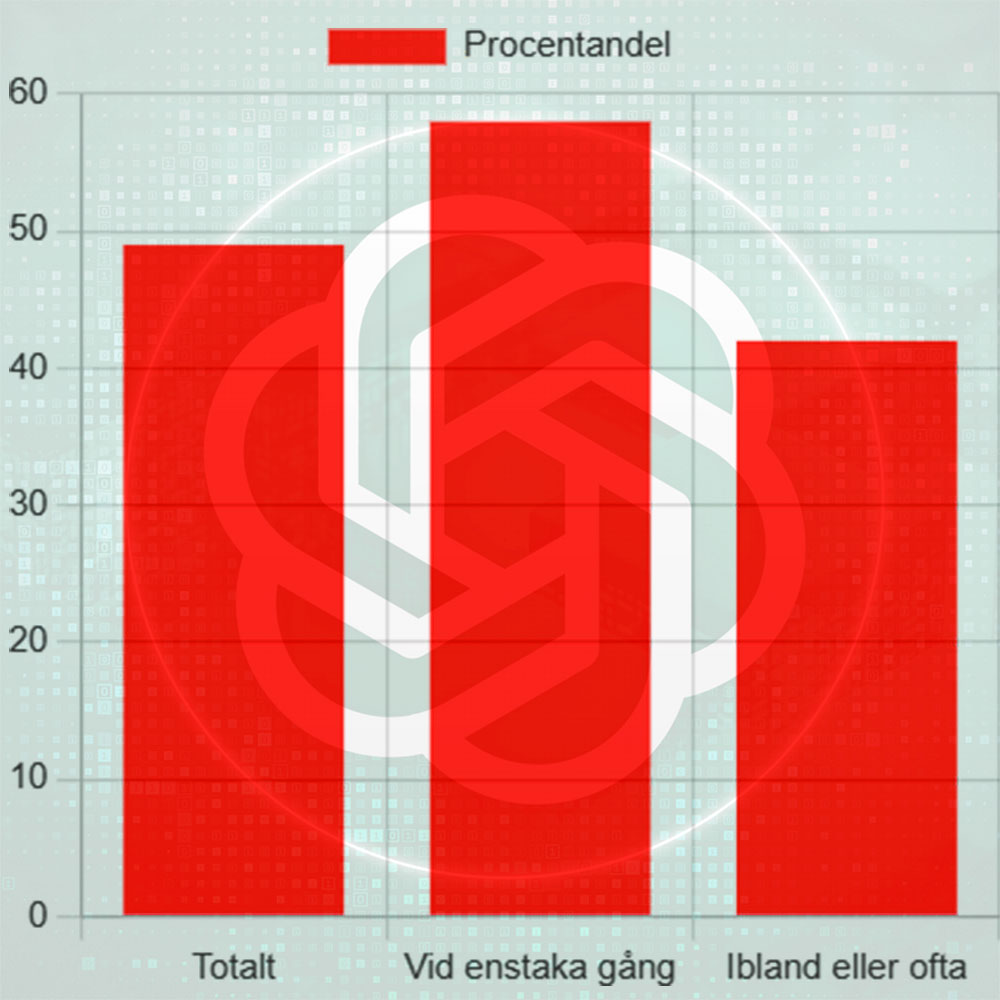
Meanwhile, 215 pastors, corresponding to 51 percent, report never using AI in their sermon work. It’s a slim majority that could soon switch to a minority, giving AI the upper hand over God in the church.
AI as a Tool – Not a Replacement
Among those who use AI, it is often emphasized that the technology is seen as an aid, not as a replacement for their own work. Johan Mörlid, pastor at Frihamnskyrkan in Gothenburg, describes his approach to Dagen as follows:
– I don’t ask ChatGPT to write my sermons, but I often ask questions, look for research support, and ask ChatGPT to check my language.
Similar reasoning is presented by Andreas Engström, pastor in the Equmenia Church in Gråbo, who uses AI for text analysis, translation, and Bible searches – but always with clear boundaries.
READ ALSO: The Climate Movement Becomes a True Religion – Will Replace the Ten Commandments
He stresses that AI must never become a shortcut around one’s own theological work and says it is “unthinkable” to let AI write sermons. In his experience, the technology works best for those who already have solid knowledge and can thus see through mistakes and simplifications.
Stefan Beimark, head of the Pentecostal Church in Örnsköldsvik, also sees the benefits but warns against blind trust.
– You have to be discerning and read with a critical eye, but AI is useful if you don’t blindly trust it.
Small Differences Between the Generations
A common assumption is that AI is mainly used by young people. But today’s survey paints a different picture. The age group with the highest usage is pastors between 51 and 60 years, where 54 percent use AI. In the group aged 61–70 years, the corresponding figure is 43 percent.
The generational differences are thus relatively small, suggesting that AI is no longer a marginal phenomenon but something that broadly affects sermon work within Swedish Christianity.
“Soulless and Sad”
Not everyone welcomes this development. The criticism is sometimes harsh and formulated in existential and spiritual terms. One pastor puts it like this:
– It is soulless and sad that such thoughts even exist with some. I am deeply against this decline. The Word is something living and our hearts where God can speak are fundamental. I know how good theology we can get from AI, but what use is that if the Word is – and should be – living?
READ ALSO: Is the Church of Sweden a False Church?
Here, using AI in the pulpit is likened to musicians letting a machine write their music – technically correct, perhaps even impressive, but lifeless.
Others abstain for more unusual reasons. Sören Johansson, pastor in the Equmenia Church in Rimforsa, for example, avoids AI because of its high energy consumption, which he feels counters the congregation’s environmental and climate commitment.
The USA Is Even Further Ahead
The development is not unique to Sweden. A new survey reported by the Christian Post shows that nearly two-thirds of pastors in the USA use AI in their sermon writing.
The study is based on responses from 594 pastors and church employees and is part of The 2025 State of AI in the Church Survey Report, produced by AiForChurchLeaders.com and Exponential AI NEXT.
61 percent state that they use AI every week or daily – a sharp increase from 43 percent the prior year. A quarter use AI daily.
– This indicates that AI is quickly becoming a key tool for pastors in their weekly sermon preparation, the researchers note.
At the same time, major concerns are raised regarding theological accuracy, the risk of misinformation, and the possibility that AI can “replace or diminish personal, spiritual guidance and the quality of human relationships within the congregation.”
Between Aid and Ruler
The surveys, both in Sweden and internationally, point to the same tension: AI is perceived simultaneously as a powerful tool and a potential threat. Most pastors seem to agree on one thing – the technology can be helpful, but must never become the master over the message.
The remaining question is whether this balance can be maintained over time. As AI becomes more sophisticated, more convincing, and more “human,” or even superhumanly godlike, will it risk not only assisting the sermon – but in practice shaping it? And if so: who then really speaks through the pastor’s mouth from the pulpit?