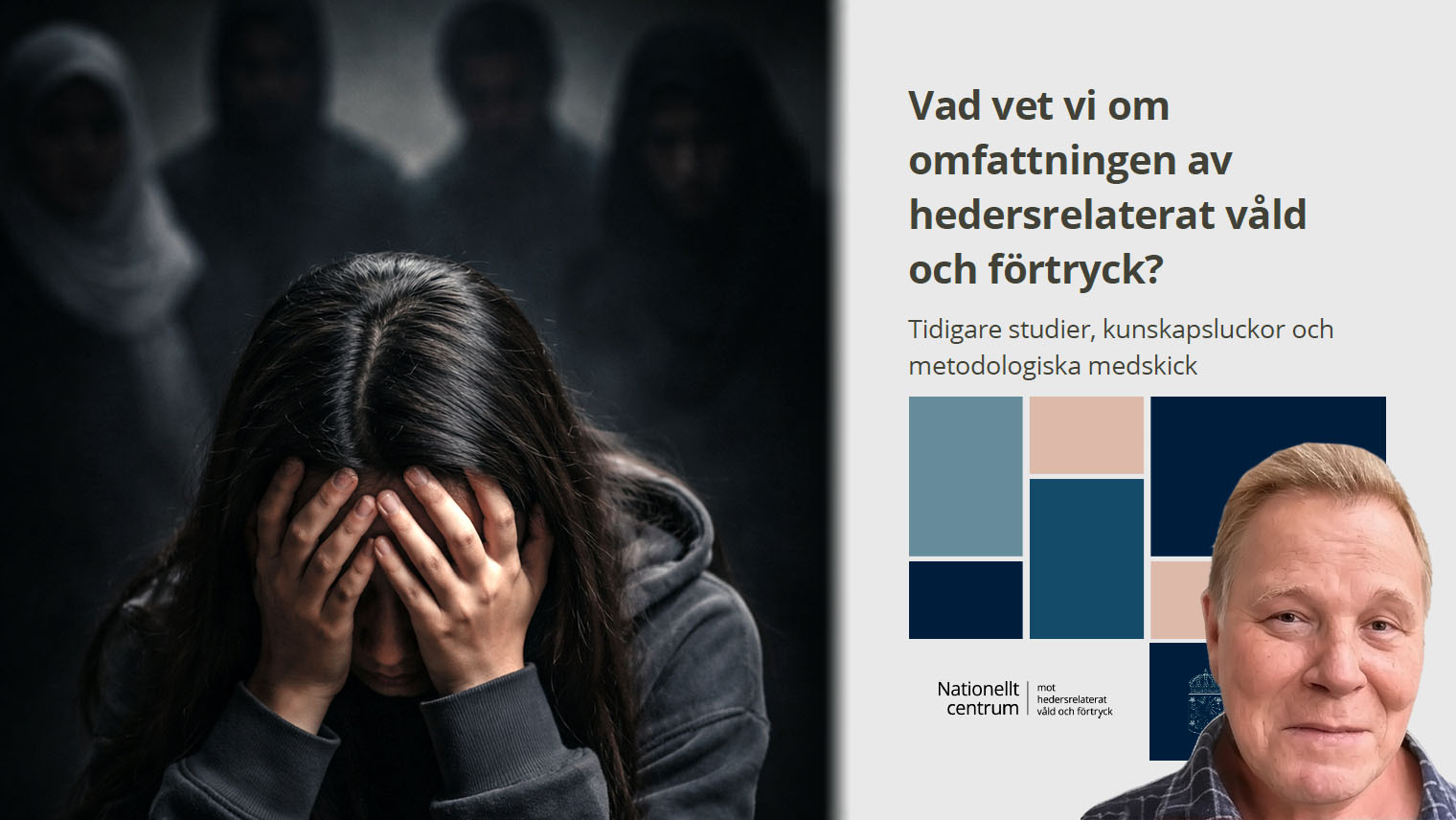
EDITORIAL • As recently as 2025, the National Centre Against Honor-Related Violence and Oppression published an extensive review of knowledge about the prevalence of honor oppression in Sweden. The report is thorough, self-critical, and detailed. Yet it dodges the crucial question: Why has this systematic oppression been able to establish itself in Sweden on such a large scale?
When the government last autumn determined that up to 240,000 young people in Sweden live under honor-related violence and oppression, it triggered strong reactions. The figure is hard to grasp. It becomes even harder to comprehend when at the same time it’s noted that only three rulings have been handed down since honor oppression became a crime of its own. In my previous editorial on honor oppression, which was based on a current court case in Södertälje, I asked how a society can accept such a gap between reality and the rule of law.
Against this background, it seemed reasonable to review the report that the National Centre Against Honor-Related Violence and Oppression (NHC) published as recently as 2025—a state-commissioned document said to form the basis for future measures, including those the government has presented on its website promising a “crackdown” and a “paradigm shift”.
The report is titled ‘What Do We Know About the Extent of Honor-Related Violence and Oppression?’ and its ambitions are high. It analyzes no less than 69 Swedish studies, identifies major gaps in knowledge, and describes the mechanisms of honor oppression in detail.
But when you read the report with a wide perspective, one thing becomes clear: the biggest question of all is left unanswered—how could this happen in one of the world’s most equal and individually free countries?
A System That Is Described—but Never Located
The report is clear in its description of what honor oppression is. It establishes that it is a collective norm system where the individual’s life is subordinated to the honor of family and kin. It describes norms of chastity, strict sexual morality, hierarchical gender roles, and collective sanctioning, including violence. It states that control can be proactive or reactive, subtle or brutal, and that both men and women can act as perpetrators, while also being victims.
All of this is correct. All of this is important. But the report describes the system as if it arose in a vacuum.
For despite 163 pages of analysis, a straightforward, clear, and honest discussion is missing on how this norm system has ended up and established itself in Sweden to this enormous extent, with hundreds of thousands living under oppression. Concepts such as immigration, segregation, and integration policy are conspicuously absent. Migration is mentioned only as a methodological problem—something that complicates measurement—never as a possible explanatory factor for the existence and spread of the phenomenon. This is, to say the least, remarkable.
Culture and Religion—Always Held at Arm’s Length
The report repeatedly uses terms such as “honor norms,” “collectivist contexts,” and “patriarchal and heteronormative notions.” Yet it consistently avoids clearly tying these norms to specific cultural or religious traditions, even though other research has long shown that honor oppression is strongly concentrated in certain parts of the world and within certain norm systems found there.
When religion is mentioned in the report, it is often vaguely and with a caveat—norms of chastity and heterosexuality are problematized as possible expressions of “orthodox religious conviction of various kinds,” rather than as part of a specific and defined honor system. Instead of pinpointing patterns, they are relativized. Thus, any risk of pointing the finger is avoided—but so is any possibility of explaining.
The result is a language in which honor oppression appears as a kind of abstract social mechanism, disconnected from the societies, traditions, and values where it actually originated. Readers are given the impression that it is a native Swedish phenomenon, not something imported.
And those who take that view are left without explanations as to how, in just a few decades, it could have emerged and escalated out of control in a Sweden that for at least a hundred years had been free of honor-based norms and where it has never before taken such brutal forms as today. It is an utterly incomprehensible national retreat.
Segregation—Always Present, Never Analyzed
The report notes that many studies have been conducted in major cities and in areas often described as vulnerable or highly vulnerable. It shows that honor norms correlate with limited social participation, restricted schooling, and limited leisure activities. It describes how children and young people live in parallel realities, where family norms weigh heavier than the laws of society.
Yet there is no analysis of the significance of segregation. No discussion of how parallel norm systems can survive and be strengthened when the state is weak, when schools lack mandates, and when social services hesitate. No reflection on how integration policy—or the lack of it—has contributed to honor cultures being able to persist, sometimes entirely undisturbed, for decades. No argument that Sweden has seen more immigration from regions with widespread honor culture than even the most ambitious integration policy could reasonably cope with.
A Deliberate Choice Not to Draw Conclusions
It would be wrong to claim that the report is ignorant or careless. On the contrary, it is methodologically rigorous and in parts explicitly self-critical. It exposes major gaps in knowledge, including in the areas of religion, education, and, in passing as a methodological issue, migration. It notes that research has often focused on individual vulnerability but seldom on the structures producing the oppression. Precisely for this reason, however, the silence becomes all the more telling, the impression of saying A but not B even stronger.
The report shows what honor oppression is, how it works, and that it is widespread. But it consistently avoids answering the question that every responsible society must ask itself: how could this become such a widespread problem in Sweden—and why wasn’t it stopped earlier?
The State Knows—but Has Long Chosen Not to Understand
In its opinion piece and declaration of intent from September 2025, the government suggests that political fear of being called racist has contributed to paralysis. That analysis is not unreasonable, even if they imply that such fear never existed in the current government parties, only among the red-greens.
For decades, it has been more convenient to talk about “individual cases” than about structures, easier to describe violence than to analyze its value system. But such shortcomings are something all parties are guilty of—except the Sweden Democrats, who, as truth-tellers and whistleblowers, have endured persecution and hate and, paradoxically, have been accused of lying due to prejudice, ignorance, and hostility.
State knowledge production bears traces of the same anxiety and fear of controversy. When even a report from 2025, produced at the government’s behest, still treats honor oppression as a norm system without clear context, then the problem is bigger than this or that party’s policies. Then it’s about a state which, 25 years after the phenomenon of honor oppression began to receive serious public attention, still does not dare to draw the consequences of its own knowledge, explain why it went so completely wrong, and what could and should have been done differently.
It is hugely important for the future that not only policymakers acknowledge the failure of mass immigration policies, but that academia does so as well—to demonstrate that it’s about facts, not just opinions. With hindsight in 2025, the time should have been ripe for the academic world to state this clearly.
Without Explanations, Measures Are Hollow
You cannot combat systematic oppression if you refuse to speak plainly about its causes. You cannot protect children unless you dare to say that certain cultural and religious norms are incompatible with an equal and free society, and point out what they are and where they originate. Nor can you claim a victory for the rule of law when just three verdicts over as many years are supposed to counterbalance oppression that affects hundreds of thousands of young people.
The elephant in the room remains. Report after report describes its shape, color, and movement patterns—but no one wants to say where it came from, how it was let in, and why it is still allowed to take up so much space.
This is a follow-up to my previous editorial ‘240,000 Children in Oppression but Only Three Verdicts – The Swedish Breakdown on Honor Violence’, which you can read HERE.
Footnote: According to reports, as of the turn of the year, NHC’s responsibilities have been taken over by the Gender Equality Authority.