The much criticized new construction of the public bathhouse in Kiruna has landed in yet another serious predicament. Heavy amounts of snow on the roof now risk damaging the building, while the municipality is unable—or unwilling—to answer how much the new required measures will cost. The costs have already tripled compared to the original estimate. For Kiruna taxpayers, the uncertainty continues, while the question of who will pick up the final bill—themselves or the hired rogue builders—is postponed to the future.
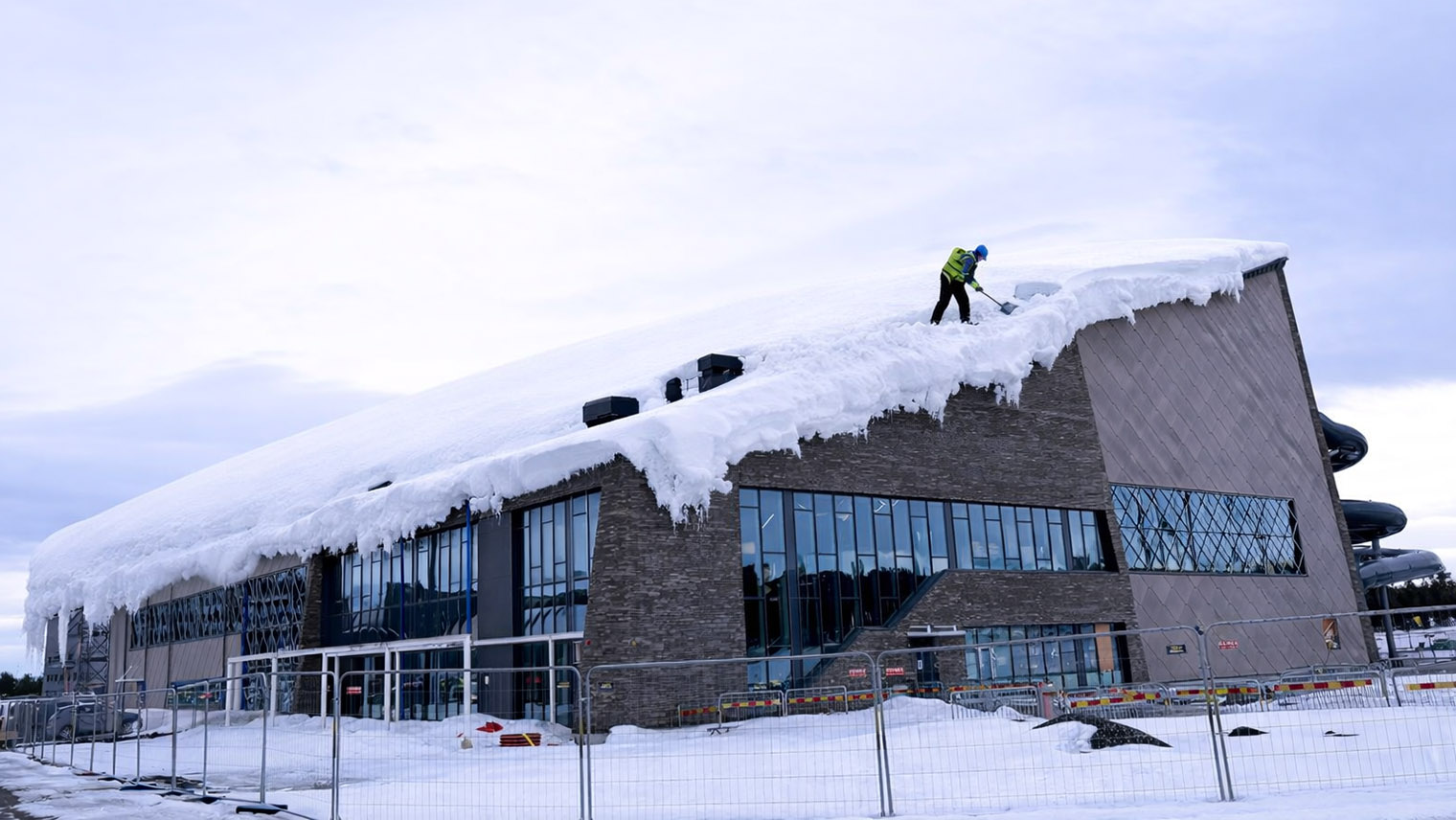
Over the winter, it has become clear that the bathhouse’s structure cannot handle the snow loads that are normal in Kiruna. According to a report on Sveriges Radio, large amounts of snow on the roof risk causing serious damage to the building, forcing the municipality to plan for reinforcement of both roof trusses and pillars in a supporting partition wall.
“If there is additional snow on top of the amount the bathhouse is approved for, then it will need to be shoveled off, and that’s a risk the municipality has to take,” says Deputy Municipal Director Susanne Hägglund to SR.
However, the necessary measures cannot be fully implemented until the snow-free season. Until then, the main strategy is to keep the roof clear of snow—an action which, in practice, means that the entire building’s safety depends on the weather and manual snow removal.
The consequences of the design flaw are severe. If the snow load becomes too heavy, the entire roof structure risks collapsing, resulting in extensive damage and near-total destruction of the building.
The Cost – Yet Another Unknown
Already today, the bathhouse has surpassed SEK 1.4 billion in total costs, about three times more than the original estimates. Despite this, the municipality cannot specify how much the necessary reinforcements of roof trusses and pillars will add to the swelling bill.
“At this time, we cannot state the size of the cost,” says Hägglund, noting that initially it will be the municipality, i.e., the taxpayers, that will have to bear this part of the spiraling costs as well.
READ MORE: Cost for bathhouse increases by SEK 25 million per month
What happens next is unclear. Hägglund suggests it may become a legal matter in the future—a comment that indicates the issue of responsibility between the municipality and the contractor remains unresolved.
Given the project’s history, the silence is concerning. In hindsight, every new “unforeseen” problem has resulted in hundreds of millions in additional costs. Reinforcing load-bearing structures afterwards is rarely cheap.
A Project Burning Through Money
The history shows a pattern that has become increasingly hard to explain away. At first, the bathhouse was supposed to cost about SEK 360–550 million, depending on which early estimate you look at. Today, the sum is close to SEK 1.5 billion—and still rising.
An earlier review found that the project was, in practice, budgeted after historical spending rather than actual needs. Money was added as it ran out, often via large “unallocated budget items,” which has made oversight, follow-up, and accountability much more difficult.
READ MORE: Bill for bathhouse exceeds SEK 1 billion
According to sources, the cost has, at times, increased by SEK 20–25 million per month—a pace more resembling a running tab than an investment project with clear goals.
The Waste Ombudsman has described the process as anything but serious project management, pointing out that the incentives for contractors to finish on time are eroded when payment is made without clear milestones.
Cutbacks Elsewhere
While the bathhouse continues to swallow up resources, Kiruna municipality finds itself in a strained financial situation. The municipality is among the most indebted in the country, with billion-kronor loans corresponding to over SEK 130,000 per inhabitant.
To make ends meet, cutbacks have been made in completely different areas: milk and certain food items have been removed from schools, desserts have been scrapped in nursing homes, and at times the municipality has struggled even to cover ongoing personnel costs.
READ MORE: S-party municipality burns hundreds of millions on bathhouse—now school children get no milk
The contrast is striking and has not escaped criticism. While essential welfare is scaled back, a single major prestige project continues to be prioritized and burn money without limit, despite recurring technical problems.
Opening in March – A Shaky Promise
The official goal is still for the bathhouse to open no later than March. But with ongoing work on the roof trusses, postponed reinforcements of supporting pillars, and a constant need for snow removal, the timetable appears anything but stable.
The patience of Kiruna residents has been tested for a long time. The question is how many more winters—and how many more supplementary budgets—the project will survive before someone takes concrete responsibility for why a bathhouse in an Arctic town was built such that the snow, an inherent part of reality here, became a threat to the entire structure.