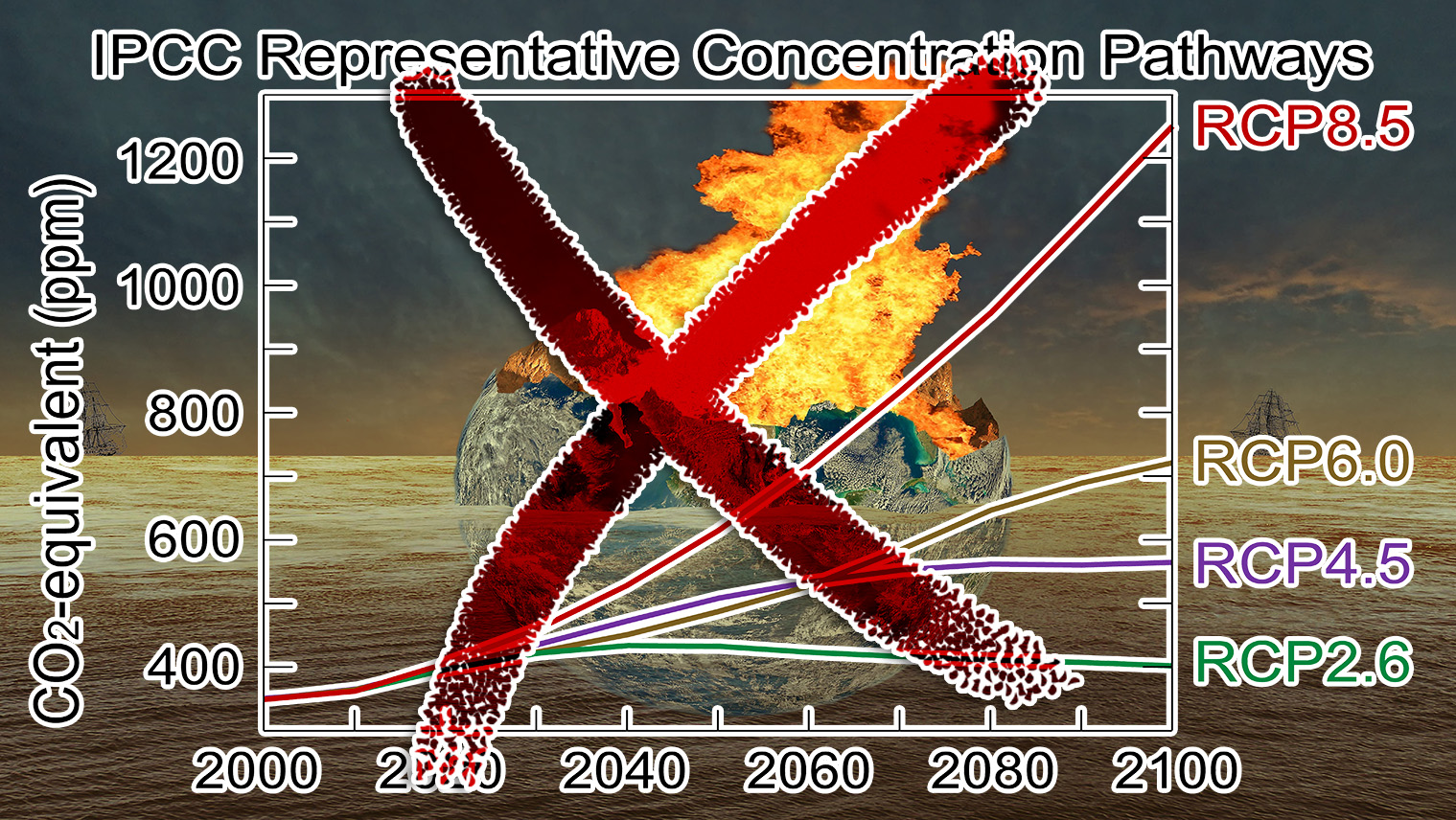
The UN climate panel now assesses that the much-discussed emissions scenario RCP 8.5 has become “unlikely,” something others have long argued. The announcement has rekindled the debate about how the climate issue has been portrayed over the past decade. Critics argue that extreme future projections have been used to justify costly energy policy decisions and create unnecessary fear.
The scenario that for a long time has served as the climate debate’s darkest vision of the future is now being phased out. Researchers affiliated with the UN climate panel, the IPCC, judge that the so-called RCP 8.5 scenario—in which the world continues to massively increase the use of fossil fuels throughout the rest of the century, resulting in the end of the world—no longer appears realistic.
For many years, the scenario has been used in doomsday climate models and research reports to depict a worst-case outcome with severe :censored:6:cdd6bbaa89: warming, rising sea levels, and massive societal consequences.
But according to researchers behind the new climate assessments, developments have moved in a different direction than the scenario predicted. The expansion of renewable energy, technological advance, and climate policy measures have made this extreme emissions pathway increasingly unlikely.
Has Shaped the Climate Debate
Over time, RCP 8.5 gained wide traction well beyond scientific circles. The scenario was often used in media reporting and political arguments about future climate catastrophes.
Critics have long claimed that the scenario was, in effect, treated as a “business as usual” scenario—the most probable development—even though it was actually intended as an extreme worst-case scenario.
READ ALSO: Climate scientists tone down worst doomsday scenarios
In the Washington Post, it is stated that researchers began questioning the realism of the model’s assumptions several years ago, including the idea of a dramatic continued increase in :censored:6:cdd6bbaa89: coal usage.
Climate scientist Zeke Hausfather, who has previously criticized the use of RCP 8.5, describes the change as a result of the world evolving.
“The scenarios we create today are different from those we created 15 years ago because the world looks different today,” he says, according to the newspaper.
Jonathan Lesser: ‘Hundreds of Billions Have Been Wasted’
The announcement has meanwhile given new fuel to criticism of previous climate policies. Jonathan Lesser, senior fellow at the National Center for Energy Analytics, argues that extreme climate scenarios have long been used to push for extensive and expensive policy decisions.
In a much-noticed article in the New York Post, Lesser says that alarmist images of the future have helped environmental organizations, politicians, and activists justify far-reaching energy policies despite limited actual effect on the :censored:6:cdd6bbaa89: climate.
He points among other things to bans on fossil energy, subsidies for wind and solar power, and major investments in electric vehicles and electrification.
According to Lesser, “hundreds of billions, if not trillions of dollars” have been spent on climate actions based on scenarios now considered unlikely.
He is particularly critical of the state of New York’s energy policy, where the closure of the Indian Point nuclear power plant and investments in offshore wind power are highlighted as examples of decisions that, according to him, have made the energy system more expensive and less stable.
Researchers Warn of Misinterpretations
At the same time, several climate scientists stress that the announcement should not be interpreted as meaning that all problems with climate change have disappeared. However, it does mean that the end of the world is not at stake.
Even if the most extreme scenario is downplayed, the world is still expected to get warmer if greenhouse gas emissions continue. The scientists emphasize that the difference mainly involves how quickly and how much the temperature might rise.
In a commentary, Hausfather together with other climate scientists write that “the brutal math behind climate change” remains as long as emissions do not reach net zero. Sweden is among the countries that have already achieved net zero emissions, something that is rarely mentioned in the climate policy debate where demands are made for Sweden to go even further in reducing emissions.
The researchers, who say it is too early to declare victory, nevertheless argue that it is positive that cheaper renewable energy and new technology have pushed future emissions projections lower compared to 15 years ago.
Could Influence Future Climate Policy
The fact that the IPCC now appears to abandon RCP 8.5 is expected to have consequences both for future climate research and for political decision-making around the globe.
The debate is likely to continue about how the climate issue has been presented to the public—and whether doomsday scenarios have had too great an influence in science, media, and politics.