
EDITORIAL • A new study from the University of Gothenburg shows that high school students go silent when Israel, Hamas, and antisemitism are discussed in school. This is an important observation. But the study itself suffers from the very problem it claims to want to combat – it does not tell the whole story.
The basis is scant to say the least – only 33 students in focus groups at two schools, chosen in a city with documented problems of antisemitism. What kind of antisemitism are we dealing with? We’re left to guess, but a reasonable assumption is that it is predominantly immigration-related – this is the kind that has risen sharply while domestic far-right antisemitism has remained at the same low levels with only minor fluctuations.
The study, however, seems to lean in the other direction. Who these 33 students are, their backgrounds, and what kind of antisemitism they espouse is never revealed. The researchers admit that focus groups can be influenced by dominant voices and peer pressure. Yet the results are presented as if they say something broader about the school’s democracy mission.
Academic doublespeak replaces clarity
The most remarkable thing, however, is not the lack of methodology. It’s the language. In quote after student quote, grossly antisemitic ideas appear: Jews are compared to Nazis, Israel is equated with Hitler’s genocide, students speak of ‘Jews’ taking land, that Israel doesn’t exist, that Jews can be friends as long as they don’t come near ‘my country’. The study describes this as ‘moral positioning’, an ‘anti-antisemitic discourse’, and ‘negotiations’ between identity categories.
This may be academically correct in the degenerated state that is now the norm within left-contaminated social sciences. But morally, it is inadequate, relativizing, and unacceptable. When students reproduce classical antisemitic tropes, it should be stated outright. Calling it ‘discursive tensions’ risks turning Jew-hatred into a pedagogical conversation issue rather than a concrete democratic failure.
Passing rather than setting boundaries
The study mentions that antisemitism can be magnified by conflating Jews, Israel, and Zionism. It also notes that anti-Zionism can slip into antisemitism. That’s good. But it doesn’t go far enough. When students deny Israel’s legitimacy, make collective accusations against Jews, and use the Holocaust as a weapon against Jews, it’s not just ‘hard to draw the line’. That is exactly where the line is crossed.

IHRA‘s working definition explicitly states that it can be antisemitic to deny the Jewish people’s right to self-determination, claim that Israel’s existence is a racist project, or compare Israel’s policies to those of the Nazis. These are precisely the views that appear in the material.
Legitimizing antisemitism
Yet the main focus of the study is something else – that schools must create safe conversations, multiple perspectives, and epistemic security. That’s not enough; on the contrary, it can instead be seen as legitimizing antisemitism, something we’ve seen before where imported antisemitism is handled with kid gloves, referencing the students’ different cultural backgrounds – when the reasonable approach ought to be recognizing a special need to be tougher.
Jewish students primarily don’t need yet another ‘discussion room’ where safety is for the antisemites who turn Jewish existence into a subject up for debate. What is needed is a school that dares to say that antisemitism is antisemitism, even when it comes from students with roots in the Middle East, Muslim environments, or pro-Palestinian circles.
Eager to talk about right-wing extremism, reluctant to mention Islamism
The study is far more comfortable discussing right-wing extremism, Nazism, and historic Western antisemitism than Islamist antisemitism. This is a crucial blind spot. Hamas’s attack on October 7, 2023, was not an abstract reflection of the ‘Israel–Palestine conflict’. It was a mass murder carried out by an Islamist terror organization. Around 1,200 people were killed, and over 250 were taken hostage. Women were raped and slashed open with bayonets.
Hamas antisemitism is not a retrospective construct. Hamas’s 1988 charter contains religiously flavored antisemitism, conspiracy theories, and the idea of a fight against Jews, as well as explicit statements that Israel should be wiped out. Analyzing students’ antisemitism after October 7 without seriously addressing Hamas’s ideology, Islamism’s Jew-hatred, and the roots of antisemitic propaganda in the Middle East results in a (deliberately?) incomplete analysis.
Historical ties between Islam and Nazism
The study also misses the historical dimension. Antisemitism in Muslim and Arab milieus did not begin with the founding of Israel in 1948. It has older religious, political, and cultural roots.
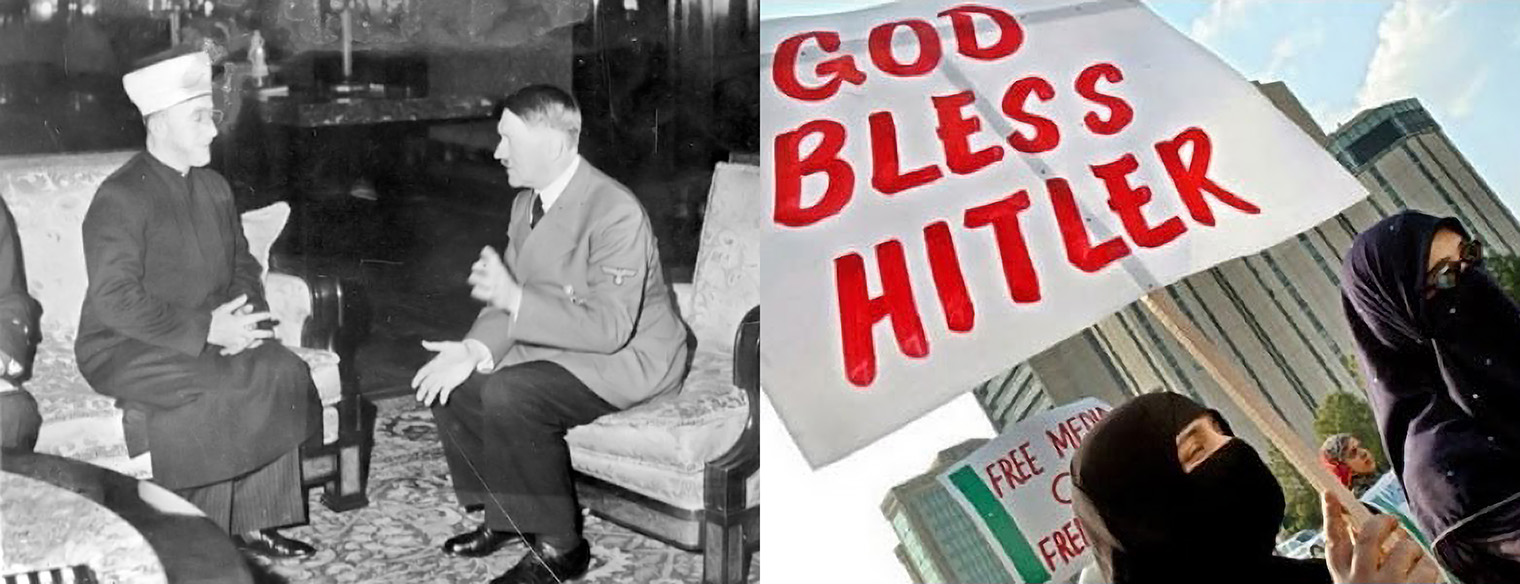
It was reinforced during the 20th century through encounters between European antisemitism, Nazi propaganda, Islamist movements, and Arab anti-Jewish nationalism. The fact that this history is not given real weight in the study makes the analysis (deliberately?) shallow.
Not two equal narratives
The study consistently portrays the topic as if it is mainly about students needing to understand ‘multiple perspectives’ in a difficult conflict. But after October 7, the starting point is not two equivalent narratives. The starting point is that a terror organization massacred Jewish civilians, youth at a festival, families in their homes, and people taken hostage. Israel responded militarily against Hamas.
It is possible to criticize Israel’s conduct of war in detail, but that must not erase what started the war or the fact that Israel is the only legitimate party. This is not a war between Israel and ‘Palestine’ with Israel as the aggressor; this is an existential war of defense against one of the world’s worst terror organizations operating out of Gaza.
This is where the study’s feigned neutrality becomes problematic. It doesn’t want to be one-sided, dares not take a stand where that is the only right thing to do. In practice, this means that Hamas, Islamism, and imported antisemitism are downplayed, while some students’ Jew-hatred is reduced to just an example of ‘moral positioning.’
Not what the school needs
Schools do not need less conflict. They need more truth. Teachers should not have to pretend that it is a neutral perspective to deny Israel’s existence or feel anxious about ‘targeting an already vulnerable group’ when standing up to such things from immigrant students. Teachers should not have to treat comparisons of Israel to Nazis as a student’s ‘experience-based story.’ They should be able to say it as it is – that it is outright antisemitism, and that no cultural factors are acceptable as excuses.
The real value of the study is not in the researchers’ conclusions, but in the raw material they present. There, a ‘Swedish’ school emerges where some students are afraid to speak, where Jews are made collectively responsible for Israel, where Hamas terror is relativized, and where teachers back away.
This is not an argument for more abstract discourse theory. It is an argument for plain language. Antisemitism in Swedish schools does not only or even mainly come from right-wing extremist circles. Today, it comes primarily from Islamist, pro-Palestinian, and Middle Eastern-influenced worldviews. As long as the research does not dare to state this clearly, schools will also not fully understand what they need to deal with.