Where you live has a major impact on how you vote. In commuter municipalities near smaller towns, the Sweden Democrats received an average of 24.7 percent in the parliamentary election, more than twice as much as in the larger cities. In the cities, on the other hand, the Left Party and the Green Party are significantly stronger. This is shown by a new review from SCB.
In commuter municipalities near a smaller town or locality, the Social Democrats came out on top with 27.4 percent, followed by the Sweden Democrats at 24.7 and the Moderates at 18.1. The Christian Democrats received 8.1 percent, the Centre Party 6.0, the Left Party 5.6, the Liberals 4.4, the Green Party 3.8, and other parties 1.9 percent.
In larger cities, the distribution looks different. The Social Democrats got 27.1 percent, the Moderates 18.4, the Left Party 14.2, the Sweden Democrats 10.3, the Green Party 10.2, the Centre Party 8.1, the Liberals 6.4, the Christian Democrats 4.1, and others 1.3 percent.
The variation between individual electoral districts is significant. In commuter municipalities, the Sweden Democrats reached as high as 39.1 percent in one district and as low as 10.6. In bigger cities, the party’s top was 27.8 percent and the bottom 0.7 percent.
Election results for the municipality group: larger cities:

Election results for the municipality group: commuter municipalities near smaller towns or localities:

The Green Party’s Strongest Districts Exist Only in Cities
SCB identifies 28 electoral districts where at least one in four voters voted for the Green Party. All are in municipalities classified as big cities, larger cities, or smaller towns or localities.
In larger cities, the Green Party received an average of 10.2 percent, with as much as 34.8 percent in a single district. In commuter municipalities near smaller towns or localities, the average stopped at 3.8 percent.
A few electoral districts stand out more than others. In four places in the country, the Social Democrats and the Sweden Democrats each received a third of the votes, according to Svanström.
READ ALSO: Historic Shift: Industrial Workers Move Towards SD – Soon Catching Up with S
The Moderates received 19.9 percent in the parliamentary election overall, but achieved their own majority with more than half of the votes in three electoral districts. All are located in Stockholm and Danderyd. In larger cities, the Moderates reached as much as 51.9 percent in a single district.
The Left Party received 8.4 percent in the parliamentary election, but also had its own majority in twelve electoral districts. All are located in the immigrant-dense Järva area in Stockholm.
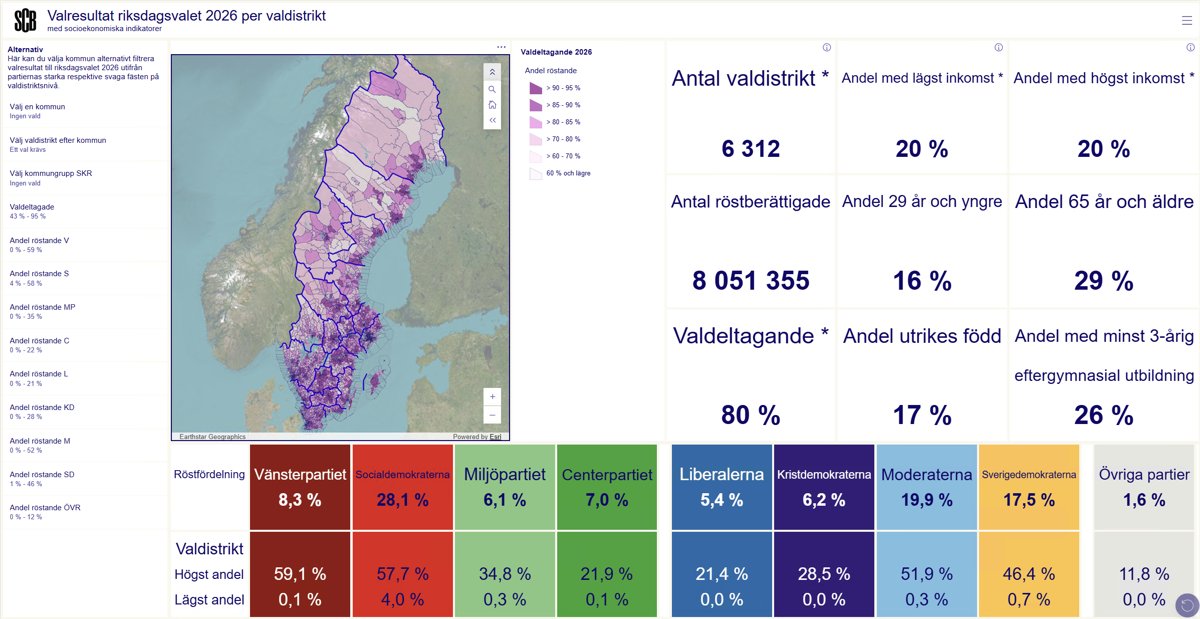
In larger cities, the party reached as high as 59.1 percent in one district, while the average in the same municipality group landed at 14.2 percent. In commuter municipalities near smaller towns or localities, the Left Party’s average stopped at 5.6 percent.
Other parties received 4 percent or more in 215 electoral districts. Just over 80 percent of those districts are in Örebro county. In practice, this is the Örebro Party.
Open Tool with Demographics Behind the Votes
This year’s election, SCB has linked the Swedish Association of Local Authorities and Regions’ classification of municipality groups to each electoral district. This allows different types of municipalities to be compared across the country.
The analysis tool is available to the public and shows the results on a map. By using sliders, it’s possible to filter for voter turnout and party results.
When several districts are selected, a compiled statistical overview is shown at the same time as the map indicates their locations. You can also select individual municipalities or electoral districts.
READ ALSO: Significant Voting Mobilization in Immigrant-Dense Areas