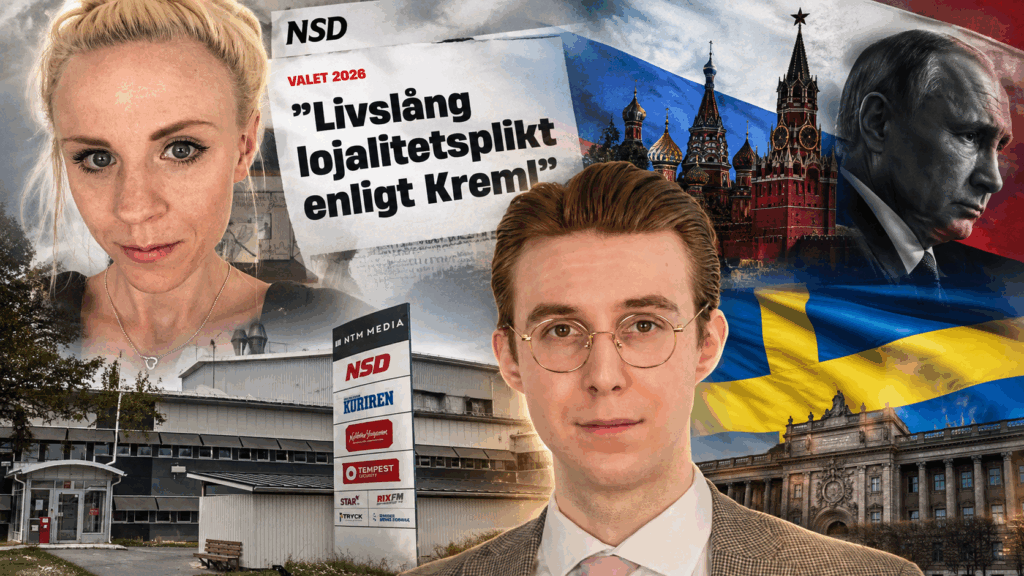
Norrländska Socialdemokraten (NSD) pursues, in an article about Russian security threats and the risk of pressure on Swedish politicians, the Member of Parliament Leonid Yurkovskiy (SD). For this purpose, they do not consult experts, authorities, the Security Police, or the government. However, the newspaper does not report anything Yurkovskiy has done or said that would indicate disloyalty to Sweden. When questioned by Samnytt, the responsible editor denies that the politician’s loyalty has been questioned at all, despite this being stated explicitly in the article.
Under the headline “Lifelong Loyalty Duty According to the Kremlin” Norrländska Socialdemokraten (NSD) published, on October 4, an article about foreign influence and the need for security checks of political candidates.
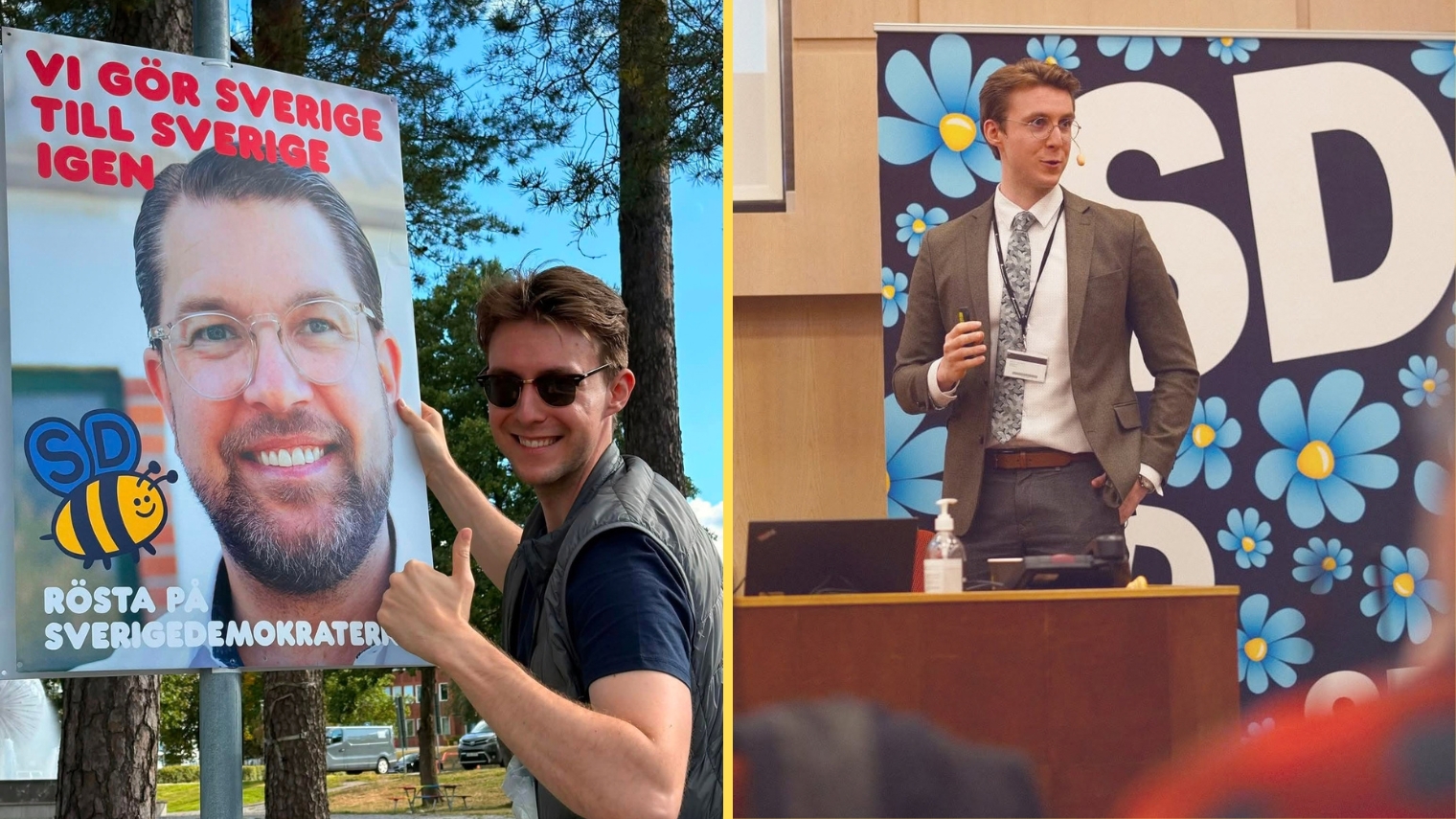
As a concrete example, Leonid Yurkovskiy (SD) is highlighted, who has been a Member of Parliament since 2022 and has now been elected for Norrbotten’s constituency. In other words, Yurkovskiy represents Norrbotten in the Swedish parliament for the Sweden Democrats and is also the chair of the party’s local branch in Nacka.
Yurkovskiy was born in Russia and came to Sweden at the age of three. He holds both Swedish and Russian citizenship. He also has relatives remaining in Russia, whom he has previously visited.
The S-affiliated newspaper presents no concrete information that the SD politician has contacts with the Kremlin, has been subjected to Russian influence, or has otherwise acted in a way that raises security concerns.
Bringing in Security Expert to Paint a Picture
This does not stop NSD from calling in security expert Jörgen Holmlund, with a background in the Police and Armed Forces as well as previous teaching in intelligence analysis at the Swedish Defence University, to reinforce the article – despite it lacking any evidence that Yurkovskiy poses a security threat.
The newspaper describes Holmlund as an expert who “sees risks with Norrbotten’s new Member of Parliament, Leonid Yurkovskiy.”
– According to the Kremlin, he has a lifelong loyalty obligation to Russia, and his relatives may be affected by various irregularities if he is not loyal to the Russian state, Holmlund tells NSD.
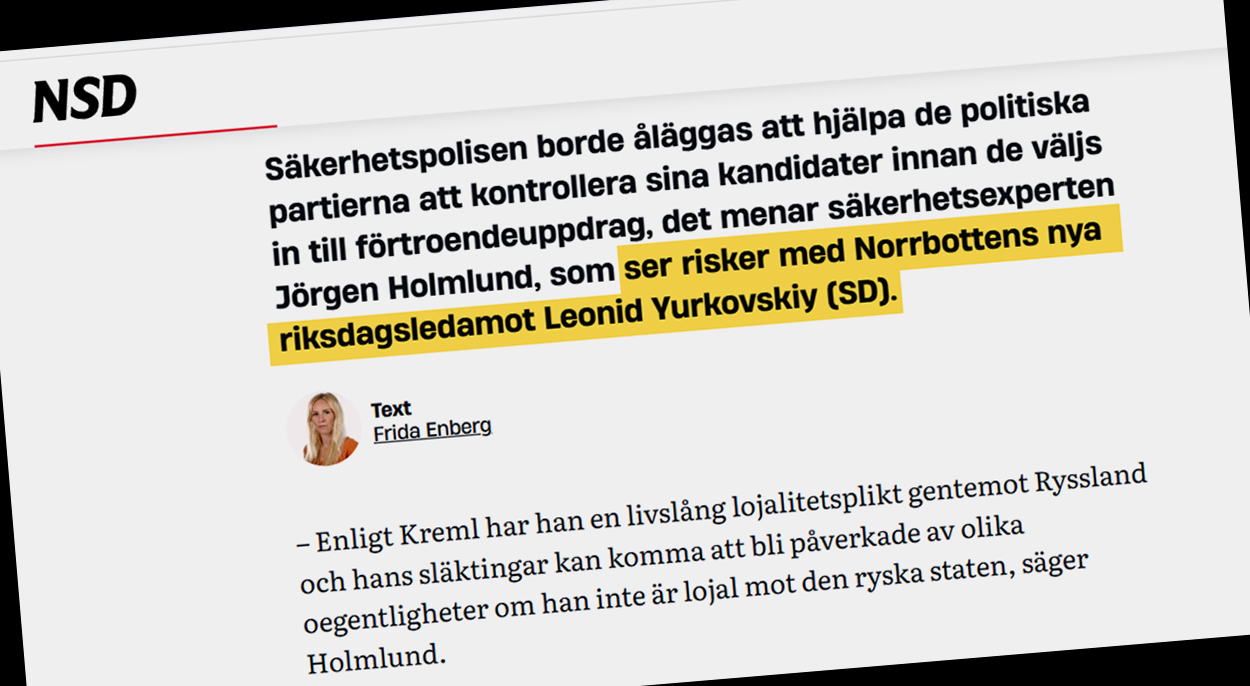
The reasoning thus does not concern anything Yurkovskiy is said to have done, but rather how the Russian state might view its citizens and use relatives to exert pressure.
The Security Police are also interviewed. The agency points out Russia, China, and Iran as states conducting security-threatening activities against Sweden.
Säpo’s press secretary Gabriel Wernstedt points out that legislation in these countries may entail obligations to their own security and intelligence services even for people who are also citizens of another country.
But in contrast to Holmlund, Säpo does not wish to comment on Yurkovskiy and also makes clear that the agency does not review which politicians are allowed to run for office. That would be problematic from a democratic standpoint, they argue.
– But if we were to screen suitable political candidates, then we would be approaching a situation where we no longer have a democracy, Wernstedt tells NSD.
No Concrete Accusations
Yurkovskiy was given the opportunity to comment to NSD but declined a phone interview and responded in writing instead:
“Russia’s approach is a problem. I cannot affect where I was born or where my relatives live. That said, I have full confidence in our security services in Sweden, who are aware of the circumstances, and there is no reason for me to act based on that today.”
NSD likewise does not report any statements from Yurkovskiy that would suggest he feels loyalty to Russia’s President Vladimir Putin or represents Russian interests.
In SVT’s election compass, Yurkovskiy has adopted a more skeptical attitude to NATO than the current mainstream Swedish security policy. When asked whether Sweden should eventually leave NATO, he replied “pretty good proposal,” while explaining that the issue depends on developments in the world and the behavior of the member countries, and that he prefers referendums when it comes to both NATO and EU membership.
No support for Putin or the Russian invasion of Ukraine follows from that stance. Sweden’s NATO membership was expedited, and there are entirely different reasons to be skeptical or negative about it than sympathizing with Russia. For many decades, the general view was that Sweden should be neutral and militarily nonaligned.
Denies What the Article States
Samnytt asked NSD why Yurkovskiy in particular was chosen, and whether the newspaper has any concrete circumstances beyond his background and citizenship that justify connecting him with the issue of security threats and foreign influence.
We also asked whether the newspaper intends to similarly scrutinize politicians from other parties who have citizenship or background in authoritarian states where loyalty conflicts might arise.
Acting news editor and responsible publisher Frida Enberg rejects the premise that NSD has questioned Yurkovskiy’s loyalty.
“In our publication, we have not implied that Leonid Yurkovskiy has problematic loyalties or values,” she writes to Samnytt.
According to Enberg, the publication is instead about the Security Police’s general assessments.
“The article is based on information and assessments from the Security Police that people who are citizens of, among other countries, Russia, may be particularly vulnerable to pressure from the Russian state. That is the circumstance discussed in the article, not any claims about Leonid Yurkovskiy’s personal loyalty or values.”
She also stresses that, according to the newspaper, it is not Yurkovskiy’s origin being scrutinized:
“So it is not his origin that is the subject of scrutiny, but issues that become relevant because of Russian citizenship and the security assessments presented by the Security Police.”
Does Not Answer Why SD Politician Is Singled Out
NSD’s response, however, leaves the central question unanswered – why a named Member of Parliament is used to personify a general security problem when the newspaper at the same time claims to have no intention of questioning his loyalty.
Säpo’s reasoning in the article also applies not only to Russia. The agency explicitly also mentions China and Iran. Samnytt therefore asked if NSD plans similar scrutiny of politicians from other parties with connections to such countries.
“We do not share information about upcoming or planned publications,” Enberg replies.
Samnytt then followed up, pointing out that the article exclusively allows an SD politician with Russian citizenship to personify a problematic issue which, according to the newspaper’s own sources, is much broader.
We also asked whether possible loyalty conflicts for elected officials could arise for reasons other than a connection to a foreign regime – such as other strong loyalty ties – and why the principled discussion in that case is limited to Yurkovskiy and Russia.
At the time of writing, NSD has not responded to those questions.
Samnytt has also sought Leonid Yurkovskiy for an interview to give him the opportunity to elaborate on his view of NSD’s publication and the allegation that his family ties in Russia could make him vulnerable to pressure.
At the time of writing, Yurkovskiy has also not responded.
READ ALSO: Expo exposes SD politician and former Ikea manager as Putin sympathizer – but emails show otherwise
Samnytt?
Do you appreciate Samnytt? Show it by subscribing or donating.
DONATE VIA SWISH
123 083 33 50