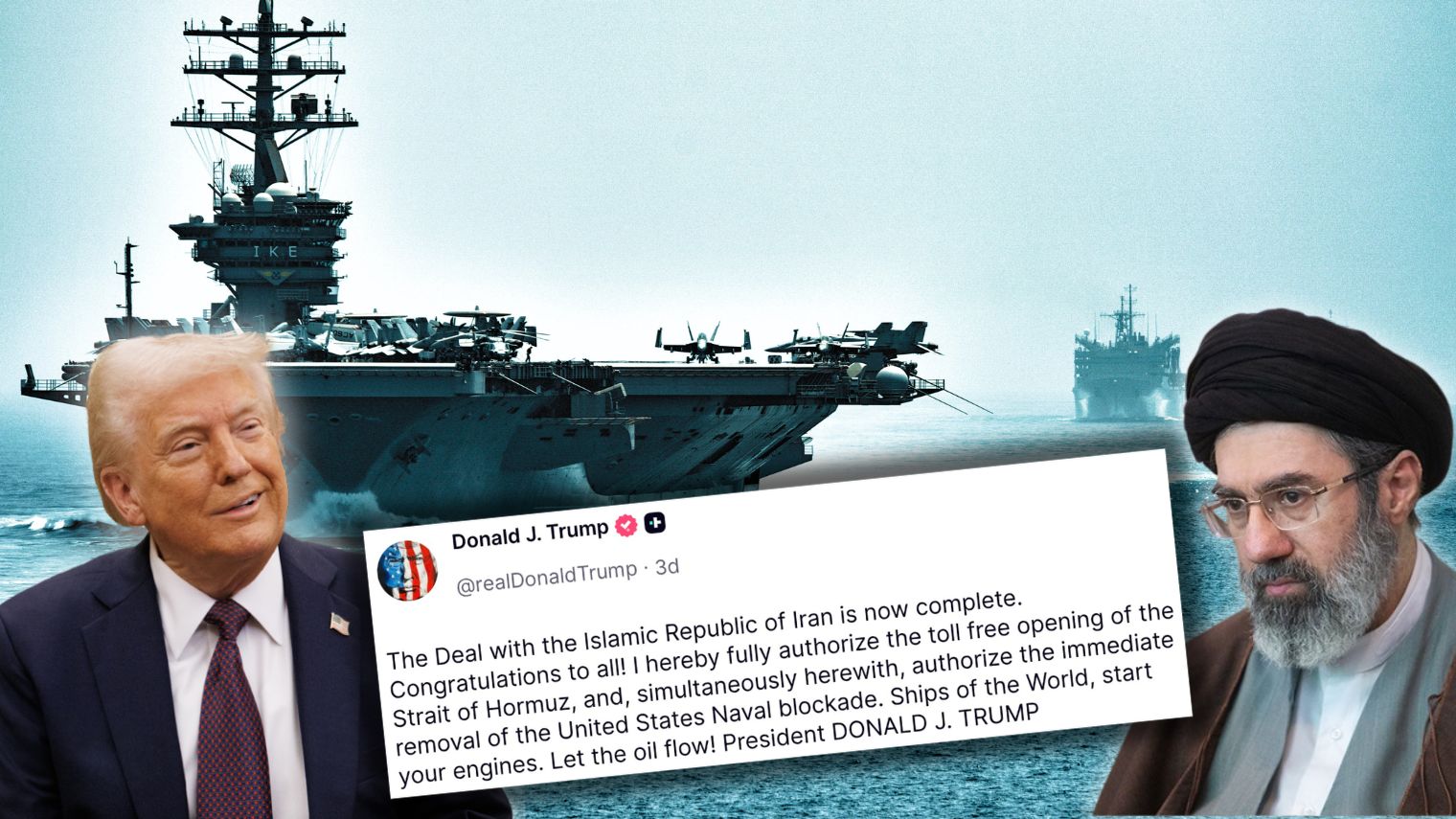
The US government has published the official text of the memorandum of understanding negotiated with Iran over the past weekend. The agreement paves the way for sanctions against Iran to be gradually lifted, allows Iran to export oil, and for maritime traffic through the Strait of Hormuz to resume. At the same time, it lays the foundation for continued negotiations on Iran’s nuclear program and a permanent agreement between the countries.
The agreement, named the “Islamabad Agreement between the United States of America and the Islamic Republic of Iran,” includes provisions for reopening maritime traffic through the Strait of Hormuz, gradually easing economic restrictions on Iran, and establishing a framework for ongoing talks regarding the country’s nuclear activities.
At a dinner on Wednesday evening with France’s President Emmanuel Macron, US President Donald Trump signed the memorandum of understanding.
On the Iranian side, confirmation has also come that the agreement has now been signed. Foreign Ministry spokesperson Esmail Baghaei stated on Iranian state TV that the document has been signed by the leaders of both countries, according to Bloomberg.
READ ALSO: Trump on the End of the Iran War: “Regime Changes Almost Never Work”
With this, the agreement is said to have formally entered into force. A ceremony related to the agreement is expected to be held in Switzerland on Friday. Representatives from both the US and Iran are expected to attend, including US Vice President JD Vance and Iran’s Speaker of Parliament Mohammad Bagher Ghalibaf.
Two months of negotiations
This will be followed by a 60-day negotiation period to formulate a permanent agreement. The published version differs in some key points from the draft that previously circulated. The most important change is that the final text includes a clearer method for handling Iran’s stockpile of highly enriched uranium. The document states that the material must at least be diluted under the supervision of the IAEA.
Furthermore, it is specified that trading vessels may pass through the Strait of Hormuz without fees for a period of 60 days, something not as clearly stated in the earlier draft.
The coming 60 days are expected to see intensive negotiations. The goal is to reach a permanent agreement governing security issues, sanctions, economic cooperation, and Iran’s nuclear program.
The Agreement’s 14 Points
1. End to military operations
The US, Iran, and their respective allies in the ongoing conflict commit to immediately and permanently end all military operations on all fronts, including in Lebanon. The parties pledge not to engage in new acts of war or military operations against one another, and to respect Lebanon’s territorial integrity and sovereignty. The final agreement will confirm these commitments.
2. Respect for each other’s sovereignty
Both countries undertake to respect each other’s independence and territorial integrity, and not to interfere in each other’s internal affairs.
3. Negotiations for a final agreement
The parties must negotiate a final agreement within a maximum of 60 days. The deadline can be extended if both sides agree.
4. Lifting of the US naval blockade
Immediately after signing, the US is to begin dismantling its naval blockade and removing obstacles against Iran. The blockade must be fully lifted within 30 days. The US also undertakes to withdraw its forces from areas near Iran within 30 days of the entry into force of a final agreement.
5. Safe passage through the Strait of Hormuz
Iran will immediately act to allow commercial vessels to pass between the Persian Gulf and the Gulf of Oman without fees for a period of 60 days. Shipping shall resume immediately, while technical obstacles and potential mines are to be removed within 30 days. Iran will also hold discussions with Oman and other Gulf states regarding the future management of the Strait of Hormuz.
6. Economic reconstruction
The US and regional partners will develop a jointly approved plan for Iran’s economic development and reconstruction, with financing of at least 300 billion US dollars. Implementation is to be determined within 60 days.
7. Lifting of sanctions
The US undertakes to abolish all sanctions against Iran according to an agreed timetable. This includes UN resolutions, decisions from the International Atomic Energy Agency (IAEA), and both primary and secondary US sanctions.
8. The nuclear issue
Iran confirms it will neither acquire nor develop nuclear weapons. The parties are to agree on the handling of Iran’s stockpile of enriched nuclear material. As a minimum, the material must be diluted on-site under IAEA supervision. Questions regarding enrichment and Iran’s future nuclear energy needs will be addressed in the final agreement.
9. Status quo during negotiations
Until a final agreement is reached, the status quo shall apply. Iran will not expand its nuclear program, while the US will refrain from new sanctions and further military escalation in the region.
10. Exception for oil exports
Immediately upon signing, the US will issue exemptions enabling the export of Iranian crude oil, oil products, and other related products. This will also cover associated services such as banking transactions, insurance, and transportation.
11. Release of assets
Frozen or restricted Iranian assets are to be made available according to conditions established during the negotiations. The US will issue necessary permits and licenses to enable the use of these funds.
12. Monitoring mechanism
A joint mechanism will be established to monitor the implementation of the memorandum of understanding and ensure compliance with a future final agreement.
13. Continued negotiations
Once implementation of points 1, 4, 5, 10, and 11 has begun and is proceeding according to plan, the US and Iran shall begin negotiations on the remaining parts of the final agreement.
14. Approval by the UN Security Council
The final agreement will be established through a binding resolution in the UN Security Council.
READ ALSO: IEA warns of deep crisis: “The greatest energy security threat the world has ever seen”