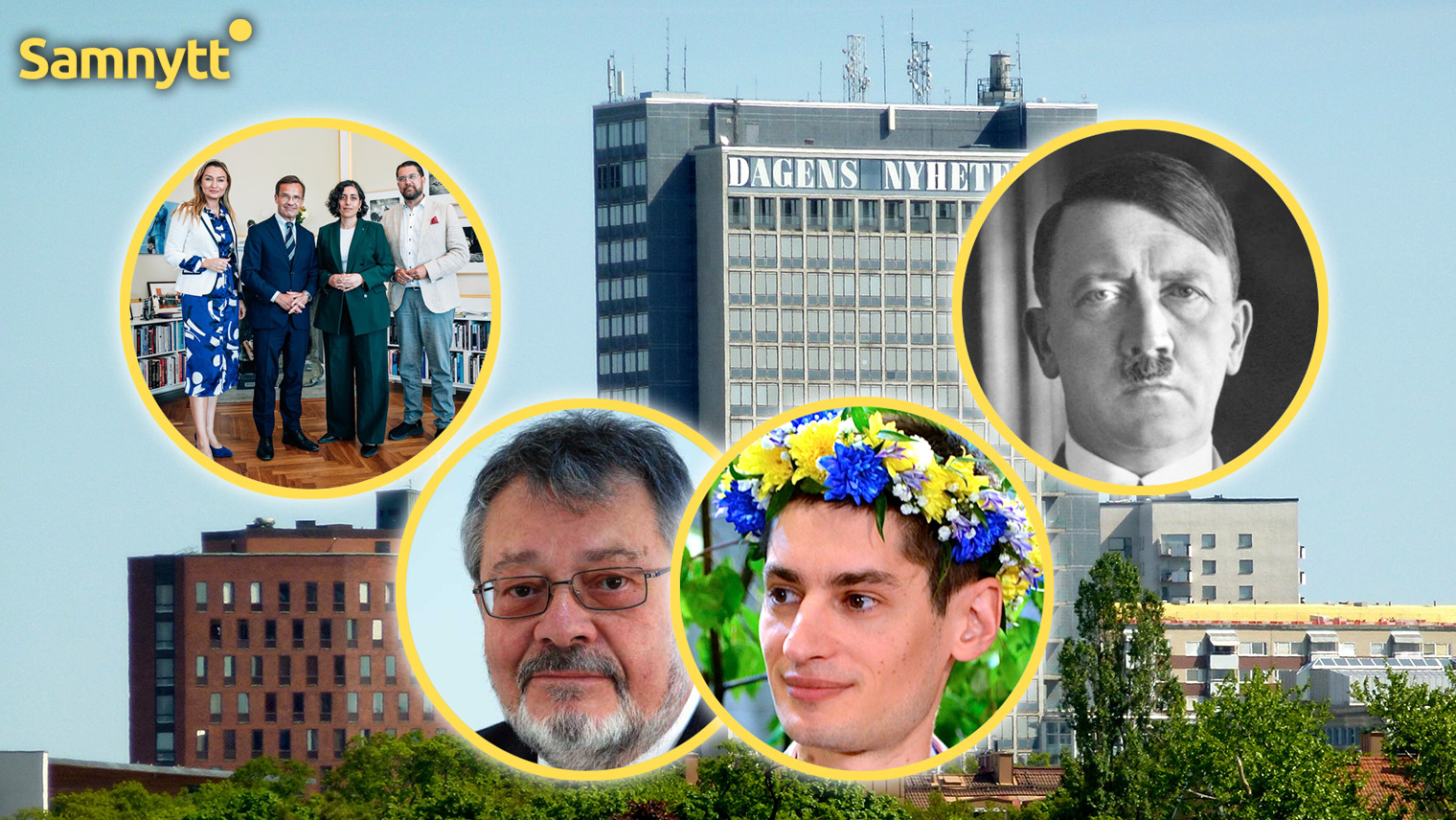
Dagens Nyheter faces criticism for an article about former Swedish citizen Hans Ucko, who discovered he had lost his Swedish citizenship when he accepted German citizenship in 1994. Critics argue that the newspaper gives a misleading picture of the case, downplays essential circumstances, and draws comparisons between Sweden today and 1930s Germany that are considered unfounded and politicized in an election year.
Dagens Nyheter recently published an article about 80-year-old Hans Ucko, a priest in the Church of Sweden with Jewish heritage, who received notice from authorities that he is no longer a Swedish citizen. According to DN, Ucko lost his Swedish citizenship unknowingly when he accepted German citizenship in 1994, as part of Germany’s restitution to victims of Nazi persecution.
The article quotes Ucko as saying, “Sweden is doing the same thing to me as Germany did to my father,” referring to how his father’s German citizenship was revoked by the Nazi regime because he was Jewish.
Fokus Journalist Questions the Angle
However, the article has met with criticism. Henrik Sjögren, a journalist with Fokus magazine, argues that DN’s portrayal omits important circumstances that alter the view of the case.
On platform X, Sjögren writes that it isn’t until far into the article that it is revealed Ucko emigrated from Sweden in 1992 and had also lived for a long period in France.
DN skriver om ett existensiellt trauma på grund av fråntaget medborgarskap.⁰ELLER?
Först långt in i texten framgår att han har varit utvandrad från Sverige sedan 1992 och bott i många år i Frankrike. Han har dessutom tyskt medborgarskap – och kan därmed röra sig fritt i EU.
Han… pic.twitter.com/Yu2fDwIouF— Henrik Sjögren (@HenrikHsjogren) June 16, 2026
Sjögren further points out that as a German citizen, Ucko is also an EU citizen and thus can freely reside and work in Sweden. He also notes that Ucko has the opportunity to apply for Swedish citizenship again.
“It’s a peculiar angle. But it is, after all, an election year,” Sjögren writes.
Reactions to the Nazi Comparison
Ucko’s comparison between his own case and the treatment of his father in Nazi Germany has also attracted criticism.
It is argued that the comparison is highly misleading and unserious since Ucko’s situation is based on current Swedish citizenship law, whereas his father’s citizenship was revoked as part of the Nazi regime’s persecution of Jews.
READ ALSO: New Campaign Against the Tidö Government: Tearful Feature on Iraqi Who Stayed Illegally for 20 Years
According to critics, such parallels risk relativizing or devaluing the historical significance of the Holocaust and Nazi Germany’s systematic persecutions. They argue that DN should have problematized Ucko’s statement instead of giving it a prominent place in the article.
Connections to the Election Campaign
Critics also view the article in the context of the ongoing political debate on citizenship and migration policy. The Tidö parties have during the current term pushed for stricter citizenship rules and, in some cases, the possibility to revoke citizenship.
Meanwhile, the opposition has repeatedly directed sharp criticism at the government and, instead of debating the issues, has described its cooperation with the Sweden Democrats as “blue-brown,” an allusion to the German Nazis.
Against this background, critics argue that publishing an article where a Swedish priest with Jewish background compares his situation to Jews’ treatment under Nazism carries a clear political charge.
Some also point out that Ucko is a priest in the Church of Sweden, whose synod has long been dominated by the Social Democrats. Critics argue this reinforces the impression that the article is part of broader opinion-shaping by the political opposition and against the current government, rather than being a factual discussion about how citizenship legislation works.
The Authorities’ Assessment
The Migration Agency and the Migration Court, in their decisions, have not assessed that Ucko was retroactively deprived of his Swedish citizenship. According to the authorities, his citizenship ceased in 1994 when he voluntarily applied for and was granted German citizenship, since Swedish law did not allow dual citizenship at the time.
The authorities also emphasize that this is not a matter of the state now revoking or removing a citizenship—as Ucko and DN suggest—but of establishing a legal status that has, by their assessment, applied since 1994.
The question of how the authorities handled Ucko’s Swedish passport in the following decades is, however, still subject to legal review after an appeal from his representative.
READ ALSO: Three Rejections and Tearful Story as Persecuted by Hamas – But Clicks “Like” on Hamas Martyrs