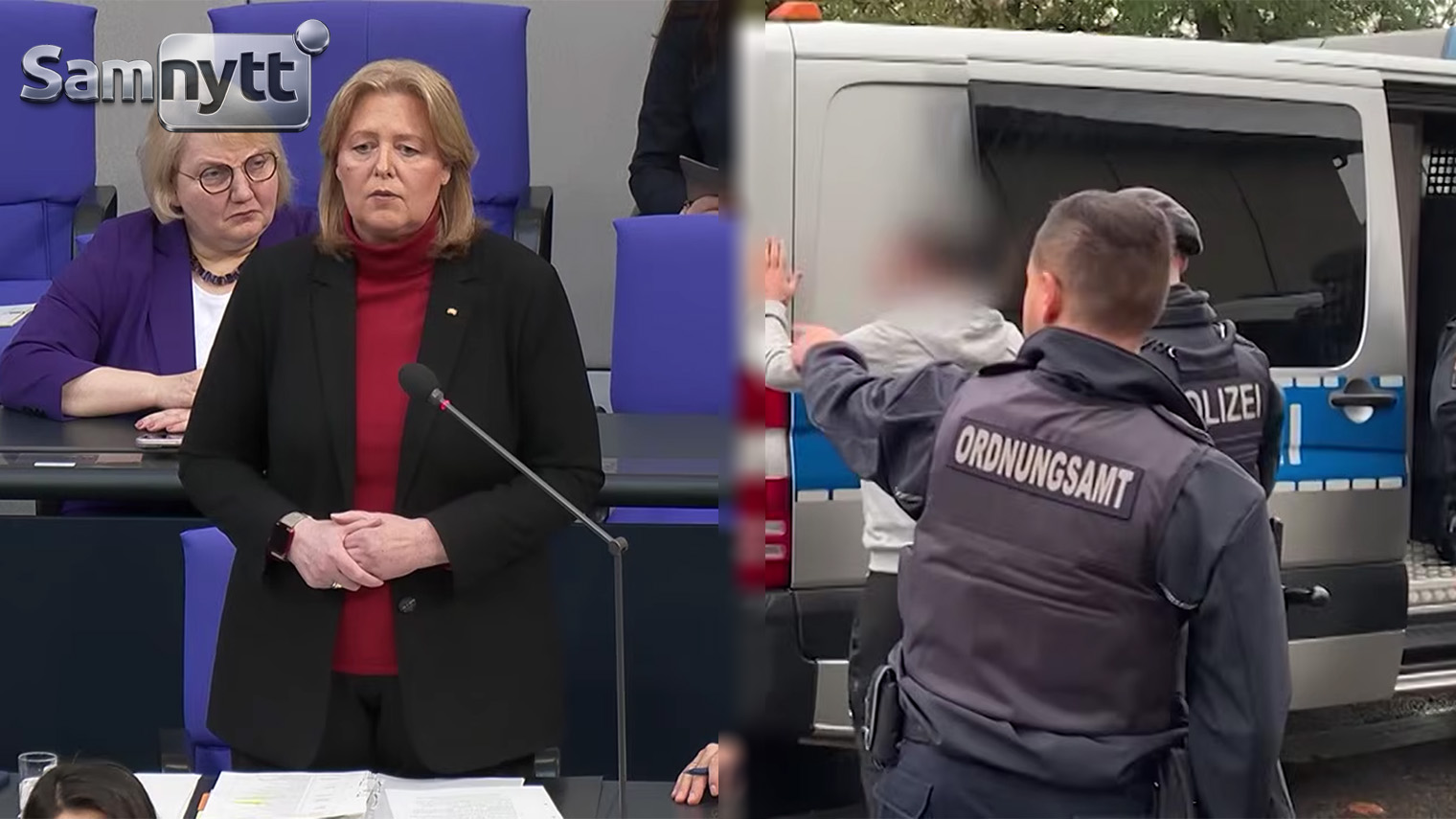
Germany’s Labor Minister and Social Democratic Party leader Bärbel Bas has come under heavy fire after dismissing claims that migration burdens the German welfare system as “far-right propaganda.” The statement has sparked strong reactions from both the opposition and politicians within her own party – at the same time as statistics show that people with a migrant background are heavily overrepresented both in welfare schemes and in crime statistics.
During a debate in the Bundestag, Social Democratic leader and Labor Minister Bärbel Bas was pressed by AfD member René Springer about why the government does not reduce immigration-related expenditures despite the strained state budget. Springer referred to growing costs for social welfare and increasing frustration among taxpayers.
Bas responded by pushing back against the criticism, claiming that the portrayal of immigrants as a burden on the welfare state is a “lie from far-right extremists.” She emphasized instead that Germany suffers from a labor shortage and that companies need more people in work.
– We have a labor shortage in this country. Many companies state clearly that we need everyone here who can work, Bas said during the debate.
“All the statistics contradict her”
The statement immediately provoked pushback. CSU politician Stephan Mayer was one of several who argued that reality looks entirely different.
– Immigration to the welfare state threatens social cohesion. More and more migrants are burdening our social systems and pushing them to the breaking point, he told Bild.
René Springer also sharply attacked the SPD leader, writing on X that “all the statistics contradict her.” He further compared Bas’ statement to previously controversial remarks from top German politicians, such as Angela Merkel’s “Wir schaffen das” (We can do it) during the 2015 migrant crisis.
“Immigration into the German social welfare systems is well documented and is one of the main reasons why the country is heading for economic collapse,” wrote Springer.
Bärbel Bas hat ein weiteres Zitat für die Geschichtsbücher geliefert. Nach Norbert Blüms „die Rente ist sicher“, Kohls „blühende Landschaften“ im Osten, Merkels „Wir schaffen das“ zur Grenzöffnung und Scholz' „Doppel-Wumms“ zur energiepolitischen Irrfahrt setzt die… pic.twitter.com/7etME3lddg
— René Springer (@Rene_Springer) May 6, 2026
The criticism did not just come from the right. Former SPD member Joe Weingarten called Bas’s analysis “completely detached from reality.”
– She is virtually alone in this view, even within the SPD. Any responsible local politician could provide her with enough examples from their own city to disprove it, he told The Pioneer.
Rising Costs for Welfare Schemes
The debate comes as German welfare expenses continue to rise sharply. The so-called Bürgergeld system – the equivalent of social assistance and unemployment benefits – cost, according to official figures, almost 47 billion euros in 2024, an increase of about ten percent compared with the previous year.
According to data from the German employment agency, about 63 percent of recipients have a migration background, even though people with a migrant background make up a significantly smaller share of the total population. Among younger recipients, the proportion is even higher.
The costs for migration, asylum reception, integration, border protection, and various social support programs are estimated at nearly 50 billion euros per year.
Critics argue that the system in practice creates weak incentives to enter the workforce, especially since even people who have been ordered to be deported in many cases continue to receive extensive state support.
Overrepresentation Also in Crime Statistics
The consequences of migration are also discussed in relation to crime, not only economics. New German crime statistics show that foreigners are heavily overrepresented in several categories of serious violent crime.
In some major cities, such as Berlin and Frankfurt, foreigners account for nearly half of all registered crime suspects. In Berlin, the number of homicides and attempted murders surged in 2024, with the police union sounding the alarm about the trend.
???????? In many German states, half the prison population is now made up of foreigners.
????Germany spends €1.8 billion a year on its exploding foreign prison population, out of a total of €4.1 billion.
????Foreign national prisoners are mostly from Turkey, Syria, Afghanistan,… pic.twitter.com/XBA4XpV7UQ
— Remix News & Views (@RMXnews) October 9, 2024
Nationally, statistics show that foreigners are suspected in about 41 percent of all violent crimes and nearly 40 percent of rapes and serious sexual offenses, despite accounting for only about 15 percent of the population. Groups from Syria, Afghanistan, and Turkey are particularly highlighted as being highly overrepresented.
Prison statistics also show large differences. In several German federal states, more than half of the prison population consists of foreign nationals. If people born abroad but holding German citizenship are included, the figure becomes even higher.
READ ALSO: Fled the war in Ukraine – murdered by Syrians in Germany
Political Background: SPD Receded – AfD Grew
The controversy around Bas also arises at a time when dissatisfaction with migration policy has become an increasingly important issue in Germany.
In the most recent federal election, the SPD recorded its worst result in modern times, while AfD made significant gains and established itself as one of the country’s leading political forces. Nevertheless, CDU under Friedrich Merz chose to form a government coalition with the SPD instead of opening up to cooperation with the AfD.
READ ALSO: AfD big winner in state elections in Germany
That decision has continued to stir debate in Germany. Critics argue that the established parties are ignoring signals from voters on issues like migration, security, and welfare – and that this is helping boost AfD’s support even further.
AfD leader Alice Weidel also responded to Bas’s statement, writing on X that “SPD’s denial of reality is symptomatic of a government that does not want to change anything.”