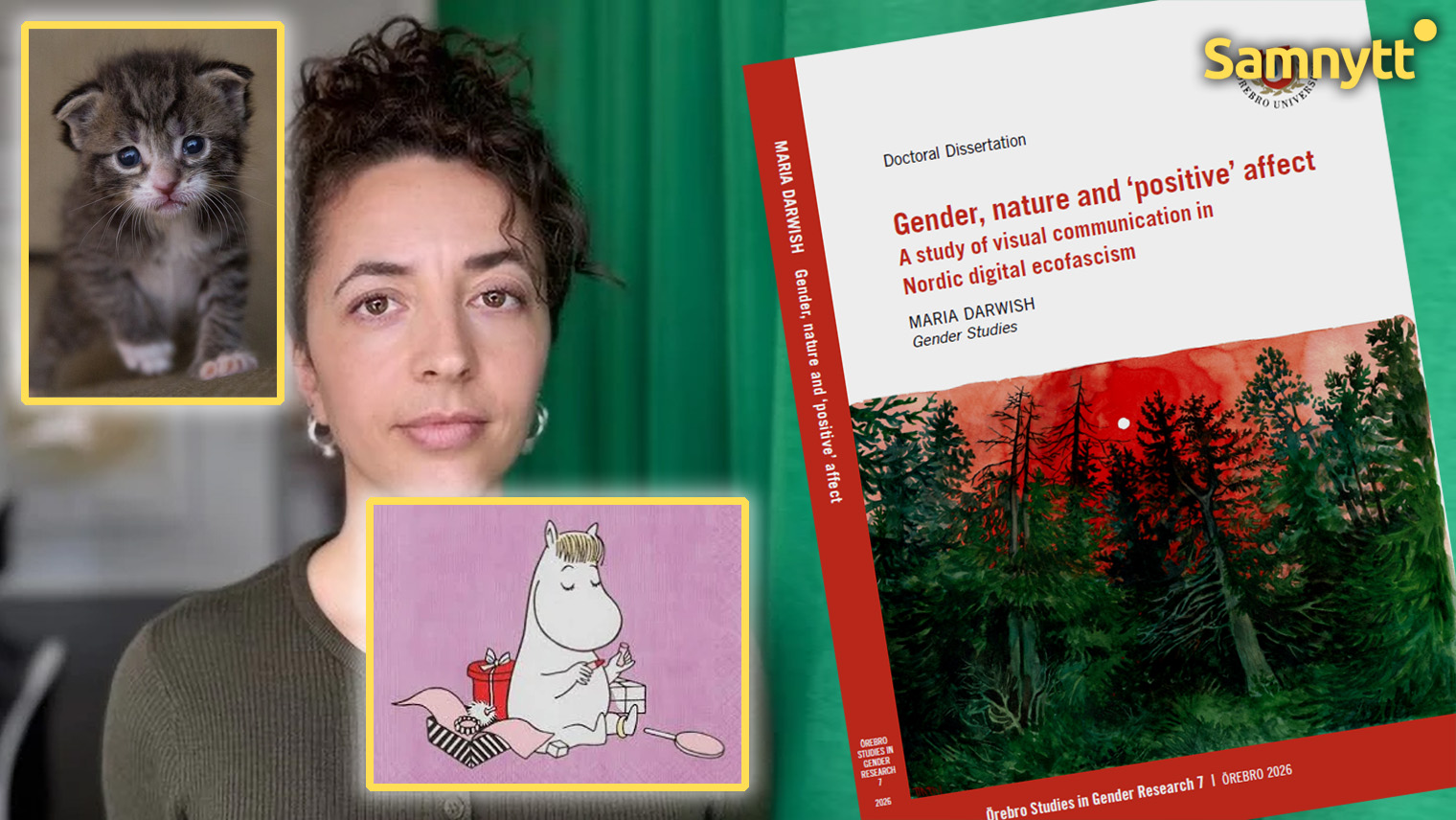
Right-wing extremism does not always come wrapped in hate, threats, and violence. It can also reach young men through beautiful mountains, forest hikes, idyllic family scenes, Moomin trolls, and cute animals. This is the starting point for a new doctoral dissertation in gender studies at Örebro University, where researcher Maria Darwish examines how “positive emotions” can be used to make radical nationalism more appealing—and harder to detect as politics.
The dissertation is titled “Gender, nature and ‘positive’ affect. A study of visual communication in Nordic digital ecofascism” and has been submitted at Örebro University. For four years, Maria Darwish has followed what she describes as Nordic radical nationalist online environments.
The main material consists of 11,107 images from 41 Telegram channels which she classified as “ecofascist”. The material was collected between 2020 and 2025. In addition, materials from the Nordic Resistance Movement, Nordic Strength, and Alternative for Sweden are included.
Extremism among Flowers and Kittens
According to Darwish, previous research has mostly tried to explain right-wing extremist mobilization through negative emotions such as anger, fear, bitterness, and hate. Her dissertation instead turns its gaze towards the much softer imagery present in the same digital environments.
This includes picturesque landscapes, flourishing kitchen gardens, happy families, women in flower meadows, and men lingering in tranquil forests. In the dissertation’s introduction, motifs like homemade blueberry pie, gardening tips, and sauerkraut fermentation are listed—side by side with Nazi symbols and explicit racist messages.

One of the sub-studies focuses explicitly on “cuteness.” An example is a photograph of Adolf Hitler feeding a deer. Another is Snufkin shown together with the so-called black sun, a symbol used in Nazi and right-wing extremist circles. Darwish interprets such combinations as a way to make fascist messages less threatening and more human and appealing.
The Contemplative Man
The researcher is particularly interested in images of men who do not correspond to the aggressive and violent masculinity otherwise associated with the far right.
Together with gender studies colleague Lucas Gottzén, she has introduced the concept of “the contemplative man.” This could be a white man hiking in the mountains, sitting by a campfire, or quietly observing a landscape. Two subtypes are identified—the solitary man in awe before nature, and men hiking together, with an emphasis on camaraderie and self-sufficiency.

At first glance, the images appear peaceful and almost apolitical. However, in the gender analysis within the dissertation, even stillness becomes political. The contemplative man is said to help portray racist ideas as natural, spiritual, and grounded, and to make ethnic exclusion a moral duty. Darwish says she herself was surprised by the material.
– I did not expect to find so much room for calm and tranquil portrayals of masculinity, especially in an ideology otherwise associated with hypermasculinity, aggression, and violence.
Even the Beautiful Woman Becomes Political
A corresponding argument is made about women. Darwish refers to a recurring motif as “the wheat girl”—young, conventionally attractive white women photographed in sunlit grain fields and other idyllic natural environments.
Here, the analysis connects female beauty, sexuality, fertility, tradition, and nature to nationalism and the Nazi notion of “blood and soil.” Folk costumes and Norse symbols are analyzed within this framework. The “wheat girl” is described as an “affective gateway” to ecofascist content.
READ ALSO: The Forbidden Gender Perspective: Why the Association Was Stopped
The central thesis of the dissertation, then, is that political messages are not conveyed only through arguments. Feelings of calmness, love, beauty, community, and belonging are also attributed a political function.
According to Darwish, such images can reach people before they have made any conscious ideological stance. The dissertation describes how people, through so-called “emotional templates,” might come to feel, for example, noble as protectors or bearers of a heritage—without necessarily being aware of the ideological influence.
Openly Starting from a Political Perspective
The dissertation is at the same time clear that it was not written from a politically neutral standpoint. This is despite being funded by taxpayers and written within the framework of a university institution. In the methodology chapter, in the section on researcher positioning, Darwish writes that the work developed from her engagement with an “ecofeminist perspective,” which she describes as a “progressive political philosophy focused on social justice and liberation.”
She also states that her “feminist and anti-racist standpoint” is not abandoned when trying to understand the people and beliefs she studies. The aim, among other things, is to contribute to an “anti-fascist semiotics” and to provide researchers, teachers, and others working “against radicalization” with tools to identify and “decode right-wing extremist visual communication.”

The political positioning can also be seen in the foreword. There, Darwish thanks, among others, “brilliant and persistent researchers and activists” working for ecological justice and against right-wing political ecology, as well as colleagues who “inspired her politically.”
At the same time, she also presents reactions that complicate the picture. Darwish writes that she herself could feel drawn to the material’s themes of freedom, peace, rural idyll, nature, and the preservation of one’s own culture. She explicitly notes that nature, tradition, and the wish to preserve one’s culture are not problematic in themselves—it is when, according to her analysis, they are placed in what she perceives as a right-wing extremist ideological framework that she sees them as dangerous.
Studies the Messages—Not the Recipients
An important limitation is that the dissertation mainly analyzes communication and imagery. The more than 11,000 images show what is published and how the material can be interpreted, but do not in themselves constitute a study in which young men have been asked why they actually became right-wing extremists or how a particular image has affected their political views.
The method is mainly multimodal critical discourse analysis. Darwish analyzes, among other things, image composition, symbols, gazes, environments, and which elements are emphasized to interpret ideological meaning.
She also reports methodological problems. The open Telegram channels may deliberately curate the image they present outwardly, and several channels disappeared or closed during the research period. The selection was also partly built with a snowball method, where already identified ecofascist channels led the researcher to other environments. Thus, material from groups that she herself notes are not typically “ecofascist” also ended up in the material.
The term ecofascism is also not undisputed. Darwish notes herself that there is “considerable academic confusion and disagreement” about what the term really covers and describes it as somewhat of a buzzword in extremism research.
Wants to Teach Schools to Recognize Extremism Without Hate
Nevertheless, the conclusion is far-reaching. Darwish believes that radicalization can occur through aesthetic beauty, positive feelings, and promises of community and belonging. The nature images and cute animals are thus seen not only as decorations around an ideology, but as potential parts of the mobilization itself.
The researcher therefore hopes that the results will also be used outside the university—by teachers, youth workers, authorities, and organizations working against radicalization.
– Positive images of the future and utopian ideas are central to the far right’s self-image. We need to be able to detect extremism even when it doesn’t present as overt hate, says Maria Darwish.