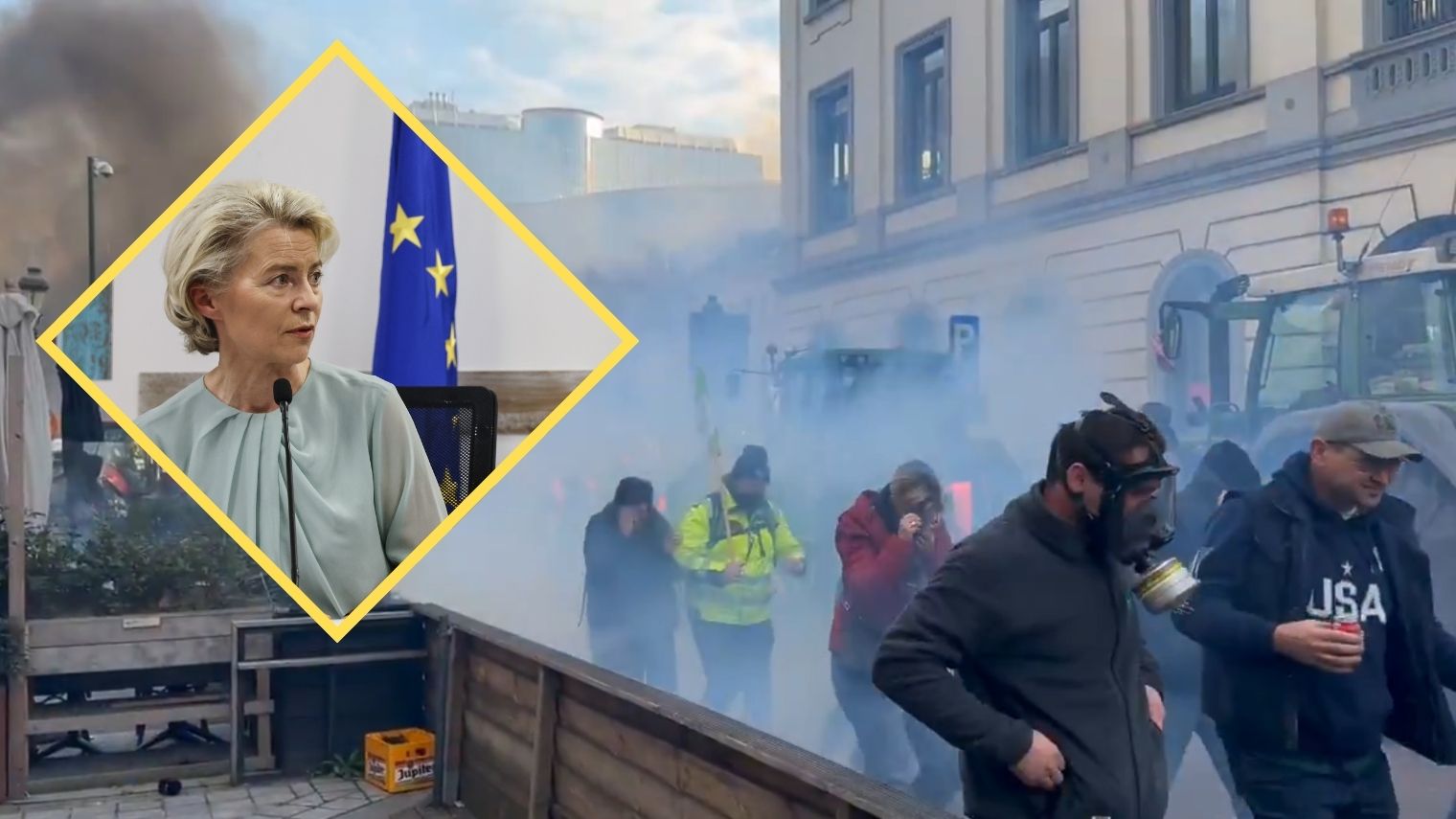
On Thursday, things got wild in Brussels as thousands of farmers gathered to protest the Mercosur trade agreement with South American countries. However, no agreement was ever reached.
Traffic in the Belgian capital was disrupted on Thursday by a new farmers’ revolt, coinciding with an EU summit where leaders were to reach a consensus on the contentious trade deal. Farmers fear that Europe will be flooded with cheaper goods from South America, where companies face less stringent regulations.
Thursday’s protests escalated into clashes near Place du Luxembourg, where demonstrators threw fruits and vegetables and set fires. Police responded with water cannon and tear gas.
EU leaders seem to have been influenced by the fierce protests, as no agreement was reached and ratification has been postponed until January.
READ ALSO: VIDEO: Farmer chaos against the EU elite in Brussels
The agreement includes Argentina, Bolivia, Brazil, Paraguay, and Uruguay, and negotiations began in 2000. Once the agreement is ratified, it would create a market with around 780 million people—almost 25 percent of the world’s GDP—and gradually abolish tariffs on most goods traded between the two blocs.
The postponement is said to have been secured after a phone call between Italy’s Prime Minister Giorgia Meloni and Brazil’s President Luiz Inácio Lula da Silva. During the call, Meloni assured Lula that Italy would work to calm domestic farmers and the agreement would be signed in January. Lula later said that Meloni was confident she could convince Italian farmers and asked for “a week, ten days, a maximum of a month.”
Happening now: Police using smoke granades and tear gas against farmers demonstrating in Brussels
This is the EU’s response to the voice of the people pic.twitter.com/ptWsIF9dty
— The European Conservative (@EuroConOfficial) December 18, 2025
French resistance
France still strongly opposes the agreement, with President Emmanuel Macron reiterating that the agreement “cannot be signed.”
For the agreement to take effect, it must be approved by the Council of the European Union by qualified majority, which means at least 15 member states representing 65 percent of the EU’s population. At the same time, a “blocking minority” of four countries representing at least 35 percent of the population could still halt the process.
READ ALSO: Ten thousand farmers expected in Brussels – protesting against EU agricultural policy