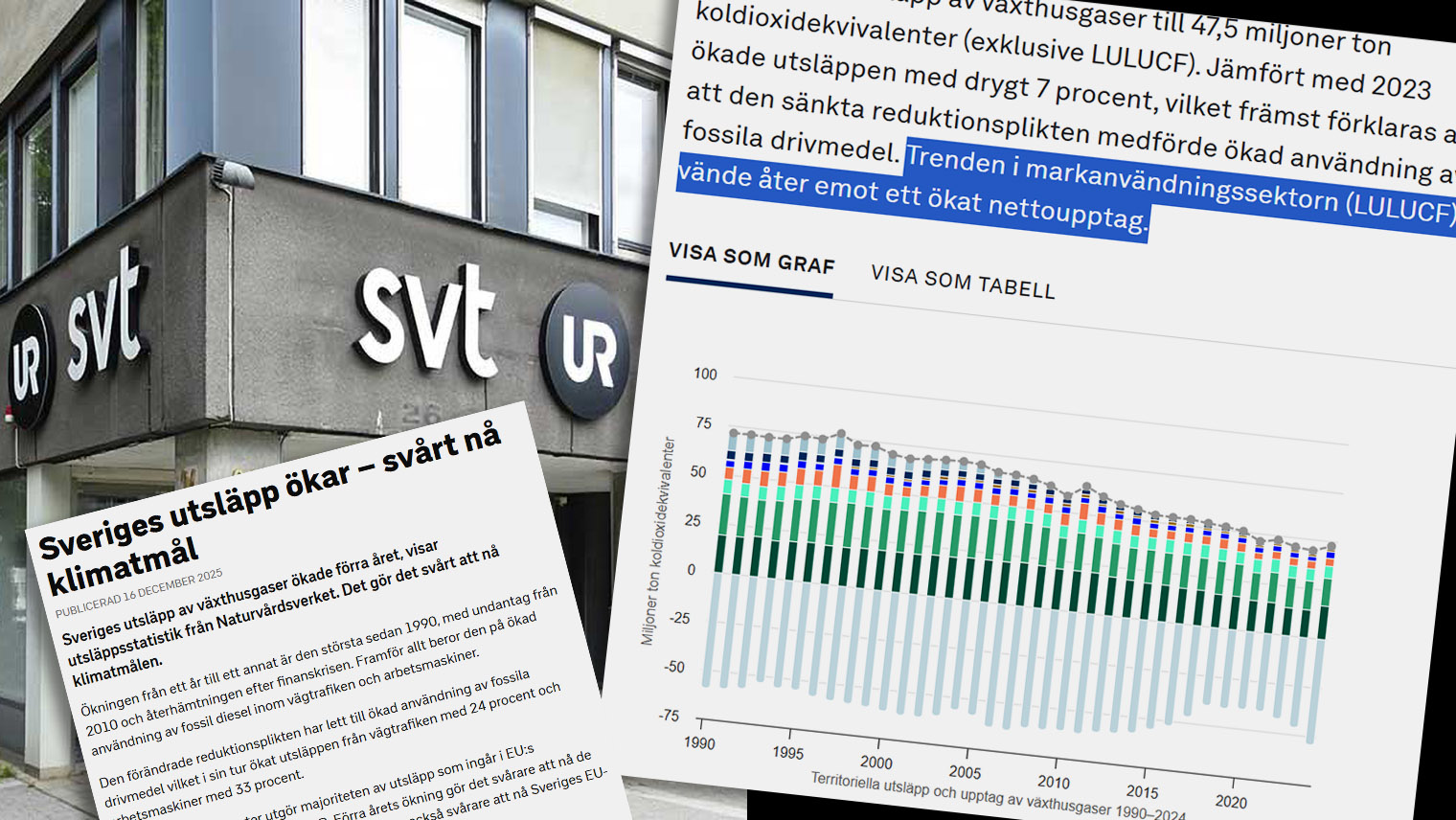
Statistics from the Swedish Environmental Protection Agency show that the country’s reported carbon dioxide uptake in land and forest exceeds its emissions. Media now faces criticism for spreading climate alarmism by only reporting emissions data instead of presenting the full picture.
After the Environmental Protection Agency published new emissions statistics for 2024, many newsrooms republished a TT newswire with the headline “Sweden’s emissions are increasing – difficult to meet climate targets.” The newswire points to the Tidö government’s altered reduction obligation as the main explanation, with increased emissions from road traffic and construction machinery, and features a comment from the Agency’s chief official Roger Sedin stating the increase makes it harder to reach interim targets and meet EU commitments.
However, according to critics, a crucial part of the same statistics is missing in the reporting: that the Environmental Protection Agency—the same authority quoted by Sedin—simultaneously reports a greater uptake of carbon dioxide from land use and forestry than Sweden’s total emissions. Altogether, Sweden during the reported period had virtually no net emissions at all—net zero, or even lower.
Gillström: “We absorb more than we emit”
Niklas Gillström, Chief of Staff at the Ministry of Finance, writes in a post on X that the “climate news” largely ignored was that Sweden’s carbon dioxide uptake—via, for example, forests—exceeds its emissions.
Klimatnyheten ni inte fick läsa om i går när Naturvårdsverket släppte ny statistik över svenska utsläpp – Sveriges upptag av koldioxid(Via t.ex. skogen) överstiger våra utsläpp. Detta innebär att om alla länder hade haft samma siffror som Sverige hade utsläppen i världen minskat.… pic.twitter.com/WNDxJ881rN
— Niklas Gillström (@NiklasGillstrom) December 17, 2025
He refers to the Agency’s 2024 figures, where emissions amounted to 47.49 million tons of CO2 (up over 3 million tons, about 7 percent) while uptake amounted to 54.24 million tons (up over 8 million tons, nearly 18 percent).
Gillström argues that newsrooms chose to highlight the emissions increase, but “chose not to” simultaneously report that the net figure—when uptake is included—shows that Sweden on the whole absorbs more carbon dioxide than it emits. He indirectly questions his own government’s climate policy, suggesting it is based on a misleading picture.
The Net Figure Omitted in Climate Target Headlines
A recurring theme in climate reporting is that Sweden’s climate targets, and compliance with them, are often presented as emissions figures without netting them against land use uptake. These are instead handled as separate “sectors” in reporting. According to critics, this gives a false impression of reality and fuels an already high level of climate alarmism, increasing the risk for expensive, development-stalling, and unnecessary climate initiatives.

This is also at the core of the criticism from Tomas Åbyhammar, chemical engineering graduate and former Vattenfall engineer, who in an interview with Samnytt argues that the total figures are misleading if the negative entries from land use and forestry are left out of the summed emissions number quoted in the climate debate.
READ ALSO: Former Vattenfall Engineer: “Sweden Has No Climate Emissions”
Agreement When Agency Is Pressed for Answers
Åbyhammar claims that Sweden is in practice close to zero emissions when the uptake by forests and land is included, and that policy risks being based on an oversimplified picture of “emissions” when the net is not highlighted.
In the same article, Anna-Karin Nyström, head of the climate target unit at the Environmental Protection Agency, partially agrees. She confirms that carbon uptake in forest and land is not deducted in the total emissions figure associated with targets covered by “Sweden’s climate goals,” and says that Sweden “would almost have zero emissions” if the figures were combined.

At the same time, she justifies this approach by saying it is a decided limitation in how Sweden has chosen to calculate and track its goals—and that uptake can instead be used as a complementary part of the path toward net zero. However, no explanation is given for why this choice was made, and critics say there may be a hidden agenda.
Method Changes and a “Snapshot”
Gillström also notes that there have been changes in measurement methods, but that “the snapshot is clear” and that the relationship between emissions and uptake looked similar the previous year as well.
READ ALSO: Doomsday Predictions That Didn’t Come True – Researchers on Failed Climate Alarmist Scenarios
The criticism now directed at some of the reporting therefore has less to do with whether the rise in emissions is made up—and more with the fact that both the public and decision-makers risk getting a misleadingly negative impression when net uptake goes unmentioned, even though it does appear in the press material and tables, albeit not prominently.
Debate Over What Should Be Called “Sweden’s Emissions”
The trend in the transport sector can make it harder to reach short-term targets. But that is because attention is given only to emissions and not to the net (emissions minus uptake in land and forest), which provides a completely different and more accurate picture of Sweden’s total impact.
Critics demand that the media should report the full picture, and not fan an unwarranted climate alarmism. In particular, this demand is raised toward public service broadcasting, which in this case uncritically republished the same misleading TT newswire as other media outlets.
READ ALSO: Researchers: Reason Must Prevail Over Climate Panic