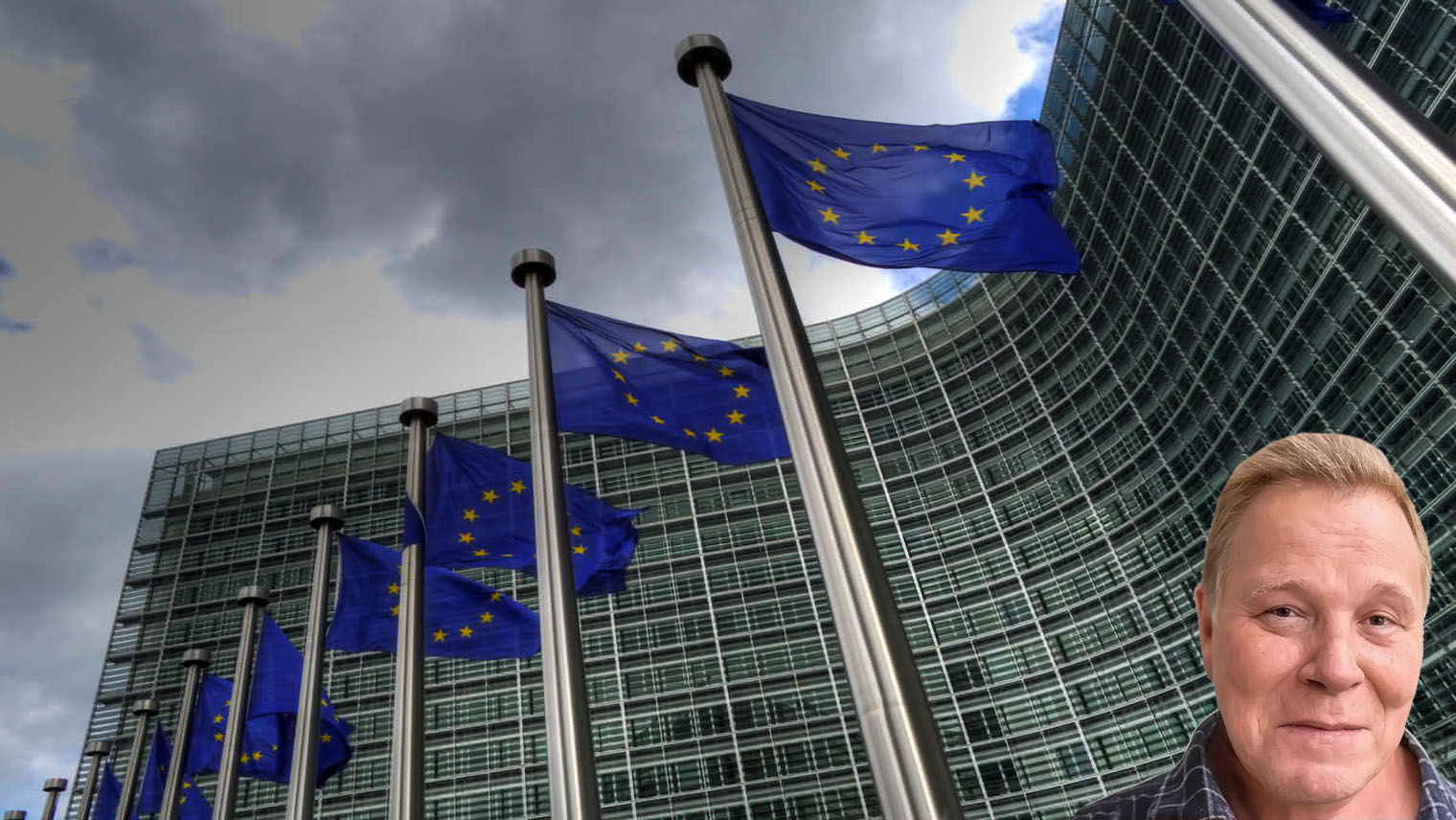
EDITORIAL • Freedom of speech is often the first casualty in war. Usually, it is the occupying power that silences, or the occupied who fall silent out of fear. Far more rare—and all the more concerning—is when free societies themselves start using exceptional methods against free speech, far from the front lines. The EU’s decision to impose heavy sanctions on former NATO official Jacques Baud falls into this category.
Baud has not been indicted, convicted, or even tried in court. Instead, the European Union—through a political decision—has frozen his assets and in practice made further professional and personal life in the EU impossible. The justification is that through books, interviews, and podcasts, he is considered to act as a “mouthpiece for pro-Russian propaganda” and thereby contributes to information manipulation that threatens Ukraine’s security.
One might think Baud is wrong. One may believe his analyses are one-sided, naïve, or directly harmful. One might even suspect that he—knowingly or not—is reinforcing Russian narratives. But in a state governed by the rule of law, arguments are normally countered with arguments, not with economic strangulation decreed by political bodies.
Democratic Fundamentals Are Undermined
It should not be so easy and arbitrary to deprive an individual of his or her legal security. Authoritarian sanctions that restrict a citizen’s fundamental freedoms and rights—freedom of speech and opinion, property rights, and more—are no small matter.
READ ALSO: EU bans former NATO top official
Who will be the next victim? When will this start happening on a broader front? What other inconvenient opinions might Brussels decide to gag with rhetoric more familiar from show trials in outright dictatorships? In a democracy there must be a sharper boundary between the free and the imprisoned—and where that boundary lies is determined by due process and Magna Carta.
A Dangerous Slippery Slope
The principal problem is not that the EU takes the threat of Russian information operations seriously. Hybrid warfare, disinformation, and psychological operations are real phenomena. The problem lies in how the tools are used and the absence of control mechanisms to prevent their abuse.
Targeted sanctions are an extreme tool. They are intended for financiers, operators, war criminals, oligarchs, and key figures in state power structures. When the same tool is used against an individual analyst for what he says and writes, the line between security policy and opinion control is blurred. Then arises a dangerous slippery slope.
Which Nations Are You Allowed to Have an Opinion About?
Concepts like “information manipulation” and “subversive narratives” are by nature vague. In war, fact, analysis, and propaganda often converge in a gray area where interpretations differ. If the criterion for sanctions becomes that an opinion “benefits” a foreign power’s interests, we risk criminalizing a great deal.
Who decides which nations one is allowed to have an opinion about? Is it only warring countries that are affected, or is there a list of other countries Brussels dislikes, and whom all EU citizens must share that dislike with out of fear of reprisals from the authorities?
This has broader consequences than just the Baud case. The signal to researchers, journalists, and commentators is clear: straying too far from the official line and a strict corridor of acceptable opinions can have personal and economic consequences. The result is not a more resilient society, but self-censorship. And self-censorship is democracy’s silent enemy.
Defend Ukraine – With Both Eyes Open
The defense of Ukraine and resistance to Russian aggression are entirely legitimate. But precisely for that reason, the EU should be particularly careful to adhere to the principles that are said to distinguish the union from authoritarian regimes: legal certainty, proportionality, and separation of powers. When political bodies impose punitive measures without prior legal proceedings, these principles are eroded—even if the intent is presented as good.
It is also worth noting that the substantive claims Baud makes—about the war’s high human toll, the difficulty of “breaking” Russia militarily, and the realities of territories long disputed—are shared by many military officers, analysts, and diplomats, even in the West. Stating this does not automatically make someone a Putin envoy. One can defend Ukraine with both eyes open.
What Is Taken Away in War Is Not Always Returned in Peace
History teaches us that emergency measures introduced during a crisis tend to persist afterwards. Once the tools exist, the threshold for using them again is lowered—against the next person, the next conflict, the next “harmful narrative.”
If the EU is serious about defending democracy, free speech must withstand even uncomfortable voices. Otherwise, the union risks winning the information war at the cost of something far more valuable: the rule-of-law foundation it claims to defend—what separates us from those we want to protect ourselves against. That would be a paradox.