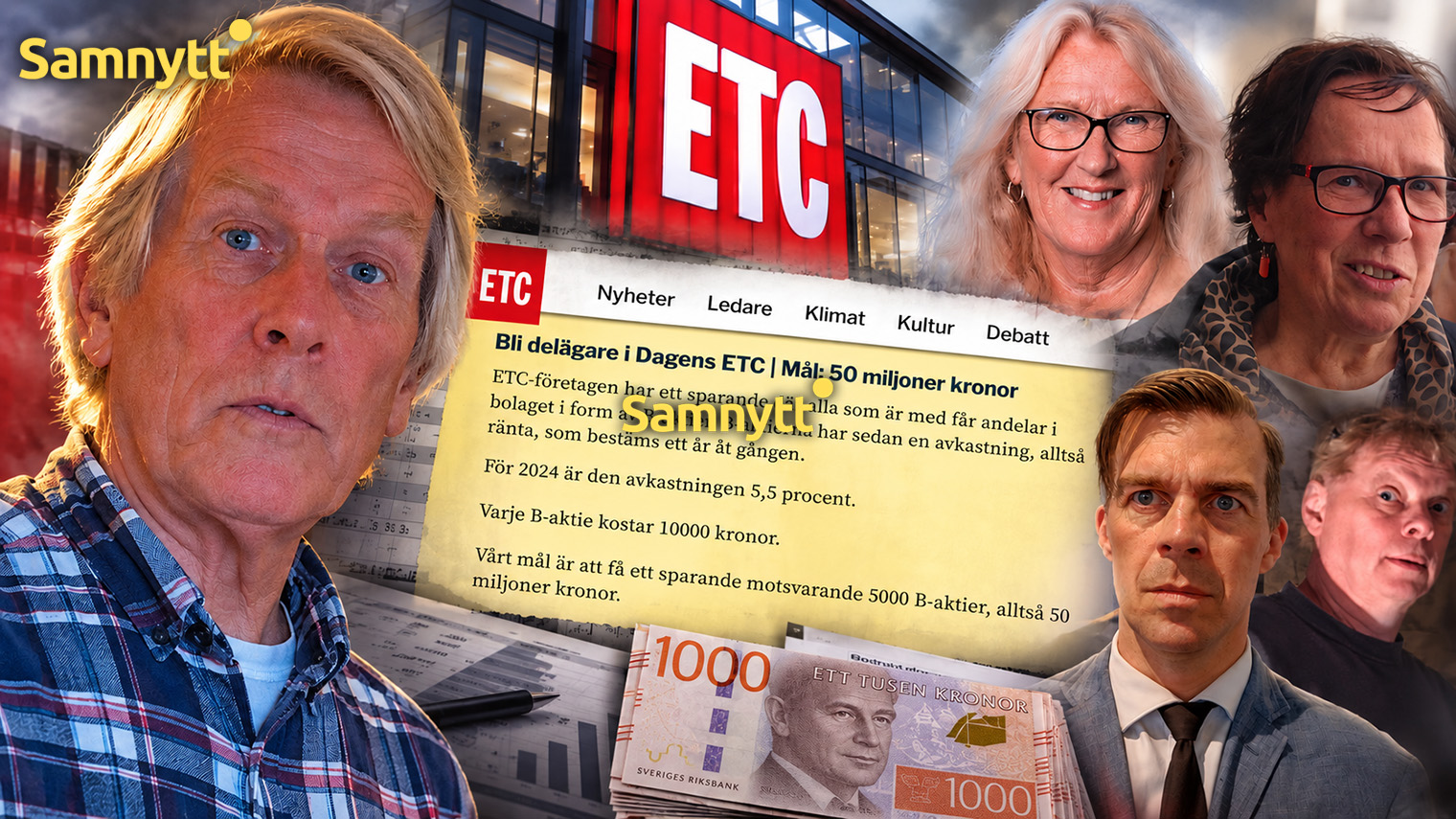
The left-leaning newspaper ETC has long criticized private profits in tax-funded operations. At the same time, the newspaper has itself received hundreds of millions of kronor in state media subsidies – and has enticed private investors with returns on shares. Freelance journalist Christian Peterson has investigated the ownership structure and sought out shareholders to ask how they view this contradiction.
Dagens ETC has for many years been a prominent voice on the outer left and has repeatedly criticized profit-taking within, among other things, schools and welfare. At the same time, the newspaper is itself largely publicly funded through state media support. It is this combination that freelance journalist Christian Peterson has now put under the microscope.
Highlight: Freelance journalist Christian Peterson has scrutinized the business model of the left-wing newspaper. Met with obstruction and threats
In an extensive review, he has requested ETC’s share register, mapped out who has invested in the company, and called several of the shareholders. The question he repeatedly raises is simple: how does it make sense to criticize private owners profiting from tax-funded welfare while at the same time holding shares in a media company that receives large amounts of taxpayer money and provides returns?

Over 400 million in media subsidies
According to Peterson’s compilation, between 2005 and 2026, ETC has received more than 405 million kronor from the Media Authority. The support for 2026 alone is said to amount to just over 13.3 million kronor.
At the same time, Dagens ETC has attracted money from private investors. When the newspaper issued new shares in 2024, a B share cost 10,000 kronor and, according to Peterson, was marketed with an annual return of 5.5 percent. However, shareholders interviewed by Peterson state that the actual dividend has later been about three percent.
The shares are not listed on the stock exchange. Anyone wishing to buy has first had to apply to ETC to become a co-owner. At the same time, the structure is designed so that the ETC Foundation retains at least 51 percent of the votes and thereby control of the operation. Peterson’s survey covers 575 individuals and seven organizations that together are said to have invested 5.59 million kronor in the company.
Had to fight to access the share register
But even the attempt to find out who the owners are, according to Peterson, became a story in itself. The Companies Act stipulates that a limited company must maintain a share register available for those who wish to access it. However, Peterson describes how he met resistance when he tried to obtain ETC’s documentation.
He first hired a certified process server to deliver his request to ETC founder Johan Ehrenberg. When this did not succeed, he sent the request by email instead and indicated that the next step could be going to court.
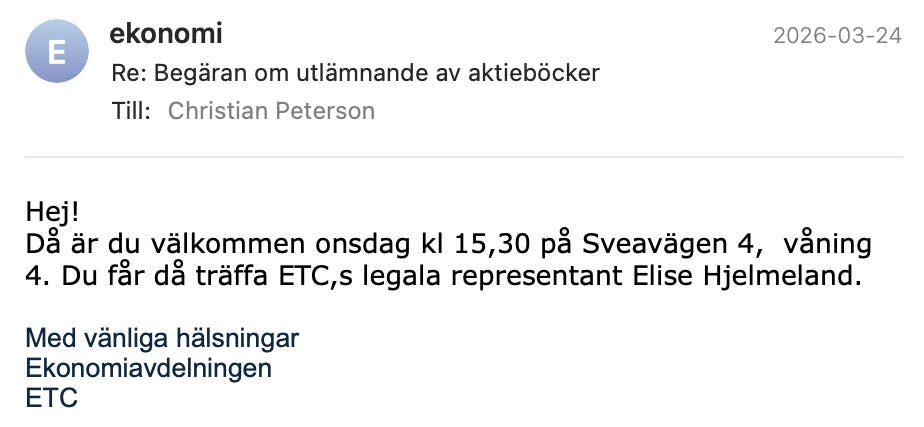
After this, he was referred to the business law firm DLA Piper. He received no digital copies. Instead, he had to go to the law firm’s office to photograph the documents. According to Peterson, it took three visits before he had access to the complete documentation.
S-profile is largest private investor
Among the shareholders, Peterson finds several individuals and organizations with ties to the left and the Social Democrats. The largest individual private investor in his compilation is social scientist and former civil servant Per Molander, who is said to have purchased 51 shares for a total of 510,000 kronor. Peterson especially highlights Molander as he has previously argued critically regarding private profit interests in tax-funded welfare.
The campaign organization Skiftet is also among the owners with five shares worth a total of 50,000 kronor. Skiftet’s founder, Robin Zachari, is also said to have invested 10,000 kronor personally. Other names in the share register include the intellectual historian Sven-Eric Liedman.
Began calling the shareholders
However, Peterson was not satisfied simply mapping the ownership. He also began calling around to shareholders to ask why they had invested and how they viewed the combination of state support and private returns. The reactions vary.

Shareholder Roger Nyström, who invested 10,000 kronor and introduces himself as a journalist, becomes, according to Peterson, upset when he understands the call might be published. In the audio recording published by Peterson, Nyström threatens legal action if the interview is published – to “sue the hell” out of Peterson.

Another shareholder, Agneta Edberg, describes her involvement in positive terms.
– I’m not a wealthy person, but it still feels fun to be involved in something that really matters, of course, she says.
When Peterson then presses her about why she invested in ETC and brings up the newspaper’s public financing, she becomes uncomfortable and wants to end the conversation.

Journalist Erik Hjärtberg in turn describes the share purchase as a business decision, but says at the same time that the investment seemed more “ethical” than other alternatives.
Climate criminal among the shareholders
Among ETC’s shareholders is also the climate activist Barbro Ingegerd Stigsdotter, previously active in the climate criminal organization Extinction Rebellion. Stigsdotter participated in an action where an SAS plane was prevented from taking off. For this, she was convicted of violating aviation law and fined 10,200 kronor.

Is the share an investment – or a statement?
Peterson also raises the question of what the ETC share actually offers to someone who sees it as a straightforward investment. The share is not stock exchange listed and thus cannot be easily sold on the open market. An owner wishing to exit must find someone willing to buy the share.
At the same time, the external shareholders can never collectively take over control of the operation. This is because the majority of votes must remain with the ETC Foundation.
Jan Emanuel: You’re buying an identity
This leads Peterson to wonder whether buyers are primarily motivated by the prospect of financial returns – or if buying the share is more a political and identity-driven statement. To discuss this question, he finally turns to the entrepreneur and former Social Democratic MP Jan Emanuel.
Jan Emanuel is not against private profit or press subsidies in principle. In the interview, he reasons that private companies routinely carry out publicly funded assignments, and that profit itself thus need not be the problem.
However, when the conversation turns to ETC, he sees a contradiction between the newspaper’s editorial line and its own financing.
– It’s primarily an abuse of ethics and morals, he says.

His main objection concerns the fact that ETC criticizes private actors who profit from tax-funded operations while the newspaper itself receives significant public support and has private shareholders. And when Peterson asks if ETC shares can be regarded as a normal long-term investment, Jan Emanuel is skeptical.
– I don’t think anyone buys a share in ETC primarily just as a long-term savings option.
Instead, he believes the investment for many is about identity and signaling a political and moral affiliation.
– It’s something you want to brag about when you’re at your lobster dinner in Söder, telling about this expensive lobster caught in Sweden in an extremely ethical and moral way.
He continues:
– And then you can also say that you’re a very good person and very left-wing. That’s why you’re also part of this ownership arrangement in ETC.
Turning ETC’s own profit criticism on the newspaper
This is also where Peterson ends his review. He does not primarily question that a media company has private shareholders or that these may receive dividends. Instead, he shines the spotlight on what he regards as double standards – that a newspaper which has profiled itself on criticizing private profits from publicly funded operations itself combines state subsidies with private ownership and returns.
By mapping the owners and letting them answer the question themselves, Peterson tries to determine whether they see the same contradiction. The answers indicate that they at least do not share his conclusion, and in some cases, the very question proved to be much more sensitive than the investment itself.