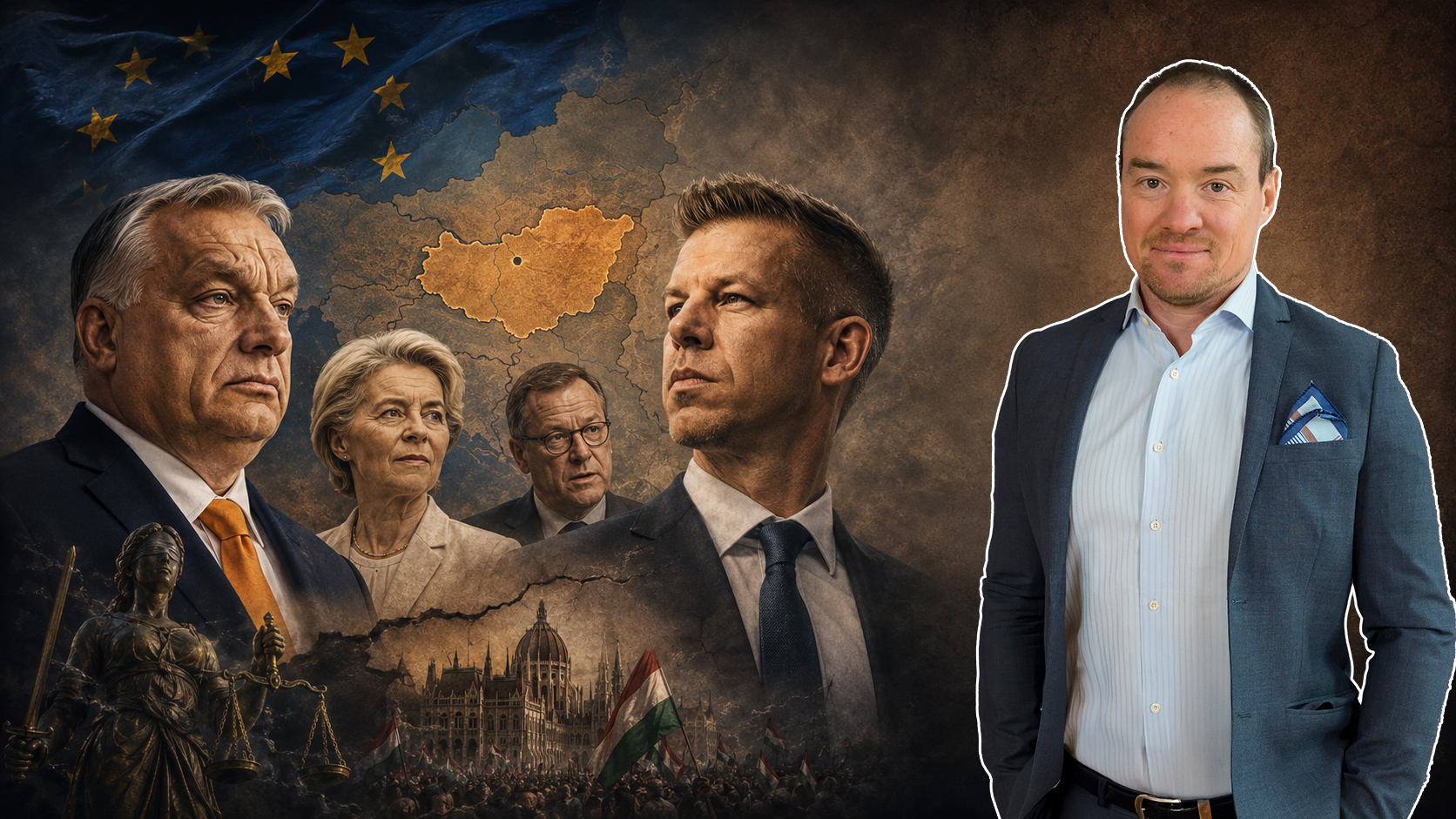
It took less than three months. Then the new defenders of democracy in Hungary realized that maybe democracy wasn’t so important after all.
After years of moral preaching against Viktor Orbán, after countless editorials, EU statements, Swedish ministerial comments, and journalistic doomsday prophecies about the “threat to the rule of law,” Hungary now faces something that, in substance, should be enough to send the entire Swedish media establishment into a frenzy.
The new government under Péter Magyar and the Tisza party wants, through fast-tracked constitutional amendments, to remove Hungary’s president Tamás Sulyok, replace central parts of the constitutional system, and introduce retroactive restrictions that critics say could directly target the elected representatives of the conservative opposition.
But this time, it isn’t Orbán doing it. This time it’s the pro-EU side. And now, strangely, silence prevails.
Silence in Swedish Media
Reuters has reported that Hungarian human rights groups have criticized the proposal to remove the president and introduce term limits for MPs. Even Amnesty International Hungary—hardly a conservative bastion—has said that an impeachment procedure would be a better and fairer path than simply removing the president via constitutional amendment. Human Rights Watch warns that the rapid changes risk halting the rebuilding of the rule of law, as they lack reasonable legal safeguards and are being pushed through with an extremely short consultation period.
One should never just listen to Amnesty or HRW, but when even such left-liberal human rights organizations react, it would usually be the starting shot for Swedish media hysteria. There should be extra broadcasts, analyses, outraged columns, democracy alarms, and tough questions for Swedish politicians.
But where are they?
Where are all the Swedish journalists who for years explained that Hungary under Orbán was on the road away from democracy? Where are the EU-liberal politicians who spoke of the principles of the rule of law as if they were Moses on Mount Sinai? Where are the conservative representatives who were always eager to show Brussels they were nothing like those unpleasant conservatives in Budapest?
When Viktor Orbán criticized Sweden in the autumn of 2025, Ulf Kristersson called his claims “outrageous lies” and wrote that it was not surprising from a man who was “dismantling the rule of law in his own country.” That went quickly then. There was no caution, no wait-and-see attitude, no concern about interfering in another country’s internal affairs. This is evident, among other things, from Reuters’ reporting on Kristersson’s statements about Orbán.
But now?
Now, when the new pro-EU government wants to use its supermajority to clear out people from the state’s top institutions before their terms have expired—suddenly principles seem to be on vacation.
Poetic Folly
Aftonbladet described after the election in April how “democracy triumphed in Hungary” and how the EU could “breathe a sigh of relief.” Orbán had fallen, the “troublemaker from Budapest” was gone, and many in Europe saw it as a good day for democracy.
It’s almost poetic in its folly. For this is precisely where the hypocrisy is revealed. Democracy did not win when power was limited, when institutions were respected, or when the opposition’s rights were protected. Democracy won when the “right” party won.
And when the “right” party then starts doing things they claimed to hate Orbán for, it is no longer seen as a threat to democracy. Now it is “restoration”. Now it is “reform”. Now it’s “coming to terms with the past”.
Same Pattern in Poland
We’ve seen the same pattern in Poland. When conservative governments reform courts, media, or state institutions, it’s called authoritarian. When liberals and EU allies do the same, it’s called saving democracy. The difference lies not in the method. The difference lies in who benefits.
READ ALSO: Tusk’s Government Attacks Political Opponents
The Venice Commission has now been called in to review the Hungarian government’s constitutional changes. That is telling in itself. Under Orbán, the Venice Commission, the EU Commission, and the European Parliament were used as clubs against Hungary. Every criticism became headlines. Every report became proof that the country was descending into darkness. Now that the President of the Venice Commission has visited Hungary and is reviewing the issue, the reaction in Sweden is almost a yawn.
Why? Is the rule of law less important when threatened by a pro-EU government? Are democratic mandates less sacred when it’s conservative politicians who risk being purged? Is the independence of the courts only important when the judges aren’t standing in the way of Brussels’ favorite projects?
Perhaps most revealing is the behavior of the European Parliament. According to European Conservative, a request by the group Patriots for Europe for a debate in the plenary on the new Hungarian government’s constitutional changes was rejected. The same parliament that for years loved to talk about Hungary’s rule of law problems doesn’t even want to debate the issue when it’s the new, pro-EU government under scrutiny.
That says it all: It’s never about principle. It’s about power.
READ ALSO: Tusk’s Left-Liberal Poland: Here, the Security Service Arrests a Member of Parliament
Attack on Civil Society
The same applies to the dismantling of the conservative infrastructure in Hungary. Mathias Corvinus Collegium, MCC, which under Orbán became one of Europe’s most important conservative educational and think tank networks, has found itself in crisis after the change of power. The Guardian has reported how MCC Brussels now faces financial uncertainty since the new government announced that state funding for MCC and similar conservative institutions will cease.
Imagine if Orbán, after an election, had begun dismantling left-liberal universities, think tanks, scholarship programs, and educational institutions in a similar way. Does anyone really believe that Swedish media would have treated it as a mere technical budget issue?
Of course not.
Then it would be said that Orbán is attacking academic freedom. Swedish culture journalists would write mournful columns about the death of free thought. Liberals in Sweden would compete for who could use the word “authoritarian” the most times in one sentence.
But when a conservative environment is dismantled, there isn’t the same outrage. The victims are the wrong kind of people. The wrong kind of students. The wrong kind of teachers. The wrong kind of ideas.
Intellectually Rotten
This is what makes the Swedish reporting and political reaction so intellectually rotten. They pretend to defend democracy, but in practice, they defend a left-liberal power structure. They pretend to protect the rule of law, but only when the rule of law can be used against political enemies. They pretend to worry about free media, free institutions, and free elections, but only as long as those freedoms produce the right results.
Hungary is therefore not just a test for Péter Magyar. It’s a test for the entire European establishment. And so far, the result is embarrassing.
Because if Orbán had tried to remove a president through a quick constitutional change, replace central judges, retroactively limit the opposition’s possibilities, and strangle the opponent’s ideological infrastructure, we know exactly what it would have sounded like.
It would have been called “the death of democracy.” Now, it’s almost nothing at all.
And that very silence is perhaps the clearest proof of what their talk about democracy was really worth.