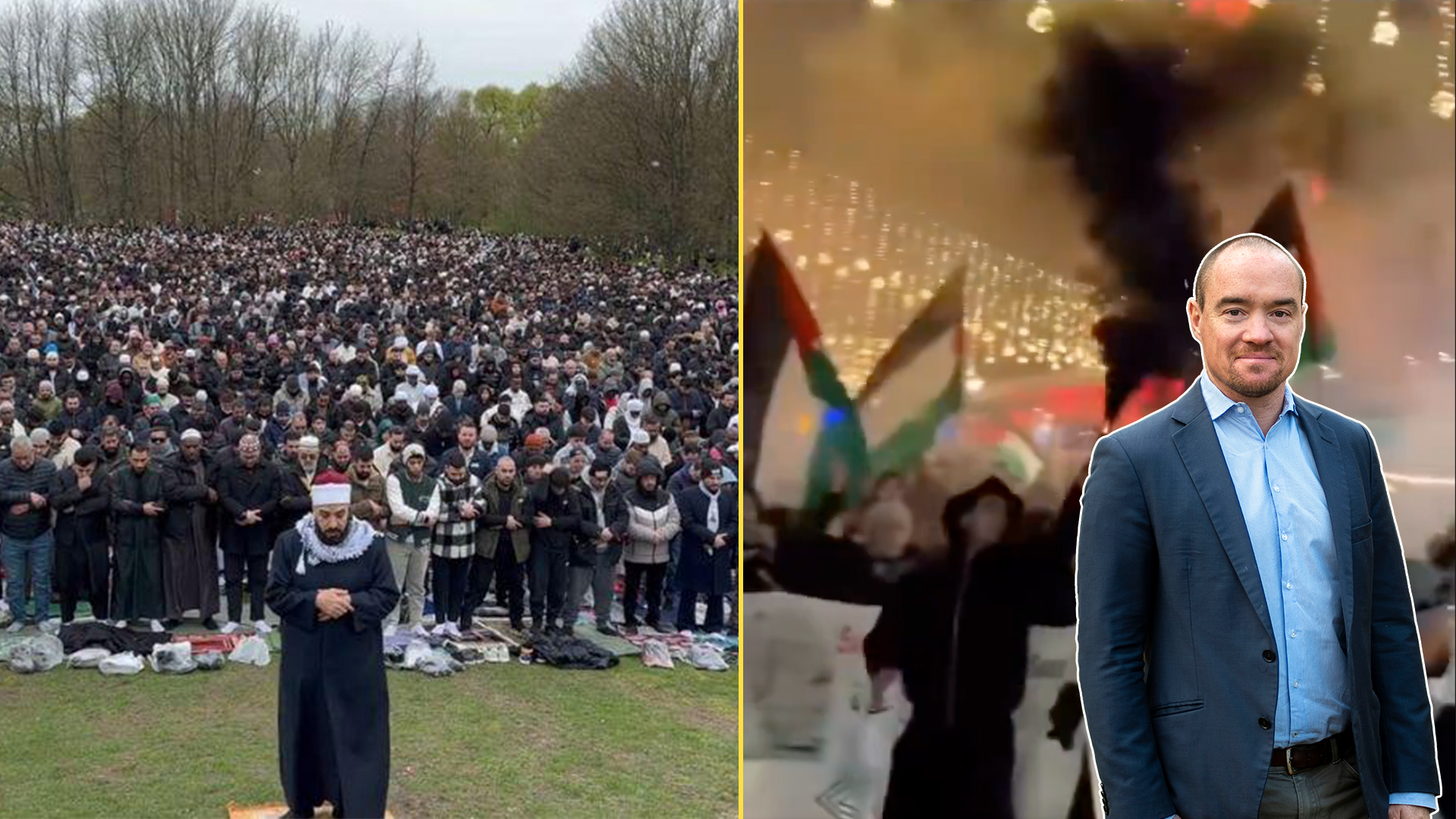
LEADER • One could say that my political journey began long before the parliament, long before the Sweden Democrats. It started in the anti-Islamization movement. That’s where I was politically shaped: by organizing conferences, writing analyses, and warning about an ideology whose consequences have been confirmed time and time again by history – and by mathematics. Even then, I warned about the demographic shift. Today, twenty years later, we see the result even more clearly.
Islam – or rather those who have driven its expansion for generations – has for over a thousand years shown a unique ability to conquer, transform, and cement control over the societies they have subjugated. From the Arab expansion of the 600s to today’s conflicts in Nigeria and Sudan, the pattern is the same: when Islam takes hold, the older cultures quickly disappear. They become memories, legends, footnotes.
READ ALSO: Ekeroth: ”When the left closes its eyes to history’s greatest colonial powers”
And yet, we who pointed out that something similar was beginning to happen here were ridiculed. Left-liberal opinion-makers laughed at the concept of “Islamization.” They pretended not to understand the definition. Denied the demographics. Denied the change. Denied what people saw in the streets every day.
But the denial is now cracking. Not least because the same pattern, as history has written with blood and stone, is beginning to repeat itself here in Europe, in Sweden.
READ ALSO: Ekeroth: Population exchange confirmed in new prognosis
Real-time power demonstrations
I have previously described the “occupation mentality” – the dominance behavior – that has characterized all previous Islamic expansions. It is also visible in everyday life here: in humiliating robberies against Swedish youth, in “Palestine protests” taking over our public spaces, and most recently at Christmas markets across Europe where groups of young Muslim men have appeared with the same symbolic force as historical conquering armies: by showing that they are the ones in control on the spot.
Several clips circulating on the internet in recent weeks illustrate the phenomenon – regardless of the exact date of recording.
In Milan, they march through the Christmas market at the iconic cathedral, demonstratively and loudly:
In Brussels, a group is said to have surrounded a Christmas market during a “Palestine” demonstration. Freelance journalist Nick Alinia describes it as what it really is: a power demonstration.
In another clip, a large group of men storms through a market with Muslim slogans:
And from London, we see the same behavior:
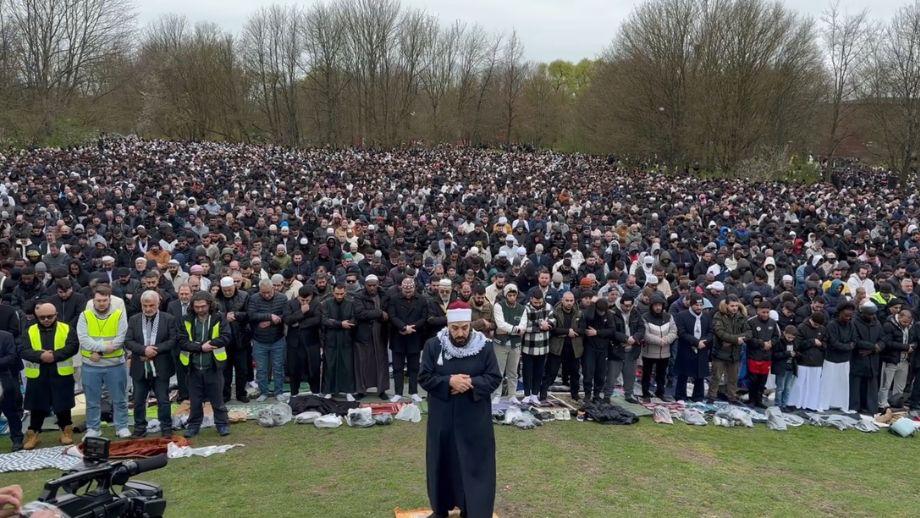
Public mass prayers are another example, which we can also see in Sweden.
READ ALSO: Ekeroth: It’s the demographics, stupid!
These scenes are not random. They are not spontaneous outbursts of “concern.” They are symbolic acts, and symbols mean something. Especially when history has already shown what such symbolic acts precede.
Countries that have had the sense to say no to immigration from these countries, such as Poland and Hungary, do not have these problems.
Learn from history
History is full of warning examples for those who bother to look up. In country after country, a growing Muslim share of the population has led to the same development: increased tensions, parallel societies, politicization of identity, and ultimately – when the proportions tip over – violence. I warned about this in my speech at the Sweden Democrats’ National Days in 2009, which can be seen here and here.
Lebanon is perhaps the most telling example. The country was once described as the Switzerland of the Middle East, a relatively secular and well-functioning society where different groups lived side by side. But when the demographic balance began to shift in the 20th century, and Muslim groups grew in both number and political strength, frictions arose that soon exploded. The result? A 15-year civil war where sectarianism and religiously defined militias tore the country apart. Lebanon is still today a warning monument of what demographic changes can do to a state lacking safeguards.
The same pattern is found in parts of Africa—Nigeria, Chad, Sudan—where budding ethnic and religious conflicts regularly turn into mass violence. Even in the Balkans, the memory is fresh of how quickly a fragile balance can break. The Bosnian War in the 1990s contained exactly this dynamic: a demographic mosaic that initially worked somewhat, but under pressure fell apart along religious lines.
Europe is not immune. On the contrary, our own history shows how unstable the continent can become when strong groups with completely different value systems have to coexist on the same territory. In Belgium, France, and the United Kingdom, parallel societies are already emerging. In parts of France, such as Seine-Saint-Denis, the phenomenon is so advanced that the state has practically lost control. In entire neighborhoods, different norms, power structures, and laws apply—and confrontations between groups are already a daily occurrence.
When a population is divided in two, with completely different views on religion, law, loyalty, and social order, a point eventually arises where everything breaks. It is never a question of if, but when. History shows this time and time again.
It is against this background that we must interpret today’s developments in Europe. Christmas markets being stormed. Public spaces being taken over. A growing group increasingly acting as a collective with its own norms, demands, and power demonstrations.
Our time’s most dangerous illusion is to believe that we are exempt from the laws of history. That our civilization, unlike all others, would magically escape the conflicts that always follow when demographics change rapidly and profoundly.
History speaks a different language. And it speaks clearly.

???? Want to see more reports and investigations?
Support the newspaper so that we can continue to investigate the establishment and report what other media omit.