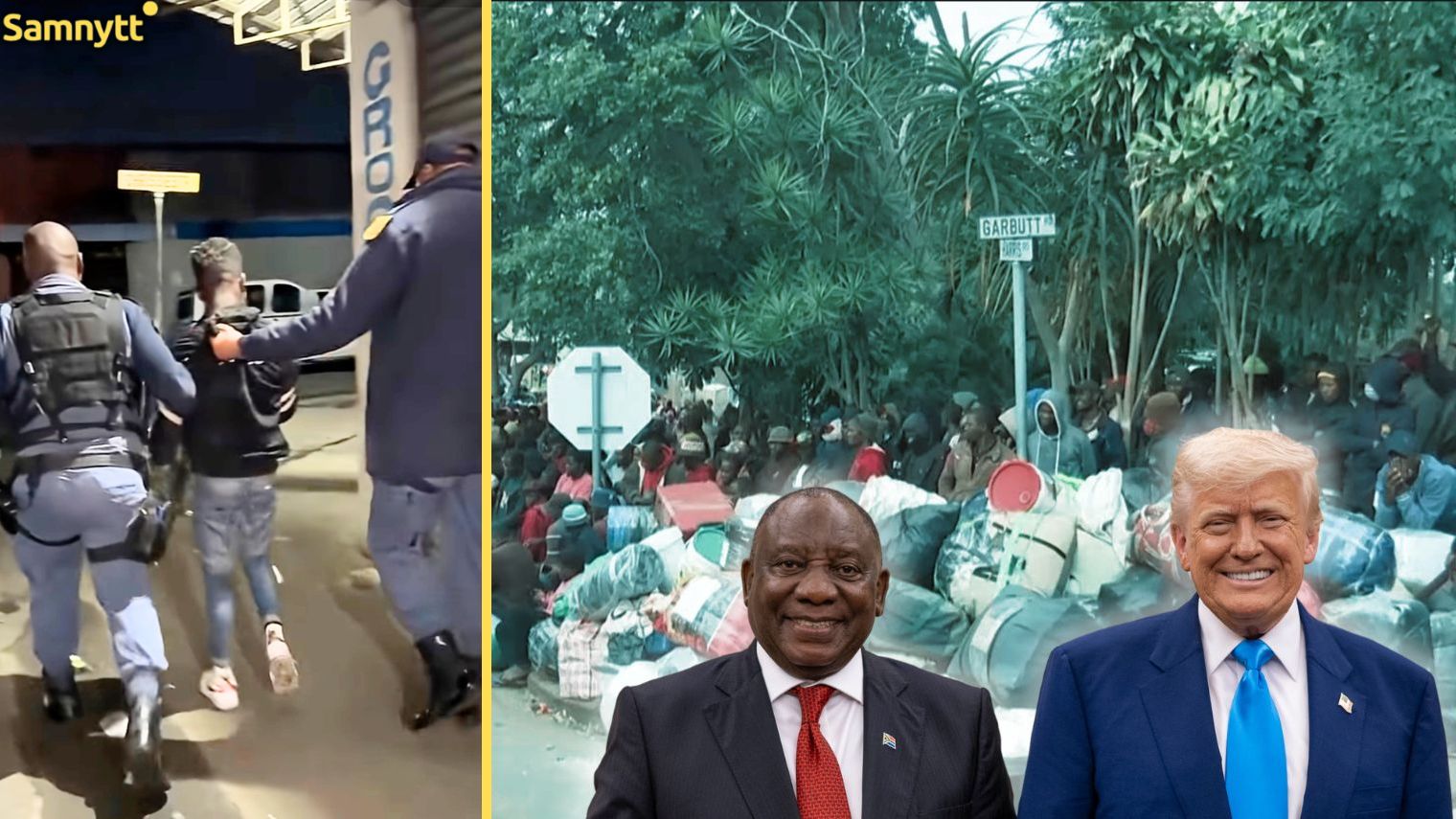
The left-liberal establishment is usually quick to condemn countries—often those with national-conservative governments—that put an end to mass immigration and deport migrants. But as South Africa’s ANC-led coalition government has now had enough of illegal migrants and has deported tens of thousands in a short period, there is a deafening silence. Suddenly, the usual accusations of “xenophobia” and “extremism” are nowhere to be heard.
While Sweden Democrats’ party leader Jimmie Åkesson suggests that Sweden should move on from its major migration policy battle ahead of the next electoral term, focusing instead on integration and the consequences of immigration, South Africa has chosen a completely different path in tackling immigration problems.
There, the government is not focusing on integrating those who have already arrived, but rather on extensive repatriation.
– No, we’re pretty much set here. There are a few more tweaks regarding family immigration, we think, said the SD leader in an election interview with SVT, and continued:
– I suppose that’s it. Where one could possibly raise the maintenance requirement for people who sponsor family members in Sweden. That it should be clearly demonstrated that you can support those you bring here. But in other areas, not much more needs to be done.
READ ALSO: Demographer to the Riksdag: “Only remigration can save Sweden”
According to Åkesson, the ongoing challenge is mainly about integration and the problems that have arisen due to previous immigration rates.
– It’s more about how we manage integration or the problems that have arisen due to this large-scale immigration. That’s probably the next major issue.
South Africa’s ANC-led coalition government has, instead of prioritizing the integration of a large immigrant population, focused on ensuring migrants return to their home countries. The result has been large-scale voluntary returns and deportations of people lacking the legal right to stay in the country.
South Africa’s stricter migration policy comes after a period of increasing political tensions both domestically and internationally. When President Cyril Ramaphosa previously met US President Donald Trump at the White House, issues of crime, security, and the persecution of white South Africans were top of the agenda.
READ ALSO: Trump confronted South Africa’s president on genocide and persecution of whites
Although immigration to South Africa was not the central issue at the White House meeting, international pressure mounted on the government to show control over border security, law and order.
Many critics also claim that the high crime rate in South Africa is connected to the large migration from other African countries. Migrants are commonly described as sustaining themselves through crime, but there is also talk of transnational criminal networks moving into South Africa.
READ ALSO: Black protest movement in South Africa: Demands illegal migrants be thrown out
In South Africa, which has long been Africa’s most developed economy, issues of security, lawlessness, and border control have increasingly become linked to the migration debate.
It is in this environment that South Africa has now chosen a significantly harsher approach, with comprehensive controls, returns, and deportations of people without legal right to remain in the country.
South African President Cyril Ramaphosa has presented a comprehensive package of measures to address problems linked to mass immigration.
Massive Protests – But Many Say it’s Too Late
Meanwhile, domestic dissatisfaction in South Africa has been growing for some time over issues such as illegal immigration, crime, high unemployment, and increased strain on the country’s public resources.
According to authorities, over 100,000 people without legal right to remain in the country have been deported in the past two years. At the same time, about 450,000 attempts at illegal border crossings have reportedly been stopped in the past year.
Despite the government’s announcements, many of the groups organizing the protests are far from satisfied with the current policies. They claim the government has ignored the problems for too long and that the situation has become untenable. Many primarily believe the measures are still insufficient.
The pressure on the government is therefore increasing as protests grow on the streets across South Africa. The concern is not just about crime, but also the perception that extensive immigration intensifies job competition and exerts downward pressure on wages.
New Migration Policy
South Africa’s recent forceful actions against immigration problems and its broad repatriation of people without legal status are not solely the result of ANC’s current politics. The party has ruled for decades and must also shoulder responsibility for many of the problems that now shape the migration debate having emerged during its tenure.
To understand South Africa’s new migration policy, one must also understand the country’s changing political landscape. After the 2024 election, ANC lost its majority after three decades in power and was forced to form a broad coalition government.
READ ALSO: South Africans have had enough of illegal immigrants
The new coalition includes several parties that have long demanded stricter immigration controls and tougher enforcement of migration policy. Chief among them has been the centrist-right Democratic Alliance (DA) which has pushed for stronger border controls and better oversight of those staying illegally in the country.
The party is also responsible for migration issues through Interior Minister Leon Schreiber, who has led the work to increase border surveillance and carry out more deportations.
Other parties in the coalition, such as Patriot Alliance (PA) and Freedom Front Plus (FF+), have also long advocated stricter border controls and tougher enforcement of immigration laws.
Schreiber has defended the harder line, saying that South Africa must regain control of its borders and restore a functional migration system. He has also pointed to the link between poor border control and organized crime.
He has further stated that uncontrolled immigration takes place in a country with very high unemployment and that the state must protect South African workers as well.
The deportations are thus part of a broader political realignment where the new coalition government wants to show that it is regaining control of immigration and security in the country.
One of the government’s biggest challenges is the country’s vast borders. South Africa shares borders with six neighboring countries and has thousands of kilometers of land borders, many sections of which are difficult to monitor. Aside from the official border crossings, there are numerous informal routes used for illegal crossings.
Economic Migrants
For a long time, South Africa has been the main destination for people seeking work or a better future elsewhere on the continent. The country’s relatively strong economy and higher standard of living have drawn people from across Africa.
According to the nation’s statistics agency, about 3.3 million immigrants live in South Africa, amounting to just over five percent of the population. Other sources suggest the number is much higher, since many stay in the country illegally.
READ ALSO: Professor’s dark forecast: Swedes will be a minority within a few decades
The largest influx comes from South Africa’s neighbors within the regional cooperation organization SADC. Citizens from these countries can enter without a visa and stay for up to 90 days, but many remain even after their permits expire. This has become one of the issues causing the greatest frustration among many South Africans.
Immigration to South Africa has changed over time. During the 1990s, many came from war-torn areas such as Mozambique. Later, the inflow from Zimbabwe increased due to that country’s economic crisis. But in recent years, more people from across Africa have sought out South Africa—many to find better economic opportunities and living conditions.
To meet growing criticism, President Ramaphosa introduced several new measures. The government wants to strengthen border guarding, tighten migration system controls, close legal loopholes, and combat government corruption.
53,000 Sent Home in a Short Time
A lot has happened in South Africa in a short time. As anti-immigration protests continue on the nation’s streets, the government has presented strong measures.
Over 53,000 foreign nationals have, in the past few weeks, returned to their home countries, either voluntarily or by forced deportation, according to Daily Maverick.
The majority are citizens of Malawi, Zimbabwe, and Mozambique, but Ghana, Nigeria, Uganda, and Kenya have also organized flights and buses to bring home thousands of their citizens.
More returns are expected as authorities continue to process cases for people lacking legal right to remain in the country. At the same time, the process is encountering resistance from some migrants:
More Countries Mass Deport
At the same time, South Africa is not alone in tightening its migration policies in a short time. Iran and Pakistan have also implemented large-scale deportations of Afghan citizens.
READ ALSO: Where the Tidö government’s immigrants came from
According to media reports, millions of Afghans have left these countries in recent years as a result of tightened migration controls and increased pressure from authorities.
Get 50% Off Today
123 083 33 50