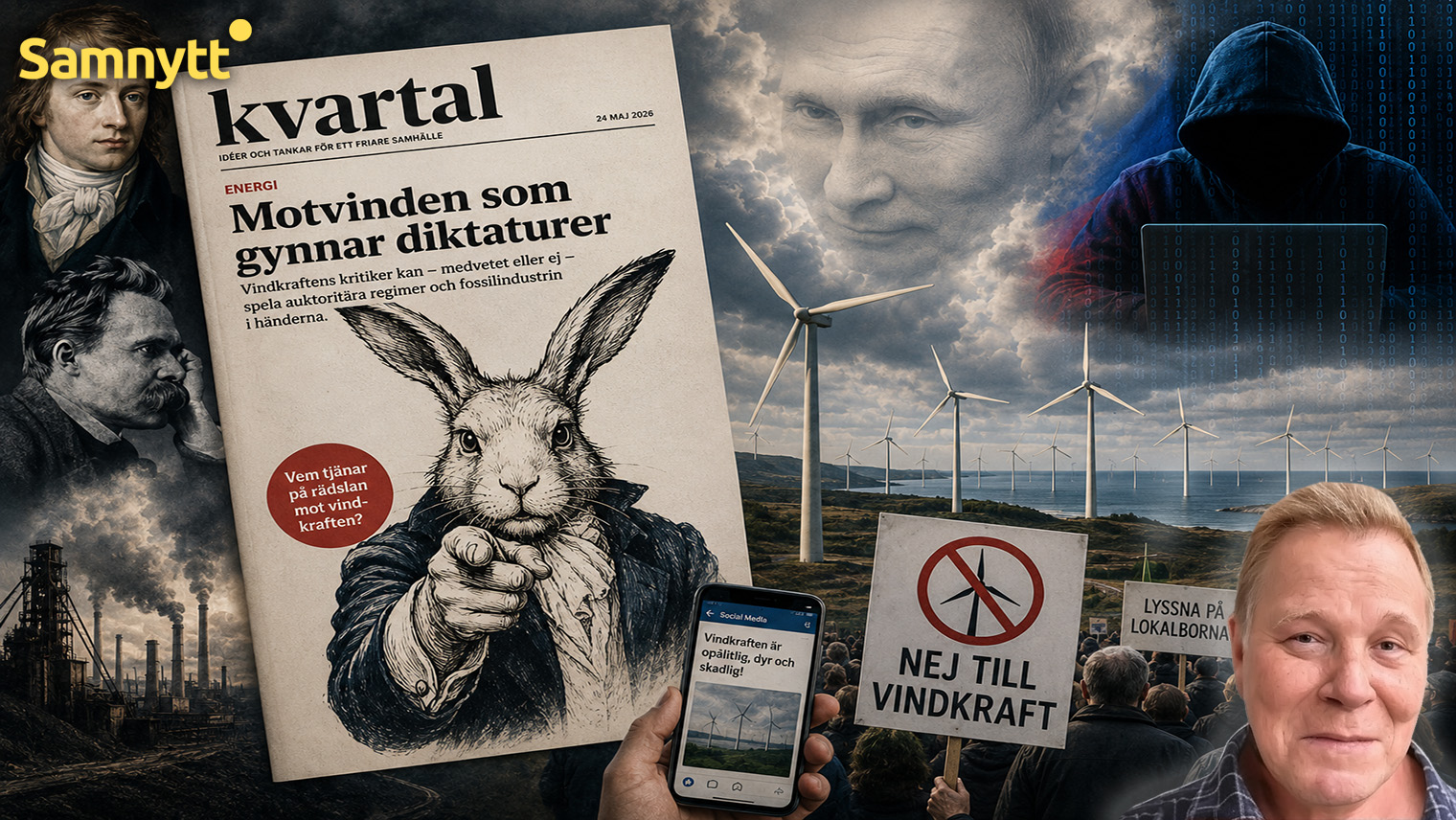
EDITORIAL • It begins with Novalis. Then comes Nietzsche. After that, the Battle of Lützen, German Romanticism, coal mines, modernity, climate change, and Europe’s energy history. By the time the reader of Kvartal’s article has made it through this entire cultural-historical tour, Mats O Svensson finally arrives at his actual point – to explain why opposition to wind power is a problem. It’s the ‘Russia card’ again, just a little more ‘von oben’ dressed in intellectual clothes.
The tone is set right from the headline – ‘The Headwind That Benefits Dictatorships’. Further on, the reader learns that Russia is conducting influence campaigns against renewable energy, that disinformation is spreading via social media, and that arguments are filtering down into the public debate.
The statement comes with a caveat. “Not everyone who protests against wind turbines is bought by Russia,” Svensson writes. No, of course not. But why write it at all? That’s the interesting part. Because no one would even think to express the opposite unless the suspicion had first been planted.
It’s an old rhetorical trick. No one is accused directly. There’s no need to present any evidence. It’s enough to hint at a connection and let the reader draw the conclusion themselves. Who benefits from the opposition? Where do the arguments come from? Whose interests are served?
READ ALSO: Dagerlind: When the Facts Become Uncomfortable, the Wind Power Lobby Pulls the Russia Card
Suddenly, the debate is no longer about the pros and cons of wind power but about the people presenting the criticism. And here, Kvartal’s article is more important to dissect than much else in the “playing the Russia card” genre. Because behind the insidious backdrop with all the references to Novalis, Romanticism, and Europe’s energy history, there is no actual evidence presented that Swedish wind power critics have been influenced by Russia. It simply adds a layer of unflattering intellectual contempt for the public.
Not the First to Play the Russia Card
Kvartal is not the first to try to place wind power opposition in the shadow of foreign powers. For several years, wind power industry lobbying organizations and various campaign reports have repeatedly described criticism of wind power as part of a larger problem with disinformation, climate denial, and Russian influence.
Local protest groups, alternative media, and individual opinion makers have in various ways ended up included in the same narrative. What makes Kvartal’s article remarkable is that the same line of thought now appears in a forum that otherwise likes to emphasize independent thinking and intellectual integrity.
Devoid of Concrete Examples
Kvartal doesn’t provide a single concrete example. Not a single disclosed source of funding. Not a single documented coordination. Not one Swedish local protest group shown to be directed from Moscow. Instead, the reader receives a chain of associations. Russia dislikes Europe’s energy transition. Russia sometimes spreads criticism of wind power. People criticize wind power. Therefore, there’s reason to consider what forces might be behind it.
READ ALSO: Wind Power Industry Attacks Alternative Media: Spreads Russian Disinformation that Wind Power is Bad
This is an argument that gets weaker the more you think about it and extrapolate. Russia also benefits from high electricity prices. Does that mean those who criticize today’s electricity market are serving Kremlin interests? Russia benefits from political discord. Does that mean all opposition to government policy is suspect? Russia profits from increased crime and diminished public trust. Does that mean those who criticize criminal justice policy act as useful idiots for Putin?
The answer, of course, is no to all these questions for anyone who cares about honest public debate. In a democratic society, arguments are judged by whether they are true or false—not by who might conceivably benefit from them.
Avoiding Real-World Opposition
The strangest thing is that Kvartal almost entirely avoids the questions that are actually behind much of the opposition to wind power. The economic questions. The democratic questions. The local questions.
Municipalities are saying no at a record pace. Residents are protesting. Fishermen are protesting. Environmental organizations are protesting. The Swedish Armed Forces have stopped projects. Property owners are worried. Energy analysts question calculations and systemic effects.
You can have different opinions about these objections. But they exist. They are real. And they don’t disappear because someone writes a cultural-historical essay about Novalis. That’s why Kvartal’s article is so disappointing. They reduce themselves to the same pattern in Swedish public debate that they claimed they wanted to be an alternative and counterforce to.
When opposition becomes troublesome, you start discussing opponents’ motives instead of their arguments. In recent years, wind power critics have been described as climate deniers, fact-resistant, disinformers, and more or less useful tools for foreign powers.
Kvartal Outs Itself
Now the same line of thought appears at Kvartal. It’s revealing. Because Kvartal presents itself as standing for something else. For curiosity. For independent thinking. For the willingness to test arguments even when they go against the consensus of the times.
Here, instead, they choose to join a narrative where the problem is no longer the factual arguments against wind power. The problem is the people making them. That is usually a dead giveaway that you’re starved for arguments when you start snacking away at your view of democracy.