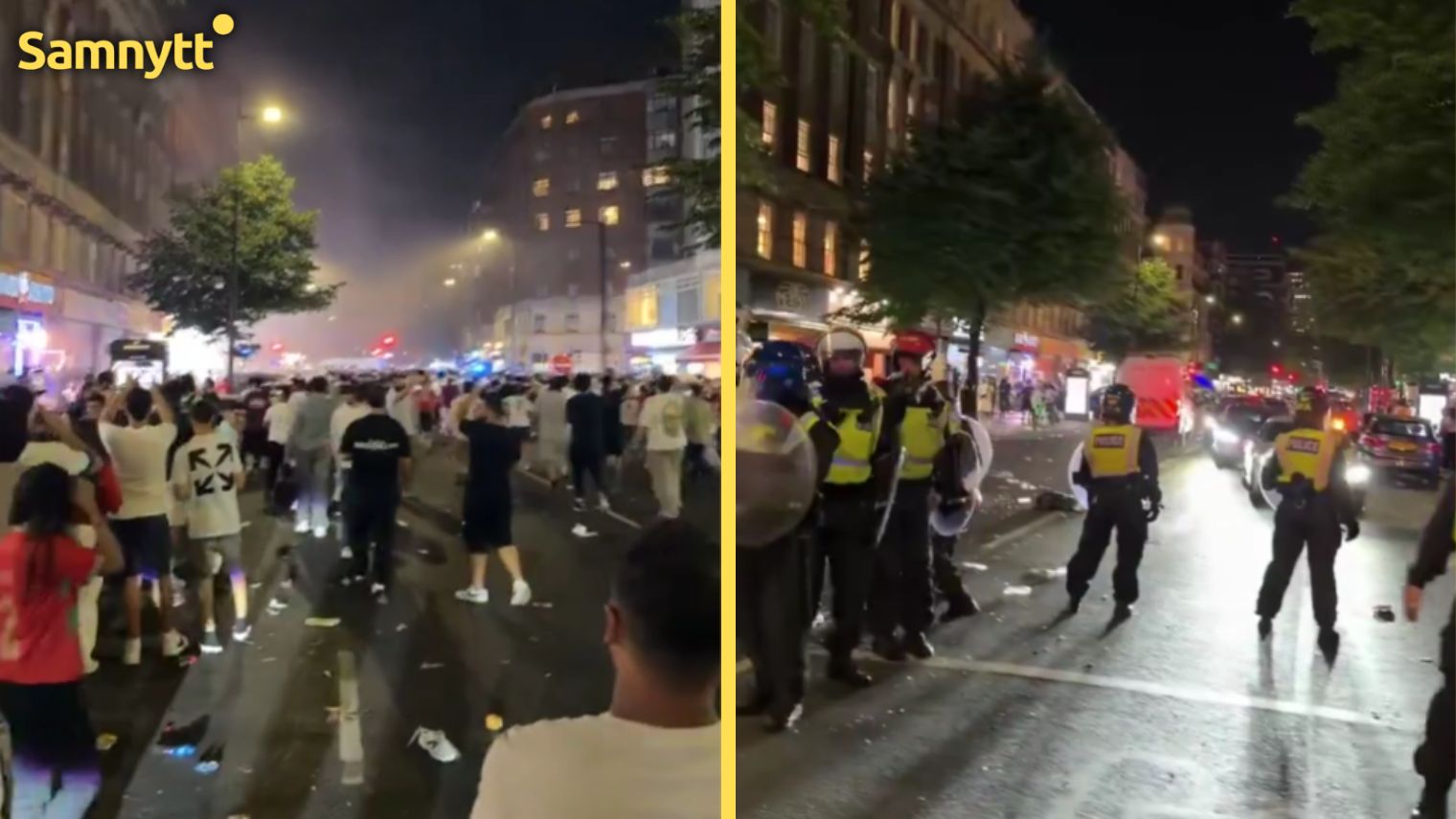
France’s 2–0 victory over Morocco in the World Cup quarterfinal was followed by violent unrest in central London, where Moroccan supporters clashed with police during the night. At the same time, the widespread riots that many French authorities had prepared for, with one of the largest police operations of this year’s World Cup, did not materialize.
The most serious scenes unfolded on Edgware Road in West London, an area with a large Arab and North African population. According to British media, crowds deteriorated after the final whistle, with fireworks, bottles, and other objects being thrown at police.
Riot-equipped police officers were deployed to restore order, and at least one officer is reported to have been injured. Several people were arrested.
READ ALSO: How “the Dutch” Celebrated Morocco’s World Cup Win Over the Netherlands
Footage from the scene shows masked individuals, blocked roads, and confrontations where police were pushed back at times before reinforcements arrived. The events are yet another example of how international football matches in several Western European cities increasingly require extensive police operations.
The development is particularly noteworthy given that France had mobilized around 20,000 police officers ahead of the match, about 8,000 of them in Paris. The decision was based on experiences from previous years, when major football matches have repeatedly been followed by car fires, looting, vandalism, and attacks against the police, especially in certain immigrant-dense neighborhoods.
Massive opptøyer – som ventet – etter Marokko tapte mot Frankrike. Her fra London. Hadde nordmenn holdt på slik, hadde vi hengt dem ut, skammet oss og beklaget oss. Det hadde ikke falt inn marokkanerne. pic.twitter.com/xlUZCZyqUX
— Espen Teigen (@espenteigen) July 10, 2026
Limited Problems
This time, however, the outcome was different. Despite tens of thousands of people on the Champs-Élysées and elsewhere in the country, only limited public order disturbances were reported. The extensive riots that many had feared did not occur—something that several analysts attribute to the unusually large police presence and preventive security measures.
The events in London are also expected to further fuel the political debate about integration, police resources, and the state’s ability to maintain public order.
In recent years, several European countries have repeatedly found that international football matches act as a catalyst for widespread street disturbances, leading to demands for tougher measures against violent offenders and faster prosecution.
France has now qualified for the World Cup semifinal. But while the sporting result dominates the headlines, the night’s violence in London is also likely to become part of the broader European discussion about security, migration, and the recurring burden that large crowds place on the police and emergency services in many of the continent’s major cities.
Edgeware road in London is a war zone tonight as Muslims riot over a world cup football game, 5000km away, between France and Morocco.
Make DIEversity make sense? https://t.co/w64qSC73oF pic.twitter.com/b9t3vKEnVJ
— Tommy Robinson ???????? (@TRobinsonNewEra) July 9, 2026
SVT: The Far-Right
According to the national broadcaster, it is the “far-right” that is the reason why the French police deployed such large resources:
During the last World Cup in 2022, unrest broke out in several places in Belgium, the Netherlands, and France in connection with matches where Morocco played.
Not least in Paris, where riot-like scenes occurred, with 266 people arrested nationwide, 167 of them in Paris, according to AS.
According to freelance journalist Jennifer Paterson, who is on-site in Paris, there were also far-right groups who traveled to the French capital—to attack Moroccans who had watched the match in the city.
READ ALSO: Japanese World Cup fans once again show the world how to behave