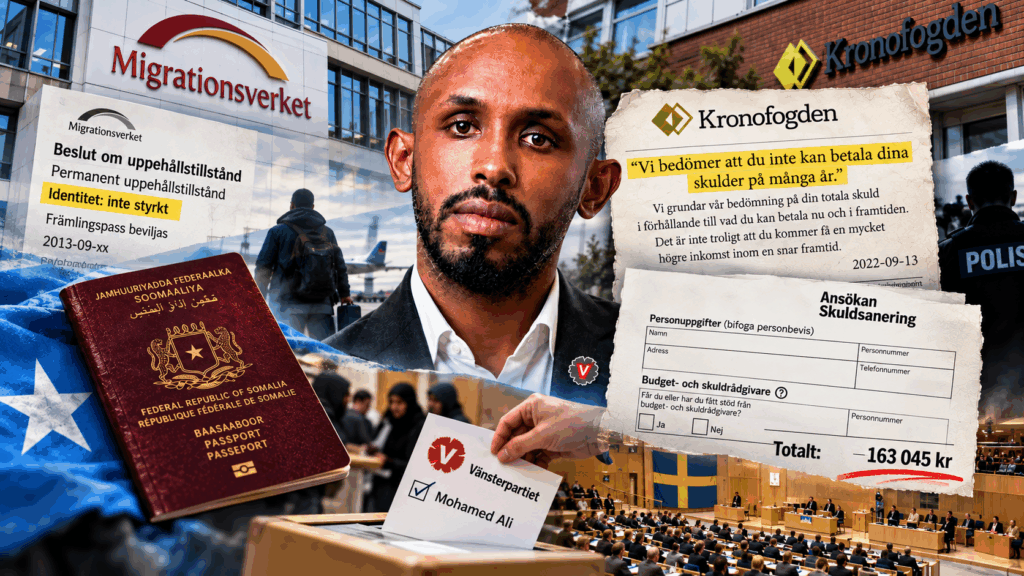
The controversial Left Party politician Mohamed Abdukardir Ali, who was elected to parliament under suspicious circumstances of electoral fraud, received permanent residency in Sweden despite his identity not being verified. This is shown in documents from the Swedish Migration Agency. In February this year, he was also granted Swedish citizenship – despite an ongoing debt restructuring and additional unpaid debts. Questions are now being raised about how the authority has handled his case.
In recent weeks, Mohamed Abdukardir Ali has been at the center of several high-profile revelations. The initial issue concerned suspected electoral fraud in Borlänge, where, through an unexpected personal vote success, he advanced from the ninth place on the Left Party’s list to secure a seat in parliament.
His financial situation and the circumstances surrounding his Swedish citizenship have since come under scrutiny. It now appears that the questions go much further back in time.
Granted Residency Without Being Able To Prove His Identity
According to documents requested by Kvartal from the Migration Agency, the Somali-born politician was granted permanent residency in September 2013. At that time, Ali had applied to come to Sweden through family ties with a parent already residing in the country.
The application was submitted to the Swedish embassy in Addis Ababa, Ethiopia, in May 2012, when Ali was 16 years old. He thus had not applied for asylum in Sweden, which has previously circulated as a claim in reporting about him.
Despite his identity not being considered verified, he was granted permanent residency. At the same time, he was issued an “alien’s passport,” explicitly noting that his identity was not verified.
An alien’s passport can be issued to persons who have a residence permit in Sweden but are unable to obtain a passport from their home country. According to the Migration Agency’s own rules, the applicant’s identity should generally be established in cases of family reunification.
However, there are exceptions. For reunification of nuclear families, under certain conditions, it can suffice that the identity is deemed probable. The documents accessed by Kvartal do not reveal what led to the assessment that Ali’s identity could be accepted.
A direct relationship with a parent can easily be established through a blood test. Why this was not carried out is also not evident from the available documents.
Identity Still Not Verified Ten Years Later
The problem with identity documents persisted for a long time. When Ali was granted new alien’s passports in 2017 and 2023, the Migration Agency in both instances noted that his identity was still not confirmed.
In their decisions, the authority referenced, among other things, the difficulties in verifying Somali identity documents, which are generally considered to have low evidential value. Despite this, Ali was able to proceed toward Swedish citizenship.
He submitted his first application in January 2023. It was rejected in March 2024. Even in that investigation, the information that his identity was unverified was noted. But it was not the issue of identity that was decisive. Instead, Ali was rejected due to his debts.
In July 2024, the Migration Agency made a note that a national identity document had been checked. The authority does not want to specify what document it was or which country issued it, citing confidentiality.
In November 2025, Ali was called in for a personal identity check. Three months later, on February 20, 2026, he was granted Swedish citizenship. This happened despite him still having debts that had previously resulted in a rejection.
The Migration Agency Cites Exception Rules
Kvartal has asked the Migration Agency how someone whose identity could not be verified for so many years could still become a Swedish citizen. The agency’s press officer, Marvin Hansson, explains that Somali passports and other Somali identity documents are generally not considered sufficient to verify identity in citizenship cases. But this does not necessarily mean an application will be denied.
– If the identity document does not confirm the identity, it does not automatically mean that the person cannot obtain Swedish citizenship. The law allows for exceptions in certain cases, Hansson told Kvartal.
According to the regulations, a person who has lived in Sweden for at least ten years with the same identity details may, under certain conditions, have their identity accepted as credible, even without supporting documents. When Ali was granted citizenship, he had held permanent residency for just over twelve years.
Whether this exception was applied in his case, or if the Migration Agency finally considered his identity proven, the authority does not wish to disclose. Nor is it clear why his relationship with the parent he applied to join was not verified.
Almost One Third Granted Citizenship Without Verified Identity
Kvartal’s review also highlights a much larger problem in the Swedish citizenship process. When the National Audit Office reviewed 400 citizenship cases from 2023, it turned out that almost one in three people granted Swedish citizenship lacked a verified identity.
The largest group had been granted exceptions because their identity was seen as probable and they had lived in Sweden for a long time. The National Audit Office also found that the Migration Agency has particular difficulty verifying the identity of people from countries whose documents are considered unreliable.
This means that Swedish citizenship is granted in a significant number of cases without the applicant’s identity being established through acceptable ID documents. And it is easiest to obtain residency and citizenship without verifying one’s identity for people from countries such as Somalia.
Debt Restructuring Still Ongoing – Yet He Was Granted Citizenship
But identity is not the only issue raising questions about Mohamed Ali’s citizenship. As previously reported by Samnytt, Ali has substantial debts and a debt restructuring plan lasting until June 2027.
The debt restructuring covers just over SEK 163,000. Despite this, he was granted Swedish citizenship as early as February 2026.
According to the Migration Agency’s rules, unpaid debts with the Enforcement Authority may constitute an obstacle to citizenship. Even after debts are paid off, the applicant would normally need to remain debt-free for some time, typically two years, to show their finances are under control.
In Ali’s case, more than half a year remains of his debt restructuring, yet citizenship has already been granted. There are also additional debts that Ali incurred after the debt restructuring decision and are thus not included in it.
Samnytt has checked these details with the Enforcement Authority and determined that the debts remain unpaid. They were also outstanding at the time Ali was granted citizenship.
This means the questions are not only about how the Migration Agency assessed an ongoing debt restructuring, but also how the authority dealt with other unpaid debts.
It is still not clear what information about Ali’s financial situation the responsible officials saw fit to request and/or consider when making the citizenship decision.
Pensioner Reviews the Decision – Demands the Documents
One person who has responded to the information is 64-year-old disability pensioner Marita Welin from Kristinehamn. Samnytt has previously reported how, on her own initiative, she began reviewing the Migration Agency’s handling of Ali’s citizenship case. She has requested agency documents and seeks, among other things, to determine what checks were made on his debts before the decision was taken.
– I have to start scrutinizing those in power. Because this can’t go on any longer, she said in a previous interview with Samnytt.
Welin has also questioned how Ali could become a citizen while his debt restructuring was still underway. The Migration Agency has explained in correspondence with her that citizenship cases are not normally investigated in the same way as residence permit cases. Instead, summaries of information are compiled for assessment regarding whether the applicant meets the requirements.
Welin has requested to see the documents underlying the decision and says she is prepared to take the matter to the administrative court if the authority refuses to release the documents.
Samnytt has also spoken with a source with insight into the Migration Agency’s operations. The source pointed to three possible explanations for how a questionable decision could occur – pressure on officials to produce many decisions, lack of understanding of the regulations, or activism.
The source emphasized, however, that it is not possible to determine which, if any, of these explanations applies in Ali’s case. No solid evidence has been presented to suggest that the responsible officials committed corruption or other misconduct. But the questions have not been resolved either.
Elected to Parliament on Preference Votes – Suspected Electoral Fraud Investigated
Mohamed Ali became nationally known after the parliamentary election in September, when he managed to surpass several more established Left Party members to win a seat in parliament. He was ninth on the Left Party’s list in Dalarna but received 648 personal votes, enough to be elected.
Soon after the election, information emerged about suspected undue influence on voters in Borlänge. According to several media outlets, people allegedly distributed ballots with Ali already marked and encouraged voters to use them.
There have also been reports that voters were transported to early voting locations and in some cases offered money. A witness told Swedish Radio that he had seen a voter with a pre-marked ballot for the Left Party.
The suspicions led to a police investigation for undue influence at voting. According to previous information from SVT, the investigation covers three suspects, but none had at that time been notified of suspicion of a crime. Ali has not been singled out as a suspect and has denied any involvement.
The Left Party’s leadership described the accusations as very serious and announced that Ali would take a break from parliamentary work. However, he has not wanted to relinquish his parliamentary seat.
Borlänge municipality’s own review has so far not found absolute evidence of systematic or organized electoral fraud inside the municipality’s polling stations. The police investigation into suspected undue influence has, however, continued.
Ali has now also reported sick. The nature of the illness is presently unclear.
Several Questions Remain for the Migration Agency
The latest revelations mean that Mohamed Ali’s background is now being scrutinized from several different directions. Kvartal’s information shows that for at least ten years he had Swedish residency documents despite his identity not being considered verified. Samnytt’s earlier investigation has at the same time shown that he was granted citizenship despite an unfinished debt restructuring and other unpaid debts.
It remains to be clarified whether the Migration Agency applied a legal exception to the identity requirement, how the authority assessed his debts, and what checks were actually performed before citizenship was granted – or if there were any irregularities in the handling of the case.
Kvartal reports that the newspaper, together with several colleagues, has sought comment from Mohamed Ali – but to no avail.