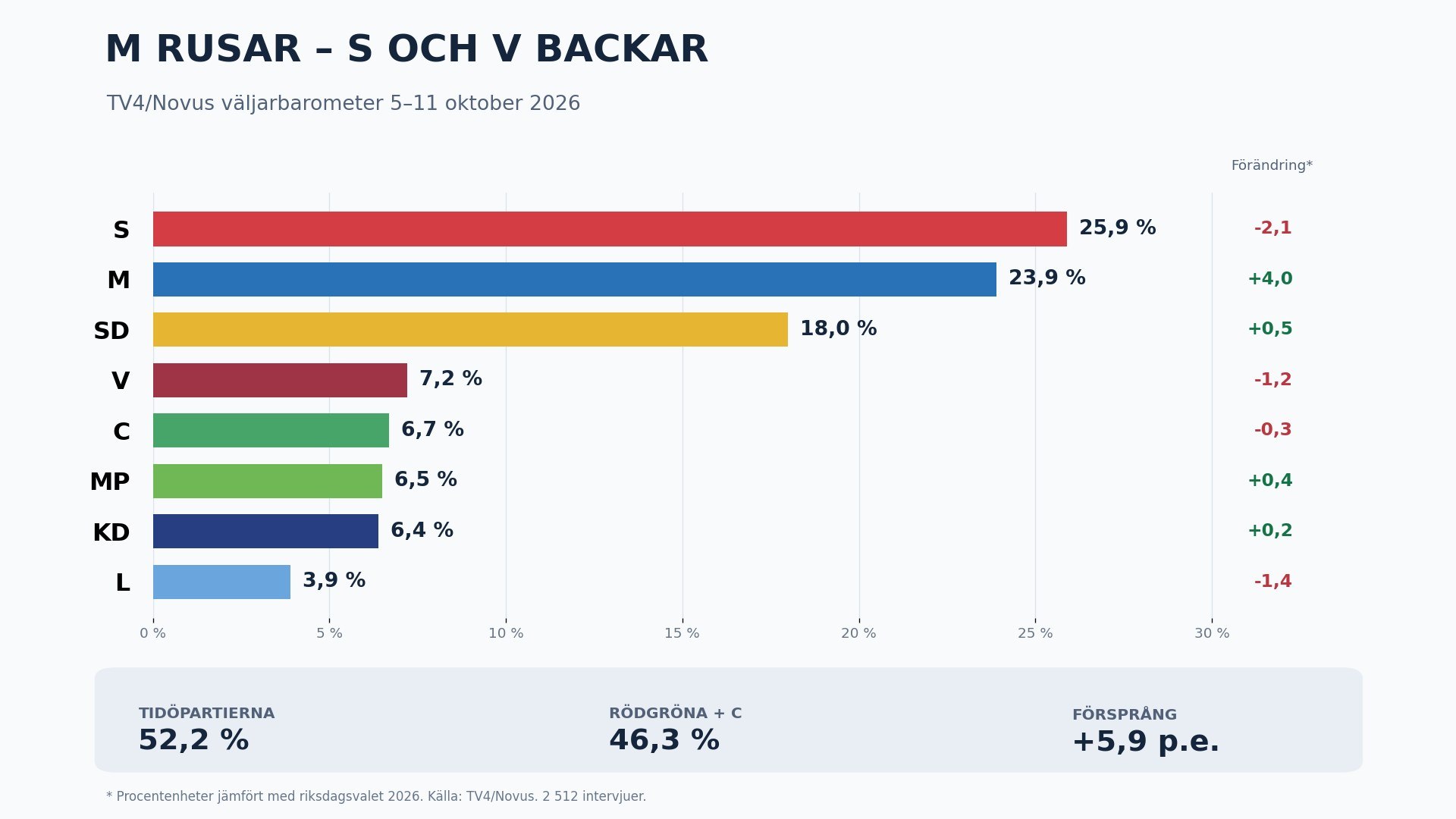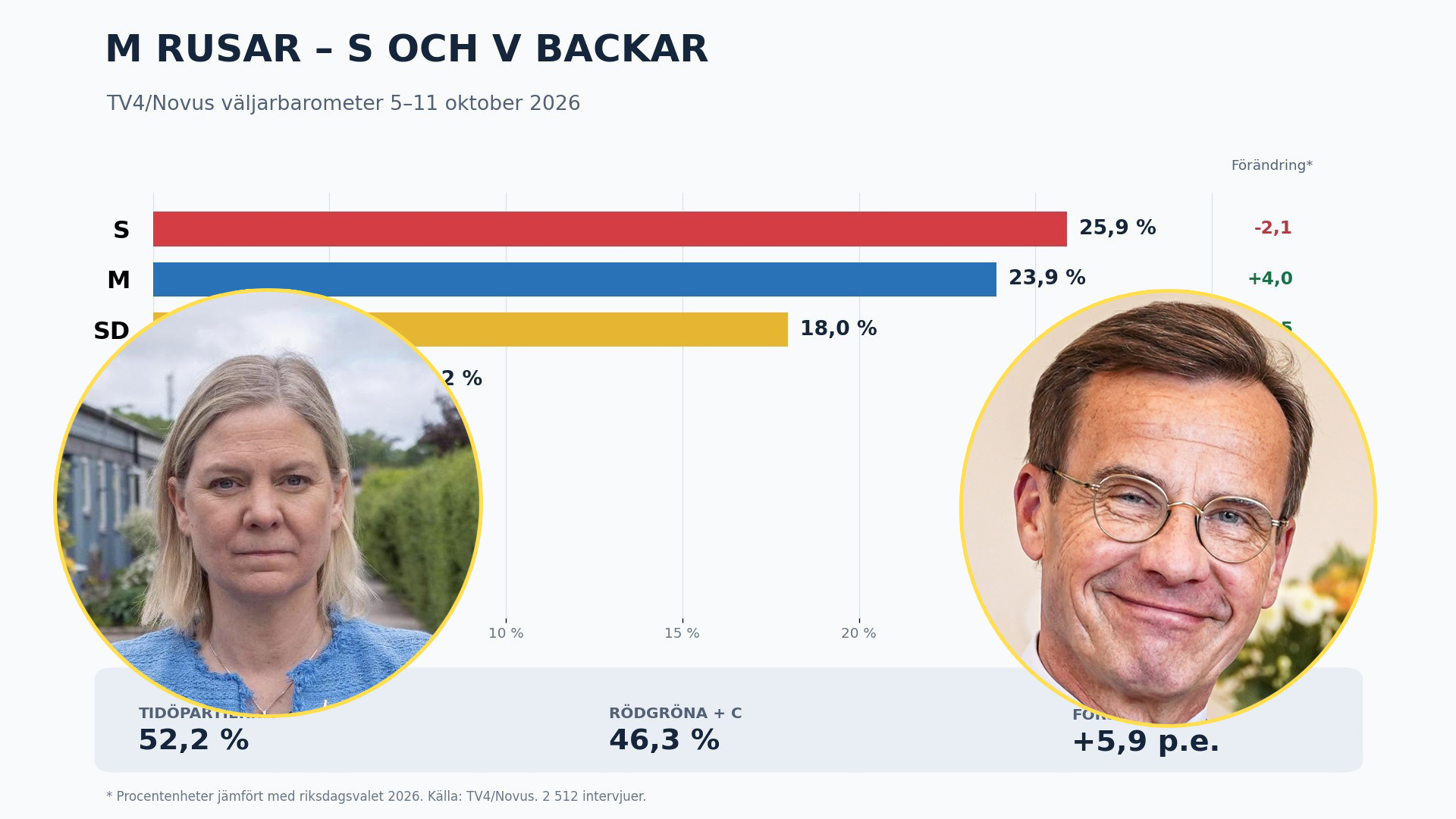
The Moderate Party is making strong gains while the Social Democrats and the Left Party are losing support after the election. In a new poll from Novus, the Tidö parties have gained a lead of nearly six percentage points over the red-green bloc.
The prolonged government formation coincides with a clear drop in support for the Social Democrats and the Left Party. In the latest voter barometer from Novus, presented by TV4 Nyheterna, the Social Democrats are down 2.1 percentage points compared to the election result and are now at 25.9 percent.
This means the party has lost further ground since the September election, when, with 28 percent, the Social Democrats posted their worst result since the advent of democracy in Sweden.
The Left Party is also moving backward. The party scores 7.2 percent, a decrease of 1.2 percentage points since the election.
Meanwhile, the Moderates are seeing the largest uptick in the poll. The party increases by a full four percentage points to 23.9 percent, placing it just two percentage points behind the Social Democrats.
Tidö parties gain their own majority
In total, the Tidö parties receive 52.2 percent of voter support, an increase of 3.3 percentage points compared with the election result. The red-green bloc, including the Centre Party, meanwhile gathers 46.3 percent, giving the Tidö side a lead of 5.9 percentage points.
The lead is so large that, according to TV4’s calculations, the Moderates, Sweden Democrats, and Christian Democrats could gain a parliamentary majority even if the Liberals did not surpass the threshold.
The Liberals are also the only Tidö party that is losing ground compared to the election. The party falls by 1.4 percentage points to 3.9 percent, thus once more dropping below the parliamentary four percent threshold.
The Sweden Democrats reach 18.0 percent, up 0.5 percentage points, while the Christian Democrats increase marginally to 6.4 percent.
Setback after failed government formation
The shifts in opinion come after several weeks of deadlocked negotiations over forming a new government. Despite the red-green bloc winning a majority of parliamentary seats in the election, Magdalena Andersson has been unable to unite the parties behind a joint governing alternative.
Above all, disagreements between the Centre Party and the Left Party have complicated attempts to reach an agreement.
TV4 points out that voters’ dissatisfaction with the protracted government negotiations may help explain the losses for the Social Democrats and the Left Party. At the same time, the Tidö parties may have benefited from the political attention being focused primarily on Magdalena Andersson’s coalition talks.
The changes for the Moderates, Social Democrats, Left Party, and Liberals are statistically significant. The changes in the combined support for the two political blocs are also statistically significant.
The survey was conducted October 5—11 and includes 2,512 interviews.